Israel PM says ordered military to ‘seize’ Syria buffer zone

Update Israel PM says ordered military to ‘seize’ Syria buffer zone
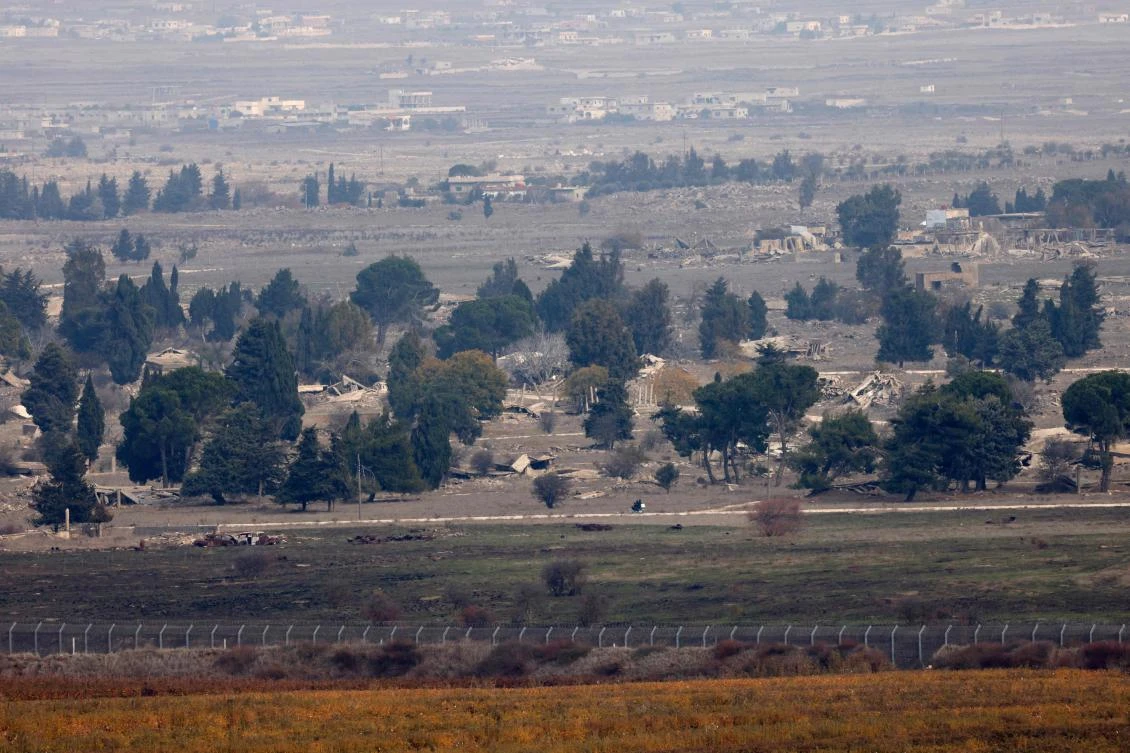
The Israeli military earlier said was ‘reinforcing aerial and ground forces’ in the occupied Golan Heights in response to sweeping Islamist-led militant advances in Syria. (AFP)
Short Url
Updated 09 December 2024
Follow

Israel PM says ordered military to ‘seize’ Syria buffer zone

Israel PM says ordered military to ‘seize’ Syria buffer zone
  • Israeli forces ‘will continue to operate as long as necessary in order to preserve the buffer zone and defend Israel’

JERUSALEM: Israeli Prime Minister Benjamin Netanyahu said Sunday he had ordered the Israeli military to “seize” a demilitarised buffer zone on the border with Syria after the overthrow of Bashar Assad in Damascus.
The Israeli premier said a 50-year-old “disengagement agreement” between the two countries had collapsed and “Syrian forces have abandoned their positions.”


As a result, he said, “I directed the IDF (military) yesterday to seize the buffer zone and the commanding positions nearby. We will not allow any hostile force to establish itself on our border.”
The announcement, which Netanyahu made while visiting the Israeli-occupied Golan Heights which abut the buffer zone, came after the military said it had deployed forces to the area.
Israel had already said the day before, as the Islamist-led rebels swiftly advanced across Syria, that its soldiers entered the UN-patrolled buffer zone to assist peacekeepers in repelling an attack.
On Sunday, the army announced a troop deployment there, citing “the possible entry of armed individuals into the buffer zone.”
“Following the recent events in Syria... the IDF (military) has deployed forces in the buffer zone and in several other places necessary for its defense, to ensure the safety of the communities of the Golan Heights and the citizens of Israel,” a military statement said.
Israeli forces “will continue to operate as long as necessary in order to preserve the buffer zone and defend Israel,” it added.
The statement stressed that the Israeli military “is not interfering with the internal events in Syria.”
Since the rebel coalition, led by Islamist group Hayat Tahrir Al-Sham, began its renewed offensive against government forces on November 27, Syrian government forces have left positions near the Israeli-held Golan, according to a war monitor.
Rami Abdel Rahman, head of the Syrian Observatory for Human Rights, said on Saturday that Syrian army forces had withdrawn from positions in Quneitra province, which includes part of the Golan Heights.
Most of the plateau has been occupied since 1967 by Israel, which later annexed it in a move not recognized by most of the international community.
In 1974, the buffer zone was established, separating the Israeli-held and Syrian territories, with UN peacekeepers stationed there since.
A UN Peacekeeping spokesperson said on Saturday that UNDOF personnel had observed “unidentified armed individuals in the area of separation, including approximately 20 who went into one of the mission’s positions in the northern part of the area of separation.”
The Israeli army said it was “assisting the UN forces in repelling the attack.”
The UN spokesperson said that “peacekeepers continue to carry out their mandated activities on the Golan.”
On Sunday, Lebanese media outlets reported an Israeli strike on Quneitra targeting an arms depot. The Israeli military declined to comment.
In a separate statement, the Israeli military said schools in the northern Golan Heights, in an area covering four Druze towns, would move to online teaching, also declaring a “closed military zone” in agricultural lands in the area.
Early in Syria’s war, which began in 2011 following the repression of anti-government protests, rebel forces and jihadist groups had taken over parts of Quneitra province.
In August 2014, Islamist rebels attacked UNDOF and took more than 40 Fijian peacekeepers hostage, holding them captive for almost two weeks.


Lebanon warns Israeli violations threaten stability as UN peacekeepers enter final phase of mission

Lebanon warns Israeli violations threaten stability as UN peacekeepers enter final phase of mission
Updated 11 November 2025
Follow

Lebanon warns Israeli violations threaten stability as UN peacekeepers enter final phase of mission

Lebanon warns Israeli violations threaten stability as UN peacekeepers enter final phase of mission
  • UN envoy accuses Israel of jeopardizing ‘hard-won progress’ by undermining Lebanese sovereignty and territorial integrity through airstrikes and border violations
  • He says Lebanon’s army commander has presented to ministers his second progress report on a plan to extend state authority country-wide and limit weapons to state control

NEW YORK CITY: Lebanon has warned that Israeli airstrikes and border violations risk undermining progress toward achieving stability in southern Lebanon, as the UN peacekeeping mission in the country begins preparations for its withdrawal.

Speaking before the UN General Assembly’s Fourth Committee, Lebanon’s permanent representative to the organization, Ahmad Arafa, welcomed the recent renewal of the UN Interim Force in Lebanon’s mandate under Security Council Resolution 2790. This authorized the extension of the force’s operations until Dec. 31, 2026, followed by an “orderly, safe and coordinated” drawdown within a year.

“The Lebanese Armed Forces have been working tirelessly to ensure full implementation of Resolution 1701,” Arafa said, referring to the 2006 resolution that ended the war that year between Israel and Hezbollah.

It calls for the disarmament of all militias in Lebanon, including Hezbollah. The US has consistently pressured Lebanese authorities to disarm the group, designating it a terrorist organization.

The November 2024 ceasefire deal with Israel also requires Lebanon to disarm Hezbollah and establish a state monopoly on arms. The agreement states that only state security forces should bear arms, which is interpreted by Israel and others as requiring the full disarmament of Hezbollah. The group insists it applies only to southern Lebanon.

Arafa said the commander of the Lebanese army has presented to the Council of Ministers his second progress report on a plan to extend state authority throughout the country and confine possession of weapons to legitimate state institutions.

However, he accused Israel of jeopardizing the “hard-won progress” that has been made, through what he described as ongoing violations of Lebanon’s sovereignty and territorial integrity, including airstrikes, the continued occupation of Lebanese territory, and the creation of “so-called buffer zones.”

UNIFIL spokesperson Dany Ghafri said last week that Israel had carried out more than 7,000 airspace violations since the cessation of hostilities in November last year, Arafa noted. UNIFIL has warned that the airstrikes breach Resolution 1701, “threaten the safety of civilians, and undermine progress toward a political and diplomatic solution,” he added

Lebanon also condemned Israeli attacks on UNIFIL personnel and positions, describing them as “a blatant violation of international law.”

Arafa expressed gratitude to the leadership of the UN force, and the countries that contribute troops, for their “dedication and sacrifice” since the mission was established in 1978. He called for the avoidance of any “security vacuum” during the upcoming transitional period, while maintaining stability and respect for Lebanon’s sovereignty.