Oman trade surplus grows 2% in November to reach $18.5bn  

Oman trade surplus grows 2% in November to reach $18.5bn  
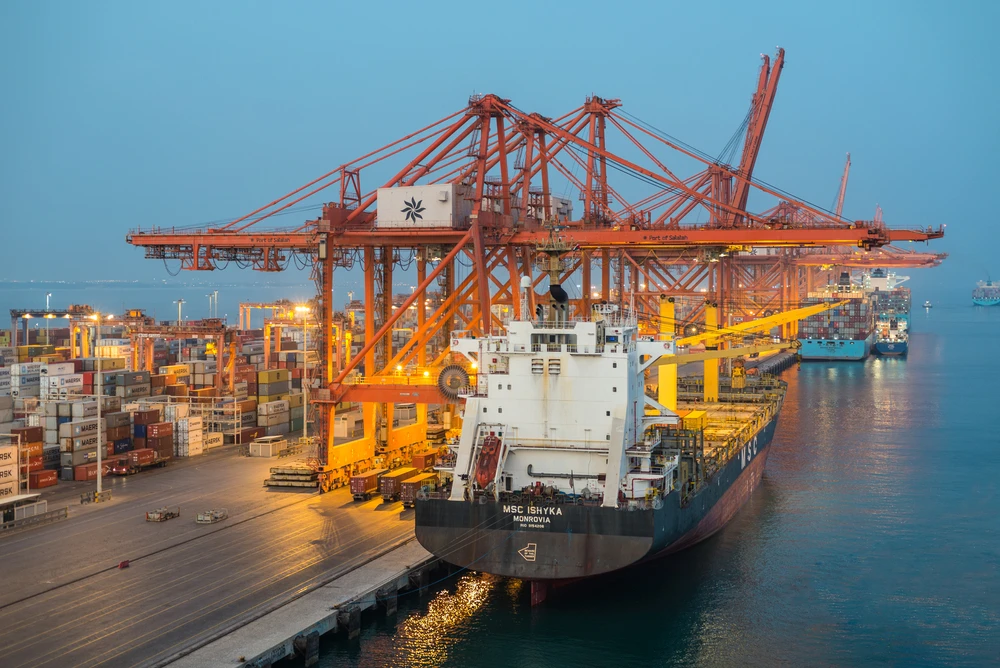
Oman’s trade surplus is part of a regional trend as the Gulf Cooperation Council continues to play a significant role in global trade. Shutterstock
Short Url
Updated 02 February 2025
Follow

Oman trade surplus grows 2% in November to reach $18.5bn  

Oman trade surplus grows 2% in November to reach $18.5bn  
  • Total merchandise exports grew 7.7% year on year to 22.23 billion rials, while imports rose 10.6% to 15.09 billion rials
  • Oil and gas exports surged 19.7% to 14.99 billion rials

RIYADH: Oman’s trade surplus rose 2 percent year on year by the end of November, reaching 7.14 billion Omani rials ($18.5 billion), up from 6.99 billion rials in the same period of 2023. 

The increase, driven largely by a surge in oil and gas exports, saw total merchandise exports grow 7.7 percent year on year to 22.23 billion rials, while imports rose 10.6 percent to 15.09 billion rials, according to preliminary data from the National Center for Statistics and Information. 

Oil and gas exports surged 19.7 percent to 14.99 billion rials, compared to 12.53 billion rials in the same period of 2023.   

Crude oil exports rose 2.5 percent to 9.13 billion rials, while refined oil exports saw a sharp increase of 174.9 percent to 3.57 billion rials. Liquefied natural gas exports, however, declined slightly by 1.1 percent to 2.30 billion rials.  

The UAE was Oman’s top trade partner in non-oil exports, with trade reaching 935 million rials, an 8.1 percent increase from November 2023.   

The UAE also remained the leading destination for re-exports from Oman at 526 million rials and was the top exporter to Oman, supplying 3.60 billion rials worth of goods.  

Saudi Arabia ranked second in non-oil exports from Oman, totaling 764 million rials, followed by South Korea with 611 million rials.   

Iran was the second-largest re-export destination at 335 million rials, followed by Kuwait at 110 million rials.   

Among exporters to Oman, China ranked second with 1.62 billion rials, followed by Kuwait at 1.49 billion rials.  

Oman’s trade surplus is part of a regional trend as the Gulf Cooperation Council continues to play a significant role in global trade.   

The latest data shows that the GCC achieved a total trade volume of $1.5 trillion, securing its position as the world’s sixth-largest trader and accounting for 3.4 percent of global trade in 2023.  

Oman’s non-oil merchandise exports declined by 16.6 percent to 5.64 billion rials in November, down from 6.77 billion rials a year earlier. Mineral products remained the largest category within non-oil exports at 1.62 billion rials, despite a 35.2 percent drop.   

Base metals and related products fell 1.1 percent to 1.20 billion rials, while plastics and rubber products grew 10.1 percent to 896 million rials.   

Exports of chemical industry products dropped 22 percent to 725 million rials, and live animals and animal products declined 12.3 percent to 320 million rials.  

Re-exports from Oman grew 18.3 percent to 1.59 billion rials. Transport equipment re-exports rose 2.1 percent to 385 million rials, while electrical machinery and equipment fell 4.1 percent to 346 million rials.   

Re-exported food, beverages, and liquids increased by 30.2 percent to 168 million Omani rials, and mineral product re-exports climbed 43.1 percent to 119 million Omani rials. However, re-exports of live animals and animal products declined 13.3 percent to 89 million rials.  

On the import side, mineral products accounted for the largest share, totaling 4.21 billion rials, up 9.5 percent.   

Imports of electrical machinery and equipment grew 26 percent to 2.61 billion rials, while base metals and related products declined 1.2 percent to 1.45 billion rials.   

Chemical industry imports rose 2.7 percent to 1.40 billion rials, and transport equipment imports increased by 13.1 percent to 1.35 billion rials. Other imported products totaled 4.07 billion rials.  

Oman’s crude oil exports totaled approximately 308.42 million barrels by the end of December, with an average price per barrel of $81.2.  

Oil exports accounted for 84.9 percent of the country’s total oil production, which stood at 363.29 million barrels for the year.   

However, total oil exports saw a slight decline of 0.6 percent compared to December 2023, when Oman exported 310.33 million barrels.   

This decrease aligned with a 5.1 percent drop in overall oil production, which fell from 382.77 million barrels in the previous year.    

Teaching machines to speak Arabic

Teaching machines to speak Arabic
Updated 06 November 2025
Follow

Teaching machines to speak Arabic

Teaching machines to speak Arabic
  • Innovation is helping AI understand the region’s language, culture, and voice

JEDDAH: As developers across the Arab world work to formalize Arabic for artificial intelligence — grappling with its many dialects, limited datasets, and deep cultural nuance — English-based AI systems have continued to surge ahead. Now, industry experts say it’s time for Arabic users to gain the same technological momentum.

The performance gap between Arabic and English natural language processing is most visible in speech recognition, where pronunciation, rhythm, and vocabulary differ sharply across dialects. These variations make it challenging for one model to understand spoken Arabic with consistent accuracy.

Despite these hurdles, progress is accelerating. With rising investment and government-backed initiatives led by Saudi Arabia and other regional powers, Arabic AI is steadily closing in on English in sophistication and accessibility.

As Arabic AI evolves, experts emphasize the importance of cultural nuance and dialect diversity in future language models. (aramcoworld.com)

Amsal Kapetanovic, head of KSA at Infobip, told Arab News: “While written NLP tasks like basic chatbots can be managed with additional work, speech recognition really exposes the limitations of current models. It requires even more fine-tuning and adaptation to handle the diversity of spoken Arabic effectively. This is where the gap between Arabic and English NLP is most pronounced.”

Infobip’s recent collaborations with telecom and private sector partners across the Gulf reveal a similar pattern: Arabic chatbots and virtual assistants often require greater oversight in their early stages than English systems. However, once they are retrained using region-specific conversational data and Gulf dialects, both accuracy and customer satisfaction rise sharply.

Arabic remains one of AI’s greatest linguistic challenges. Unlike English, it is not a single unified language but a family of dialects stretching from Asia to Africa. Its complex morphology — with prefixes, suffixes, gender and number agreement, and the absence of short-vowel diacritics — poses major obstacles for tokenization and model training.

Opinion

This section contains relevant reference points, placed in (Opinion field)

Kapetanovic referenced a 2025 study published in JMIR Medical Informatics (“InfectA-Chat: An Arabic Large Language Model for Infectious Diseases”), which tested instruction-tuned models like GPT-4 in both English and Arabic. The research found that Arabic models still trail English by 10–20 percent in complex tasks.

“Arabic models still lag slightly behind English ones, particularly in areas like accuracy and sentiment analysis,” he said. “This is primarily due to the smaller size of Arabic training datasets and the complexity of Arabic dialects.”

He added: “Arabic itself is a family of languages and dialects — much richer and more complex than many others. This diversity adds another layer of challenge.”

Amsal Kapetanović, head of KSA unit at Infobip. (Supplied)

Yet optimism remains strong. “The good news is that there is significant investment happening, especially in the MENA region, with countries like Saudi Arabia leading the way,” Kapetanovic said. “Initiatives like Vision 2030 are accelerating progress, and we’re seeing more focus on localizing AI for Arabic speakers.”

Speech recognition continues to represent the most visible gap. “A Lebanese speaker and a Saudi speaker might use different words and speak at different speeds, making it challenging for a single model to recognize and process spoken Arabic accurately,” he said.

Localization, Kapetanovic explained, extends far beyond translation. “At Infobip, we are defining the evolution of communications in co-creation with our customers and partners throughout the region. Gartner has recognized us as a Leader in their 2025 Magic Quadrant for CPaaS. We are committed to delivering the next generation of AI-powered customer conversations to unlock seamless, high-impact engagement for MENA businesses. That’s why we put a strong emphasis on localizing our AI-driven platforms and tools to serve Arabic-speaking users effectively.”

Technical, cultural, and ethical challenges shape the future of Arabic AI, as developers strive for inclusion and linguistic parity. (aramcoworld.com)

Real-world applications are already bearing fruit. “For example, Nissan Saudi Arabia rolled out a WhatsApp chatbot (‘Kaito’) that handles customer queries in both Arabic and English,” he said. “These bots leverage Infobip’s Answers platform, which includes built-in NLP capabilities for Arabic — such as right-to-left text support and Arabic stop-word recognition — to interpret queries and intent.”

“For Saudi Arabia and the Gulf, we’ve gone beyond simple translation by implementing features and partnerships tailored to the region,” he continued.
“We’ve partnered with Lucidia, a leading Saudi tech company, to co-develop solutions that address local business needs and integrate with popular regional channels like WhatsApp and X.”
“We’ve also built language models that recognize Gulf-specific dialects and cultural expressions, making our chatbots and automation tools more intuitive for users. Additionally, our platform supports local payment integrations and business workflows unique to the region. These initiatives reflect our commitment to delivering genuinely localized technology, not just Arabic language support.”

DID YOU KNOW?

• Saudi Arabia is leading investment in Arabic AI, with Vision 2030 initiatives.

• AI can become biased and exclusionary if it does not speak or understand Arabic well.

• Infobip’s Arabic chatbots now ‘think’ in Gulf dialects, improving accuracy.

Cultural understanding, he added, is key to truly human-like AI. “Culturally aware AI should ideally be AI that understands the why behind the what,” he said. “It’s about deep research and understanding the background — not just giving straight answers to straight questions.”

“At Infobip, we integrate with multiple large language models and do so in an agnostic way,” he said. “We combine them and see which ones serve which purpose, giving us the flexibility to avoid pitfalls like AI hallucination or unwanted replies.”

The ethics of language and inclusion

Kapetanovic cautioned that neglecting Arabic in AI development poses not only technical risks but ethical ones.

“The ethical risk is that AI can become biased and exclusionary if it doesn’t speak or understand Arabic well,” he said. “If AI systems don’t handle certain languages or dialects properly, or if they lack enough regional data, they can exclude parts of the narrative or reinforce bias.”

“It’s essential for everyone in the AI ecosystem to contribute to making AI as inclusive and democratized as possible. Otherwise, we risk reinforcing disparities in services, information, and opportunities.”