Tripartite deal set to boost homeownership for 40k Saudi families

Tripartite deal set to boost homeownership for 40k Saudi families
1 / 2
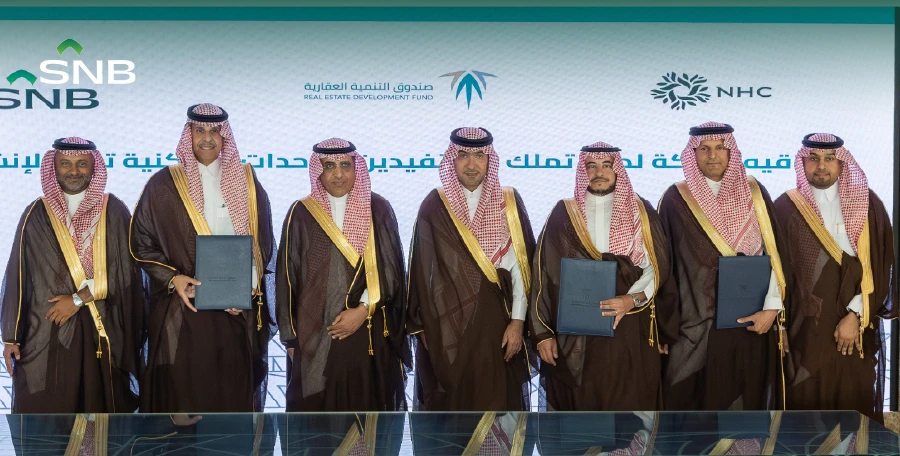
The Real Estate Development Fund, National Housing Co., and Saudi National Bank signed the deal in Riyadh under the patronage of Housing Minister Majid Al-Hogail. REDF
Tripartite deal set to boost homeownership for 40k Saudi families
2 / 2
The Real Estate Development Fund, National Housing Co., and Saudi National Bank signed the deal in Riyadh under the patronage of Housing Minister Majid Al-Hogail. REDF
Short Url
Updated 19 August 2025
Follow

Tripartite deal set to boost homeownership for 40k Saudi families

Tripartite deal set to boost homeownership for 40k Saudi families
  • Deal covers 24 residential projects, with financing options starting from 2.99%
  • Aims to stabilize real estate market, expand partnerships, and diversify financing

JEDDAH: More than 40,000 Saudi families are set to gain access to new homes under a tripartite agreement aimed at expanding ownership and stabilizing the real estate market. 

The Real Estate Development Fund, National Housing Co., and Saudi National Bank signed the deal in Riyadh under the patronage of Housing Minister Majid Al-Hogail. 

The agreement covers 24 residential projects across the Kingdom, with financing options starting from 2.99 percent, and was signed in the presence of REDF CEO Loay Al-Nahidh, NHC CEO Mohammed Al-Bati, and SNB CEO Tareq Al-Sadhan. 

The deal is part of efforts to stabilize the real estate market, expand partnerships, and diversify financing, providing off-plan housing beneficiaries with broader options aligned with Vision 2030’s Housing Program. 

“The agreement reflects the state’s commitment to providing suitable housing for Saudi families and enhances balance in the real estate market with diverse financing options, in support of the goals of the Housing Program and Saudi Vision 2030,” said Al-Hogail in a post on his official X account.

“The collaboration marks a new stage in its partnerships with developers and financiers, accelerating homeownership through innovative financing solutions that strengthen market stability and broaden access to housing,” the REDF said. 

The fund’s existing support programs include non-refundable down payment assistance of up to SR150,000 ($40,000), the “Your Support Equals Your Installment” scheme, and in-kind subsidies to help families buy off-plan units. 

“This partnership is part of the bank’s commitment to supporting the Housing Program — one of the programs of Saudi Vision 2030, and enhancing the stability of the real estate market by offering diverse and innovative financing options,” the Saudi National Bank said in a statement on X.

Coinciding with the cooperation announcement, NHC launched sales for two new residential projects in Madinah and Riyadh, offering over 3,000 units in total. 

Saudi Arabia’s homeownership rate reached 63.74 percent by the end of 2023, up 16.7 percent since 2016. The figure slightly exceeded the Housing Program’s target of 63 percent for the year, reflecting steady progress toward the Vision 2030 goal of 70 percent by the end of the decade. 

This was followed by a 2.7 percent increase in housing units occupied by Saudi households, which reached 4.4 million in 2024, accounting for 50.6 percent of total units, according to the General Authority for Statistics. These housed 21.69 million people, with an average Saudi household size of 4.9.


Kuwait leads Gulf non-oil growth as Egypt stabilizes and Qatar slows: S&P Global PMI 

Kuwait leads Gulf non-oil growth as Egypt stabilizes and Qatar slows: S&P Global PMI 
Updated 9 sec ago
Follow

Kuwait leads Gulf non-oil growth as Egypt stabilizes and Qatar slows: S&P Global PMI 

Kuwait leads Gulf non-oil growth as Egypt stabilizes and Qatar slows: S&P Global PMI 

RIYADH: Gulf business conditions diverged in October as Kuwait’s non-oil sector strengthened, Qatar’s non-energy growth slowed, and Egypt’s contraction eased to an eight-month low. 

According to the latest S&P Global Purchasing Managers’ Index surveys, Kuwait’s PMI rose to 52.8, indicating solid growth; Qatar’s PMI slipped to 50.6, pointing to only a marginal upturn; and Egypt’s index increased to 49.2, suggesting a softer decline in business activity. 

In Egypt, the non-oil private sector showed signs of stabilization as declines in output and new orders moderated.  

The PMI rose from 48.8 in September to 49.2 in October, remaining below the 50 threshold that separates growth from contraction but above its long-term trend. 

“The Egypt PMI stayed above its long-term trend in October, pointing to a year-on-year GDP growth rate of about 4.6 percent,” said David Owen, senior economist at S&P Global Market Intelligence.

However, he cautioned that “rising cost pressures could slow things down if companies struggle to absorb these costs.” 

Wage costs climbed at the fastest rate since 2020, lifting input inflation, though firms largely held prices steady to support sales. 

In Kuwait, non-oil firms reported faster increases in output, new orders, and employment, marking the most robust expansion in several months.  

The PMI climbed to 52.8 from 52.2 in September. “The October PMI data for Kuwait help to allay any fears that the recent growth slowdown was going to result in a more prolonged soft patch,” said Andrew Harker, economics director at S&P Global Market Intelligence.

Hiring grew at the fastest pace in four months, but staff shortages contributed to a further accumulation of backlogs.

Companies also faced sharper rises in input and staff costs, yet output prices rose only marginally as firms sought to remain competitive and secure new business.

Meanwhile, Qatar’s non-energy private sector recorded a slowdown, with the headline PMI easing to 50.6 in October from 51.5 in September, the weakest reading since January.

The decline reflected softer output and new order volumes, with construction activity showing notable weakness. 

“Qatar’s non-energy private sector continued to report an overall improvement in business conditions in October,” said Trevor Balchin, economics director at S&P Global Market Intelligence.

That said, he added, the headline PMI eased to a nine-month low of 50.6, signaling only a fractional upturn.

Despite weaker demand, employment increased at one of the fastest rates on record, led by gains in manufacturing.

Firms also reported rising wages and purchase prices but lower overall input costs as competitive pressures weighed on selling prices.