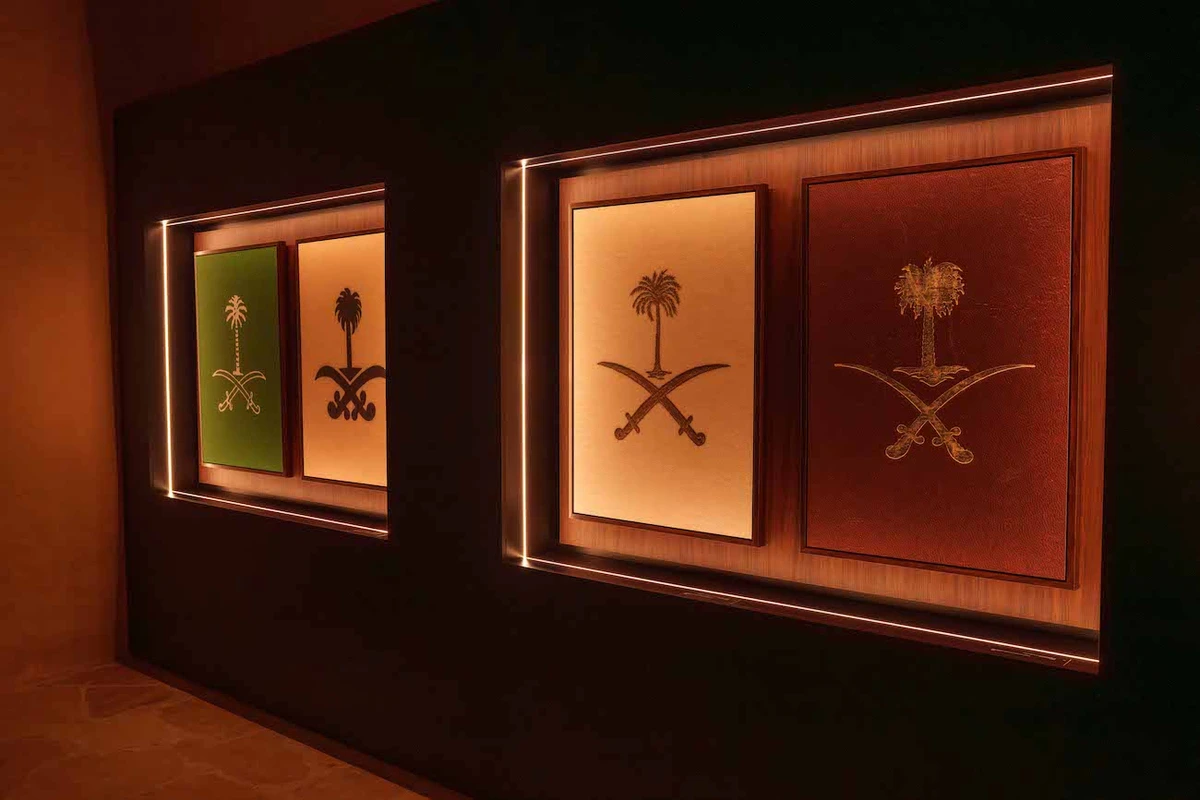
- ‘Two Swords and a Palm’ presents an archive of Kingdom’s national symbol, bridging past and present
RIYADH: “Two Swords and a Palm: The Saudi Emblem Archive” exhibition opened to the public on Saturday and runs until Nov. 21, providing a visual guide to the emblem of Saudi Arabia, archiving its historic significance and use over the years.
The exhibition was curated by Mohammed Alruways and Abdullah Kenani, a Saudi pair whose passion for heritage drove them to painstakingly build this archive.
“This whole project started four years ago,” Alruways told Arab News. “We started to become interested in the changes of the emblem and noticed that it doesn’t have a specific drawing. So, we started to investigate the changes throughout the years, since the unification of Saudi in the ’30s until now.”
Alruways and Kenani began the project together, collecting objects adorned with the emblem and digitizing them.
But their biggest challenge was not collecting pieces for the archive but tracing them back to specific dates and professionally digitizing and archiving them.
“We were learning as we go … Some of them (the objects) are from the ’40s and ’50s and ’60s, but it was hard to connect them to a specific date or era at that time. So that’s why we mainly focused on documents and books,” Alruways said.
The exhibition space is organized in three stages. The first room invites the viewer to look through the found objects; the second highlights the emblem in different sizes, including large paintings made for diplomats; and the third demonstrates the archival process, including video footage of the digitization procedure.
The interactive experience includes visual presentations and animated films, allowing visitors to explore the emblem’s development and its evolving aesthetics, reflecting its ability to adapt to social and cultural changes while maintaining its presence as an icon that represents the Kingdom’s values and unity.
Al-Masmak Palace holds symbolic importance due to its link to the 1902 recapture of Riyadh by King Abdulaziz, a pivotal moment in the Kingdom’s unification.
“I think it was the right place (for this exhibition) because it’s where Saudi unification started and also has links to the emblem,” Alruways said.
“When we decided to host the exhibition here in Al-Masmak, we noticed that one of the rooms featured the emblem in its original form, so we replicated that as an installation,” he added.
Nestled in the heart of the capital, Al-Masmak Palace bears witness to the early beginnings of the state, preserving features of that era within its walls.
Over recent decades, it has transformed into a national museum that welcomes visitors from within and outside the Kingdom, telling the story of the founding of modern Saudi Arabia through its halls and exhibits.
For this exhibition, Alruways and Kenani connected the emblems by the era of the kings that ruled Saudi Arabia ever since the unification by King Abdulaziz, finding that each era usually held a standard aesthetic.
“We noticed that post-2009, most of the emblems look similar and we realized that’s because of the internet, basically, so that’s where everybody starts copying each other,” Alruways said. “But pre-2009, it’s usually hand drawn. You notice there are some similarities, but usually whenever someone draws it by hand … they add their own touch. That was one of our early findings.”
Some of the rare finds include royal dining plates from the eras of King Abdulaziz and King Fahd, including a 1949 passport among the first to feature the emblem on its cover.
Saudi Arabia’s Museums Commission emphasized that the exhibition is part of its efforts to preserve cultural heritage and raise public awareness of the importance of national identity.
It noted that the national emblem, with its symbol of the two swords and the palm tree, is not merely a fixed visual form, but “a living record that reflects the state’s journey and aspirations across generations.”
The exhibition aligns with the goals of Saudi Vision 2030, which seeks to highlight national heritage and enhance its role in the present and the future by transforming major historical sites like Al-Masmak Palace into vibrant cultural spaces that attract visitors and enrich their knowledge.
The program includes workshops and activities for all age groups, to connect generations with the history of their homeland and introduce them to the value and significance of the national emblem in Saudi Arabia’s collective memory.