Trump concerned South Korean arrests could ‘frighten’ investors

Trump concerned South Korean arrests could ‘frighten’ investors
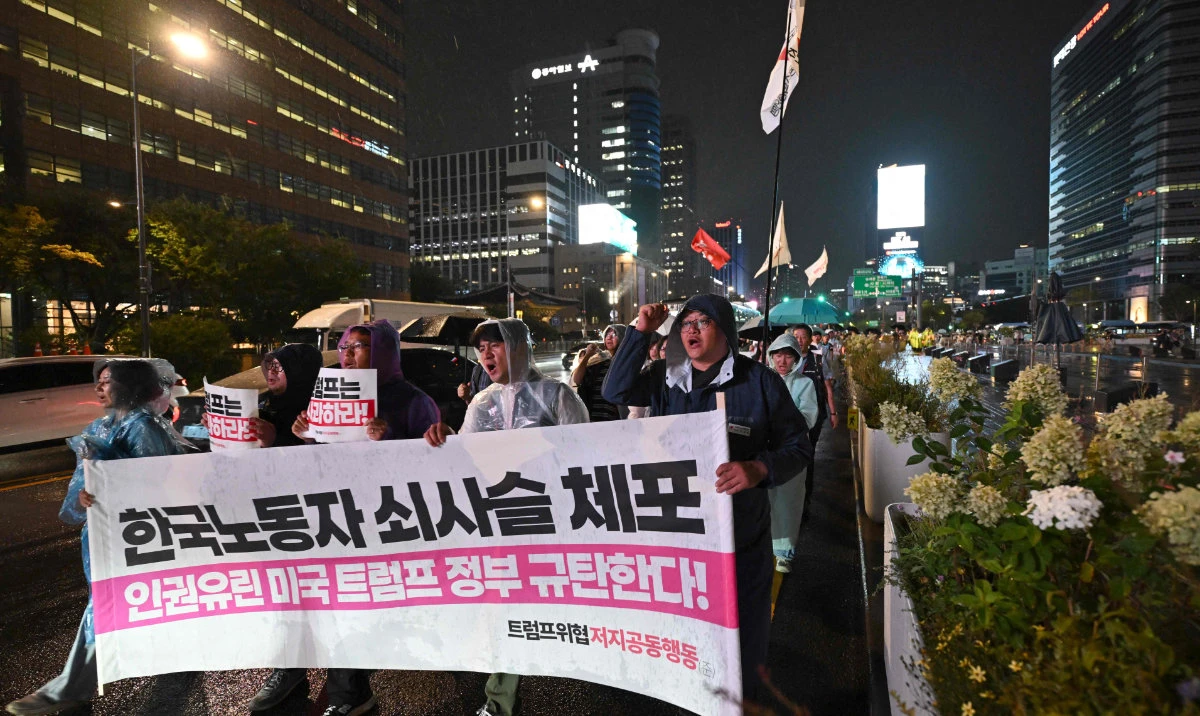
South Korean protesters march with a banner reading "We condemn the Trump government for human rights violations!" toward the US embassy during an anti-US rally against detention of South Korean workers after a US immigration raid in Georgia, in Seoul on September 12, 2025. (AFP)
Short Url
Updated 15 September 2025
Follow

Trump concerned South Korean arrests could ‘frighten’ investors

Trump concerned South Korean arrests could ‘frighten’ investors
  • In a post on his Truth Social platform, the 79-year-old Republican wrote: “I don’t want to frighten off or disincentivize investment”

NEW YORK: President Donald Trump on Sunday said foreign workers sent to the United States are “welcome” and he doesn’t want to “frighten off” investors, 10 days after hundreds of South Koreans were arrested at a work site in Georgia.
In a post on his Truth Social platform, the 79-year-old Republican wrote: “I don’t want to frighten off or disincentivize investment.”
Some 475 people, mostly South Korean nationals, were arrested at the construction site of an electric vehicle battery factory, operated by Hyundai-LG, in the southeastern US state of Georgia on September 4.
Immigration and Customs Enforcement (ICE) officials alleged South Koreans had overstayed their visas or held permits that didn’t allow them to perform manual labor.
The Georgia raid was the largest single-site operation conducted since Trump launched a sweeping immigration crackdown across the country.
Though the United States decided against deportation, images of the workers being chained and handcuffed during the raid caused widespread alarm in South Korea.
Seoul repatriated the workers on Friday.
South Korean President Lee Jae Myung called the raid “bewildering” and warned Thursday that the raid could discourage future investment.
In his post, Trump described the circumstances for temporarily allowing foreign experts into the US to build “extremely complex products.”
“Chips, Semiconductors, Computers, Ships, Trains, and so many other products that we have to learn from others how to make, or, in many cases, relearn because we used to be great at it, but not anymore,” Trump wrote.
“We welcome them, we welcome their employees, and we are willing to proudly say we will learn from them, and do even better than them at their own ‘game,’ sometime in the not too distant future,” Trump added.
Korea’s trade unions have called on Trump to issue an official apology.
UK government faces legal action over failure to help evacuate Gaza families

UK government faces legal action over failure to help evacuate Gaza families
Updated 12 sec ago
Follow

UK government faces legal action over failure to help evacuate Gaza families

UK government faces legal action over failure to help evacuate Gaza families
  • Two fathers in the UK have instructed the law firm Leigh Day to act on their behalf

LONDON: The British government is facing legal action over its alleged failure to assist in the evacuation of families trapped in Gaza, despite pledging months ago to do so, The Guardian reported on Tuesday.

Two fathers in the UK have instructed the law firm Leigh Day to act on their behalf, arguing that the government’s inaction is unlawful and breaches their families’ human rights.

“I wished that I didn’t have to do this, that it didn’t have to reach this level that I’d have to involve courts,” said one father in the UK, who asked to remain anonymous. “I wish anyone would intervene and take my children out of the life that they are living.”

The man, who was granted humanitarian protection in the UK before the war broke out in 2023, said he was informed by the British Foreign, Commonwealth and Development Office in August that he would soon be reunited with his family after they received a positive family reunion decision the previous month.

In Gaza City, the man’s wife, three children and adopted nephew are now living in a tent in Al-Zawida. His wife walks for an hour to make phone calls to him, and he says his children have been shot at by Israeli forces while trying to collect aid. Their flour and rice have also been taken by gangs, he added.

“It was really shocking to see that this didn’t actually end up happening,” said the 39-year-old, who is from Gaza City and spoke through a translator.

He compared the government’s handling of the case to “being released from prison, only to be told you have to return.”

He added: “The war is not over, there’s still aggression from Israel, there’s no food or water, people are not OK.”

According to Gaza’s Health Ministry, the death toll has risen beyond 67,000. Israel has been accused by the UN of violating the October ceasefire and committing acts of genocide.

In August, the British government announced plans to evacuate ill and injured children from Gaza. However, medical charity Medecins Sans Frontieres has urged the authorities to scale up those efforts after only a small number of children were brought to the UK.

Two months later, the government said Palestinian students with scholarships at UK universities would be allowed to bring family members from Gaza on a case-by-case basis.

“My children are students as well,” the father said. “Why shouldn’t (they) be brought here?”

Although the family has an approved reunion decision, they remain unable to travel because of biometric requirements. With no visa application center in Gaza, lawyers say the UK government has refused to secure assurances from Jordanian authorities to allow the family to cross the border for biometric checks there.

The FCDO, which was contacted for comment, is understood to have responded to a pre-action letter in October stating that the family could not be assisted at present, and that the differential treatment between them, students and medical evacuees was not unlawful.

Sarah Crowe, a solicitor at Leigh Day, said the government had “turned its back” on promises to help ensure their clients’ safe passage.

“Meanwhile, other groups have been safely evacuated under similar circumstances. Our clients argue that this differential treatment is not only unjustifiable and unfair, it is unlawful,” said Crowe.

Another father in the UK, who also requested anonymity, has launched separate legal action to reunite with his six children in Gaza.

Earlier this year, the government agreed to assist the family after a pre-action letter, but they now say that commitment has not been upheld.

Speaking through a translator, he said relatives in Gaza are living in a tent after their home was bombed, and that they are entirely dependent on charities for food.

His daughter has developed blood clots in her legs, while his son struggles to breathe after inhaling phosphorus gas, he said. In the UK, his two daughters often ask when their siblings will arrive.

He described himself as exhausted and emotionally broken.

“My children were supposed to be here in May,” said the father, who fled Gaza in 2018 after being imprisoned and tortured by Hamas. “I was supposed to have already been with them for five or six months now.”

A government spokesperson said: “It would be inappropriate to comment while legal proceedings are ongoing.”

Earlier this year, figures showed how Home Office bureaucracy has made it nearly impossible for people trapped in war zones such as Gaza and Sudan to reunite with relatives in the UK. For months, campaigners and parliamentarians have called for a bespoke humanitarian scheme similar to the one created for Ukrainians following Russia’s invasion.