Saudi point-of-sale spending holds firm above $3bn  

Saudi point-of-sale spending holds firm above $3bn  
Food and beverages remained the top category. Shutterstock
Short Url
Updated 17 September 2025
Follow

Saudi point-of-sale spending holds firm above $3bn  

Saudi point-of-sale spending holds firm above $3bn  

RIYADH: Saudi Arabia’s point-of-sale transactions held above the $3 billion mark for a 12th straight week, supported by resilient consumer demand for food and beverages, official data showed. 

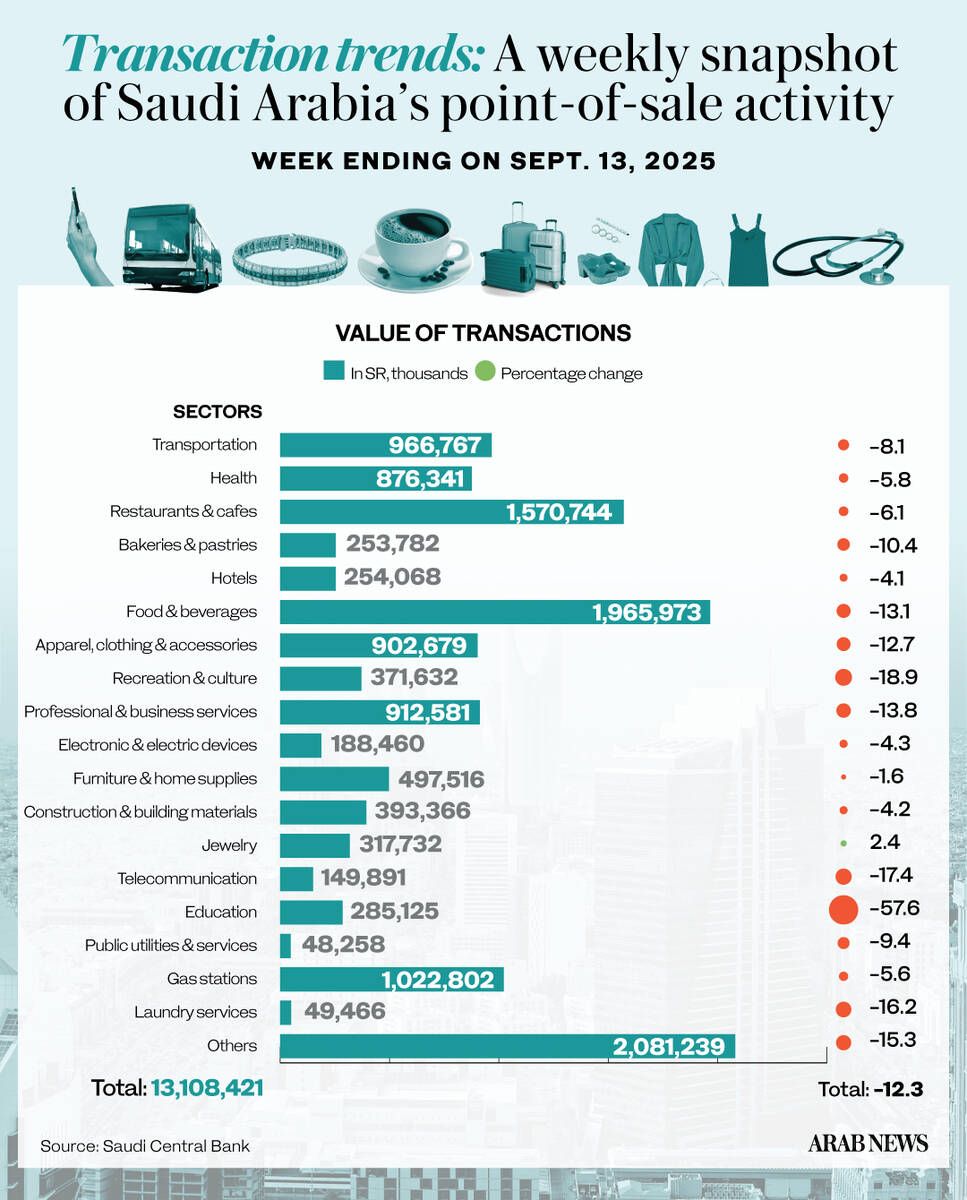
The Saudi Central Bank, known as SAMA, reported that POS spending totaled SR13.10 billion ($3.49 billion) in the week ending Sept. 13, with the number of transactions at 231.05 million. 

While this represents a 12.3 percent weekly drop in spending, and a 4.7 percent fall in transactions, the headline figures do underscore consumer confidence and the Kingdom’s ongoing digital transformation of payments, supported by initiatives under Vision 2030. 

This marks a key milestone in Saudi Arabia’s cashless economy ambitions under the Financial Sector Development Program. 
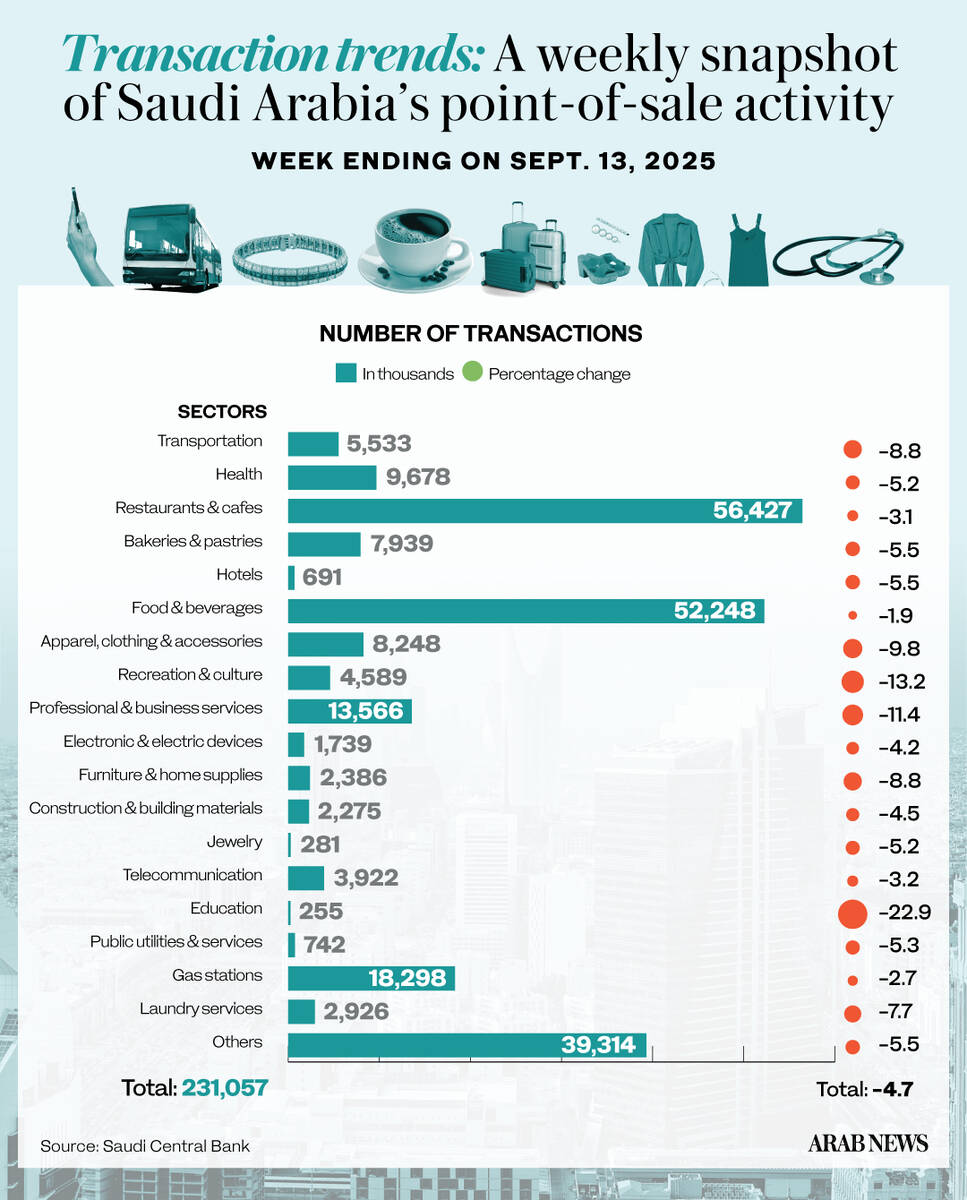
Food and beverages remained the top category, accounting for SR1.96 billion in sales despite a 13.1 percent decline. Restaurants and cafes registered SR1.57 billion, down 6.1 percent, while gas stations fell 5.6 percent to SR1.02 billion. Transportation transactions dropped 8.1 percent to SR966.76 million. 

The sharpest drop was in the education sector, where POS value stood at SR285.12 million, marking a weekly decline of 57.6 percent. 

Spending on professional and business services reached SR912.58 million, while apparel, clothing, and accessories totaled SR902.67 million. 

The healthcare sector recorded a weekly decline of 5.8 percent to SR876.34 million. 
Geographically, Saudi Arabia’s capital Riyadh dominated POS transactions, with a value of SR4.65 billion and 75.95 million operations. Compared with the previous week, however, spending in the capital fell 10 percent. 

In Jeddah, POS transactions amounted to SR1.84 billion, down 12.4 percent, while Dammam recorded SR663.98 million. Makkah and Madinah registered SR506.11 million and SR496.20 million, respectively. 

Al-Khobar posted SR376.90 million, while Buraidah and Abha stood at SR318.46 million and SR167.80 million, respectively. 

The latest SAMA data indicates that consumer confidence in the Kingdom remains firm despite global economic headwinds, lending crucial support to Saudi Arabia’s broader economic transformation agenda. 

In April, the central bank reported that non-cash retail transactions in Saudi Arabia reached 12.6 billion in 2024, up from 10.8 billion in 2023, highlighting the continued expansion of electronic payment systems across the Kingdom. 


Saudi Arabia, Canada explore ways to enhance cooperation in technology, innovation 

Saudi Arabia, Canada explore ways to enhance cooperation in technology, innovation 
Updated 04 November 2025
Follow

Saudi Arabia, Canada explore ways to enhance cooperation in technology, innovation 

Saudi Arabia, Canada explore ways to enhance cooperation in technology, innovation 

RIYADH: Saudi Arabia’s technology and innovation partnership with Canada is set to receive a boost after senior ministers met to explore new avenues of cooperation and strengthen trade ties. 

Saudi Minister of Investment Khalid Al-Falih said in a post on X that he met with Canada’s Minister of Artificial Intelligence and Digital Innovation Evan Solomon to discuss ways to strengthen relations between the countries and to build partnerships that contribute to mutual economic growth, particularly in priority investment sectors. 

This comes as trade between the two nations continues to expand. In February, Saudi Arabia exported SR641 million ($170 million) to Canada, marking an 86.6 percent increase from SR344 million in February 2024, according to data from the Observatory of Economic Complexity.

It also follows an agreement in January 2024 for both countries to re-exchange trade delegations to enhance economic relations and boost trade and investment flows. 

In a subsequent post on X, Al-Falih stated: “The dialogue took place between me and Anita Anand, the Canadian Minister of Foreign Affairs, in the presence of the Saudi ambassador to Canada, Amal Yahya Al-Moallimi.” 

He added: “We discussed supporting and strengthening relations between our two countries, and facilitating investment exchange, in order to achieve more fruitful cooperation in the most important sectors, which will bring success to both peoples.” 

Artificial intelligence has become a central pillar of Saudi Arabia’s post-oil economic strategy, with the Kingdom leveraging advanced technologies to drive data-led industries and automation. 

Now at the halfway point of Vision 2030, the country is accelerating efforts to position itself as a global technology leader, balancing innovation with sustainability goals. 
Key initiatives — including the Project Transcendence program, valued at around $100 billion — aim to further establish Saudi Arabia as a global hub for AI innovation. 

Over the past five years, Saudi Arabia has made significant progress toward establishing itself as a regional artificial-intelligence hub. PwC projects that AI could contribute about $235 billion — or 12.4 percent — to the Kingdom’s gross domestic product by 2030.