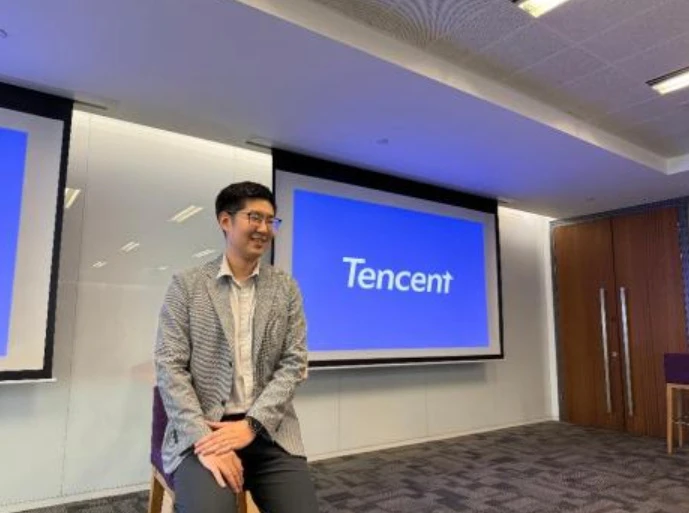
- Dowson Tong, senior executive vice president of Tencent and CEO of the Cloud and Smart Industries Group, said the new Saudi data region marks a “major growth opportunity”
- Tencent’s expansion dovetails with Saudi Arabia’s Vision 2030 goals to build a world-class digital economy
RIYADH/SHENZHEN: Chinese technology giant Tencent is accelerating its cloud and AI push into Saudi Arabia, positioning the Kingdom as its primary hub for the Middle East under Vision 2030.
On the sidelines of the Tencent Global Digital Ecosystem Summit 2025 in Shenzhen, senior executives told Arab News that the company is finalizing the launch of its first Middle East cloud region in Riyadh, part of a $150 million investment announced earlier this year.
Riyadh data region: a strategic hub
Dowson Tong, senior executive vice president of Tencent and CEO of the Cloud and Smart Industries Group, said the new Saudi data region marks a “major growth opportunity” for the company.
“We already serve many Chinese companies that are increasing their investments in the Kingdom, and several of our partners are lined up to benefit from the new center,” Tong told Arab News. “This will allow us to expand not only within Saudi Arabia but across the region as a whole.”
He said Tencent is working to secure the necessary approvals and certifications to provide cloud services for both public and private sector clients in the Kingdom.
“We are pushing to accelerate this process because we want to move at full speed in serving the Saudi market,” Tong said. “Saudi Arabia is central to our strategy in the region, and we see cloud as a foundation for broader digital transformation.”
Vision 2030 alignment
Tencent’s expansion dovetails with Saudi Arabia’s Vision 2030 goals to build a world-class digital economy, expand its data infrastructure, and attract global technology leaders.
According to Tong, Tencent’s Saudi investment goes beyond infrastructure. “Localization is key,” he said. “We are adapting our technologies to serve sectors such as digital media, e-commerce, gaming, tourism, telecommunications, and financial services. We are also building local teams and working with system integrators to ensure our solutions are fully aligned with Saudi business and regulatory environments.”
He also praised the Kingdom’s fast-growing gaming and esports ecosystem, underscored by the Esports World Cup in Riyadh earlier this year.
“This is one of the main reasons we are accelerating the establishment of our data center — to provide lower latency, faster response times, and an overall better user experience for players and streamers,” Tong said.
Industrial AI
Eric Li, director of AI Global Commercialization at Tencent, highlighted how the company’s AI solutions could be applied to Saudi industries.
“Right now, we are building server rooms in Saudi Arabia. Once those are completed and ready for use, we will be fully equipped to serve local industries in Saudi Arabia, the wider Middle East, and beyond,” Li told Arab News.
He noted that Tencent is tailoring products that could be implemented in Saudi Arabia to meet demand in sectors prioritized under Vision 2030.
“For example, E-KYC could be adopted in finance and telecom operations, while Palm AI could be applied in cloud services as well as in the culture and tourism industry,” Li said.
He also revealed that Tencent will launch its new data center in Saudi Arabia by the end of the year, which will strengthen service delivery and integration for enterprises in the Kingdom.
Supporting startups, new markets
Li said Tencent Cloud’s AI Agent Development Platform will be particularly valuable for Saudi startups and SMEs, many of which lack in-house AI development teams.
“With our ADP platform, local enterprises and startups in places like Saudi Arabia can build and operate their own AI agents more easily,” he said. “It provides ‘brain support’ for generating ideas and implementing them on the ground.”
He added that such platforms could benefit not only large enterprises but also Saudi gaming startups and event-tech companies, helping them scale with advanced AI tools.
Tencent’s digital human technology, already deployed by Abu Dhabi’s tourism department, is another solution that could be replicated in Saudi Arabia to enhance cultural tourism experiences in multiple languages, Li said.
KSA as the main gateway
Dan Hu, vice president of Tencent Cloud International for the Middle East and North Africa, said Saudi Arabia will serve as the company’s “main gateway” into the region.
“The new cloud region represents a strategic pillar of our investments in the Kingdom, accelerating digital transformation and boosting smart city growth,” Hu said.
He cited advanced solutions such as edge computing and AI-powered analytics, which enable real-time applications in predictive maintenance, urban planning, and smart building management.
A milestone in Saudi’s digital journey
For Tencent, the Saudi launch is more than an infrastructure project; it is a chance to apply lessons from China’s AI and cloud commercialization to one of the world’s fastest-growing digital economies.
“Saudi Arabia is not just another market — it is a partner in building the future of intelligent industry,” Li said.
As the Kingdom pushes ahead with Vision 2030, Tencent’s investment signals growing confidence that Riyadh is on track to become a global hub for cloud and AI solutions.