Israel detains Palestinians in Nablus, reopens West Bank-Jordan crossing

Israel detains Palestinians in Nablus, reopens West Bank-Jordan crossing
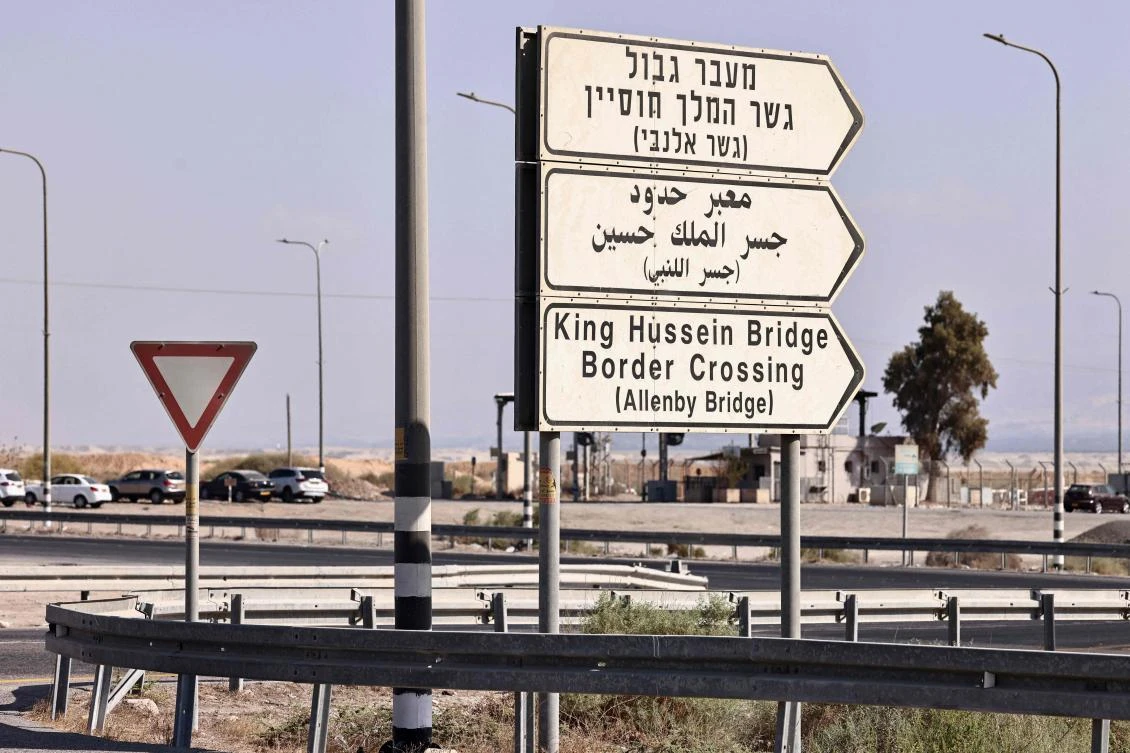
A picture taken on Sept. 24, 2025, shows an Israeli army inspection point on the road leading to the King Hussein (Allenby) bridge, the main border crossing between the Israel-occupied West Bank and Jordan. (AFP)
Short Url
Updated 26 September 2025
Follow

Israel detains Palestinians in Nablus, reopens West Bank-Jordan crossing

Israel detains Palestinians in Nablus, reopens West Bank-Jordan crossing
  • “The suspects were subsequently transferred to the Shin Bet for questioning,” the spokesman added
  • The detentions “will only fuel public anger,” said Abdul Rahman Shadid, a Hamas official in the West Bank

NABLUS, Palestinian Territories: The Israeli military detained several Palestinians in an overnight raid in the occupied West Bank city of Nablus, an AFP journalist at the scene said on Friday.
When contacted by AFP, an Israeli military spokesman confirmed the raid and said that “forces operated in the Nablus area to apprehend several suspects involved in terrorist activities.”
“The suspects were subsequently transferred to the Shin Bet for questioning,” the spokesman added, referring to the Israeli domestic intelligence agency.
An official from Palestinian Islamist movement Hamas said that “former prisoners, journalists, academics and members of the Legislative Council,” were among those targeted.
The detentions “will only fuel public anger,” said Abdul Rahman Shadid, a Hamas official in the West Bank, which Israel has occupied since 1967.
Violence in the West Bank has soared since the Hamas attack on Israel triggered the Gaza war in October 2023.
Since then, Israeli troops and settlers have killed at least 983 Palestinians in the West Bank, including many militants, according to health ministry figures.
Over the same period, at least 36 Israelis, including members of security forces, have been killed in Palestinian attacks or during Israeli military operations, according to official figures.
Meanwhile, the Allenby border crossing — which is the only international gateway for Palestinians to leave the West Bank that does not require entering Israel — reopened on Friday, but later than scheduled.
The crossing had been largely closed since a Jordanian truck driver transporting humanitarian aid to Gaza shot dead an Israeli soldier and a reserve officer at the border last week.
On Tuesday, Palestinian and Jordanian authorities said Israel was indefinitely closing the crossing, which Palestinians feared was retaliation by Israel for France and other Western countries formally recognizing a Palestinian state.
Israel announced on Thursday it would reopen the crossing only for passenger traffic from the next morning.
At around 11:00 am (0800 GMT) on Friday, Palestinian travelers confirmed the reopening, roughly three hours later than scheduled.
Thousands of people gathered in front of the terminal, an AFP journalist on the scene reported.
In an angry UN address on Friday, Israeli Prime Minister Benjamin Netanyahu vowed to block a Palestinian state, accusing European leaders of pushing his country into “national suicide” and rewarding Hamas.

Israeli settlers torch a mosque and scrawl hateful messages after condemnation from military leaders

Updated 20 sec ago
Follow

Israeli settlers torch a mosque and scrawl hateful messages after condemnation from military leaders

Israeli settlers torch a mosque and scrawl hateful messages after condemnation from military leaders
DEIR ISTIYA: Israeli settlers torched and defaced a mosque in a Palestinian village in the central West Bank overnight, scribbling hateful messages in a show of defiance a day after some Israeli leaders condemned a recent attack by settlers against Palestinians.
One wall and at least three copies of the Qur’an and some of the carpeting at the mosque in the Palestinian town of Deir Istiya had been torched when an AP reporter visited Thursday.
On one side of the mosque settlers had left graffitied messages like “we are not afraid,” “we will revenge again,” and “keep on condemning.” The Hebrew scrawl, difficult to make out, appeared to reference Maj. Gen Avi Bluth, the chief of the military’s Central Command who issued a rare denunciation of the violence Wednesday.
It was the latest in a string of attacks that have provoked expressions of concern from top officials, military leaders and the Trump administration. Israel’s Prime Minister Benjamin Netanyahu has not commented on the surge in violence.
Soldiers from Israel’s military, which did not immediately respond to a request for comment, were present at the scene.
Speaking at a press conference Wednesday, US Secretary of State Marco Rubio said there was “some concern about events in the West Bank spilling over and creating an effect that could undermine what we’re doing in Gaza.”
Young settlers have launched hundreds of attacks since the war in Gaza erupted two years ago. The attacks have intensified in recent weeks as Palestinians harvest their olive trees in an annual ritual. October was the month with the highest-ever number of recorded settler attacks in the West Bank since the UN’s humanitarian office began keeping track in 2006, says the office.
On Tuesday dozens of masked Israeli settlers attacked the Palestinian villages of Beit Lid and Deir Sharaf in the West Bank, setting fire to vehicles and other property before clashing with Israeli soldiers.
President Isaac Herzog described the attacks as “shocking and serious,” adding a powerful voice to what has been muted criticism by top Israeli officials of the settler violence. Herzog’s position, while largely ceremonial, is meant to serve as a moral compass and unifying force for the country.
Herzog said the violence committed by a “handful” of perpetrators “crosses a red line,” adding in a social media post that “all state authorities must act decisively to eradicate the phenomenon.”
The Israeli army’s chief of staff, Eyal Zamir, echoed Herzog’s condemnations of the West Bank violence, saying the military “will not tolerate the phenomena of a minority of criminals who tarnish a law-abiding public.”
He said the army is committed to stopping violent acts committed by settlers, which he described as contrary to Israeli values and that “divert the attention of our forces from fulfilling their mission.”
In his comments Wednesday, Rubio commended Israel’s president and the high-ranking military officials for denouncing the Beit Lid attacks.
Palestinians and human rights workers accuse the Israeli army and police of failing to halt attacks by settlers. Israel’s government is dominated by far-right proponents of the settler movement including Finance Minister Bezalel Smotrich, who formulates settlement policy, and Cabinet minister Itamar Ben-Gvir, who oversees the nation’s police force.