Prince Mohammed Al-Faisal, the visionary behind Saudi Arabia’s desalination revolution

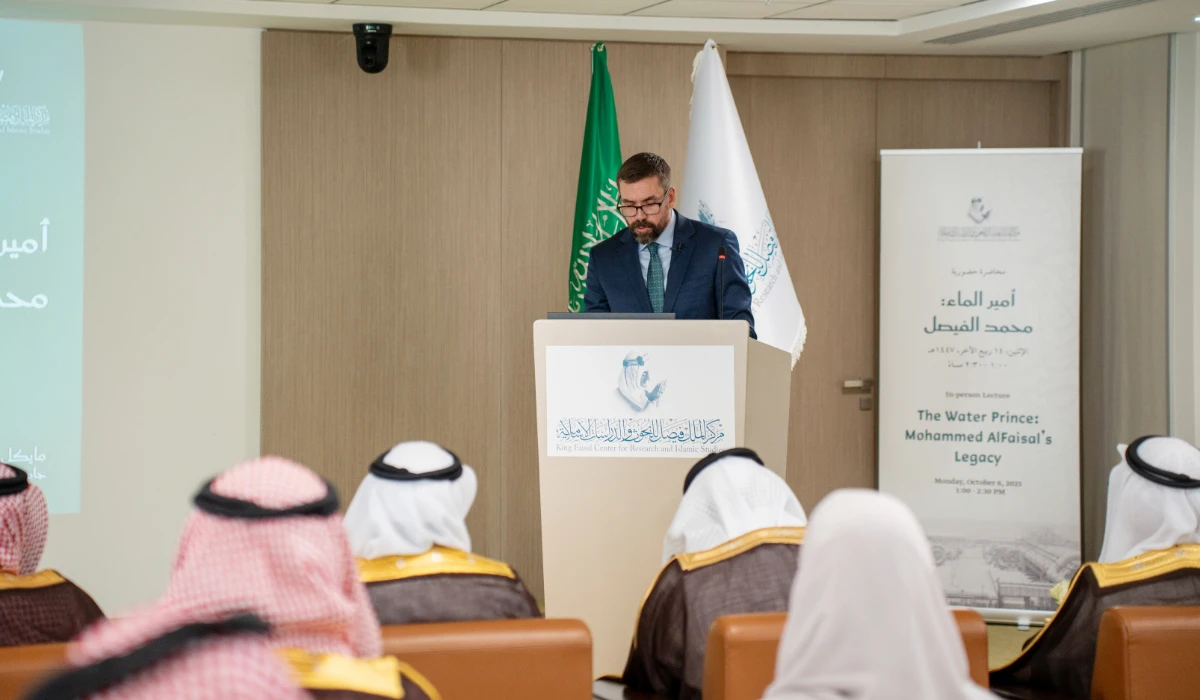
Michael Christopher Low, associate professor of history and director of the Middle East Center at the University of Utah. (AN photo by Jafar Al-Saleh)
Short Url
Updated 06 October 2025
Follow

Prince Mohammed Al-Faisal, the visionary behind Saudi Arabia’s desalination revolution

Prince Mohammed Al-Faisal, the visionary behind Saudi Arabia’s desalination revolution
  • Lecture in Riyadh focuses on pivotal figure who helped reshape Saudi Arabia

RIYADH: Saudi Arabia is no longer just a petrostate but has become a global leader in desalinated water production, Michael Christopher Low, associate professor of history and director of the Middle East Center at the University of Utah, told an event in Riyadh on Monday.

Speaking at the King Faisal Center for Research and Islamic Studies, Low presented a lecture on the pivotal role of Prince Mohammed Al-Faisal, whose pioneering work in desalination during the 1970s helped reshape Saudi Arabia and secured its water future.

Low said that Prince Mohammed’s commitment to solving water scarcity was rooted in his childhood experiences during the 1930s and 1940s, when Saudi Arabia faced severe water shortages.
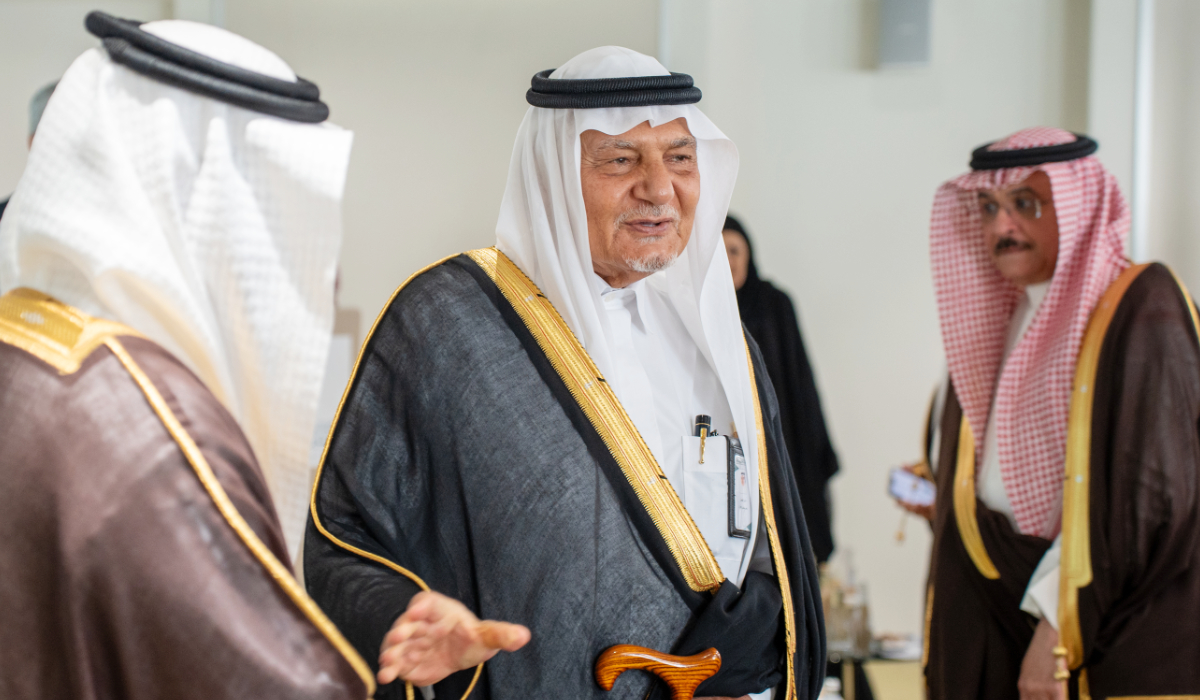


Prince Turki Al-Faisal attended the event on Monday. (AN photo by Jafar Al-Saleh)

The prince often spoke of Jeddah’s old desalination plant, known as the condenser, which provided fresh water during droughts. These early struggles, Low said, inspired the prince’s lifelong mission to ensure Saudi Arabia’s water security.

“In 1972, the Saline Water Conversion Department separated from the Ministry of Agriculture and Water,” Low said.

This marked the first step toward creating a dedicated water infrastructure. Two years later, a royal decree established the Saline Water Conversion Corporation, and Prince Mohammed was appointed its founding governor.

Low explained that under the prince’s leadership, desalination infrastructure expanded rapidly.

“By the time of his resignation in 1977, 28 major desalination projects were either completed or underway,” Low said.

Low described the 1970s and 1980s as the era when Jeddah became the epicenter of Saudi Arabia’s “saltwater kingdom.”

He highlighted several key events, starting with phase one of Jeddah’s desalination plant in 1978.

Low said: “Reverse osmosis units were added, making it the largest such facility in the world at the time and increasing capacity by 40 percent.”

More expansions followed. In 1979, phase two introduced multi-stage flash desalination technology, which added 1 million gallons of daily water production as well as 85 megawatts of electricity.

Low said phase three in 1980 added another 2 million gallons per day and 256 megawatts of electricity, while phase four a year later produced a further 5 million gallons per day and added 590 megawatts of energy.

“These projects not only addressed Saudi Arabia’s water shortages but also supported its rapid urbanization and population growth,” Low said.

Low called desalination “the revolution of the 20th century that sustained Saudi Arabia and enabled it to become the welfare state it is today.” He said that the prince’s work laid the foundation for Saudi Arabia’s position as the world’s largest producer of desalinated water.

Low also discussed Prince Mohammed’s bold and controversial plan to tow icebergs from Antarctica to Saudi Arabia.

The prince convened an international conference on iceberg utilization in 1977, bringing together scientists and experts to evaluate the feasibility of harvesting freshwater from glacial ice.

“The iceberg project reflected the technological optimism of the 1970s,” Low said. While the plan ultimately did not materialize, Low said that it showcased the prince’s innovative mindset and willingness to explore unconventional solutions.

Low said that Prince Mohammed’s contributions to desalination transformed Saudi Arabia to such an extent that desalinated water became fundamental to daily life.

“His towering legacy is an inheritance that every Saudi citizen is bound to take for granted when they turn on the tap,” Low said.

He added that the prince’s visionary work ensured that Saudi Arabia could thrive in an arid environment, with water scarcity turned from a challenge into an opportunity for progress.


Savvy Games Group signs MoU with HUMAIN to expand use of AI across operations

Savvy Games Group signs MoU with HUMAIN to expand use of AI across operations
Updated 06 November 2025
Follow

Savvy Games Group signs MoU with HUMAIN to expand use of AI across operations

Savvy Games Group signs MoU with HUMAIN to expand use of AI across operations
  • Agreement announced this week sets the stage for both companies to explore the development of customized AI models
  • CEO of Savvy Games Group Brian Ward: We are looking forward to working with HUMAIN to identify and unlock ways that would enhance the way we utilize AI at Savvy

RIYADH: Savvy Games Group has signed a memorandum of understanding with HUMAIN, the Saudi-owned artificial intelligence company, to integrate AI systems into the gaming group’s operations.

The agreement announced this week sets the stage for both companies to explore the development of customized AI models.

It also gives Savvy access to HUMAIN’s cloud-based data centers and computing infrastructure, positioning the partnership as both a technology and capability-sharing arrangement between two Public Investment Fund portfolio firms.

“We are looking forward to working with HUMAIN to identify and unlock ways that would enhance the way we utilize AI at Savvy,” said Brian Ward, CEO of Savvy Games Group.

For HUMAIN, the deal comes shortly after the launch of HUMAIN ONE, its agentic AI operating system announced at the Future Investment Initiative in Riyadh last month.

The company positions the system as a foundation for sector-specific AI deployment, including gaming — a field HUMAIN says is now entering a phase where AI can shape both productivity and creative output.

“Game development is one of the most exciting fields where the effective use of AI solutions can make a tangible impact on boosting both creativity and productivity,” said HUMAIN CEO Tareq Amin.

Savvy, which is backed by a $38 billion investment mandate from PIF, has been positioned as a key player in Saudi Arabia’s ambition to become a global gaming hub.

While most of the company’s public activity has focused on investments and industry consolidation, the MoU suggests a shift toward internal AI capability-building as the domestic gaming market matures.

HUMAIN, meanwhile, sits at the center of Saudi Arabia’s emerging sovereign AI stack, covering data centers, model training and AI solutions designed for both government and private-sector clients.

Its focus on building Arabic-trained large language models and sector-specific applications has aligned the company with national digital priorities, including localization of core technologies and talent development.

The partnership also reflects a broader strategy inside PIF to create interoperability across portfolio companies, particularly in digital infrastructure and emerging tech.

Rather than treating AI as a standalone product, the agreement signals a move toward shared platforms, shared data layers and unified technical standards — a direction Saudi policymakers have repeatedly stressed as part of Vision 2030’s digital economy agenda.

Neither company disclosed financial terms or a project timeline, but both confirmed that joint R&D initiatives are part of the scope, including experimentation with new AI-driven tools for future gaming projects.

If successfully executed, the agreement would make Savvy one of the first large-scale gaming entities in the region to operationalize AI beyond content recommendation and analytics — shifting it into areas such as automated workflows, talent systems and creative asset generation.