Saudi industry minister sets out investment opportunities to Greek officials

Saudi industry minister sets out investment opportunities to Greek officials
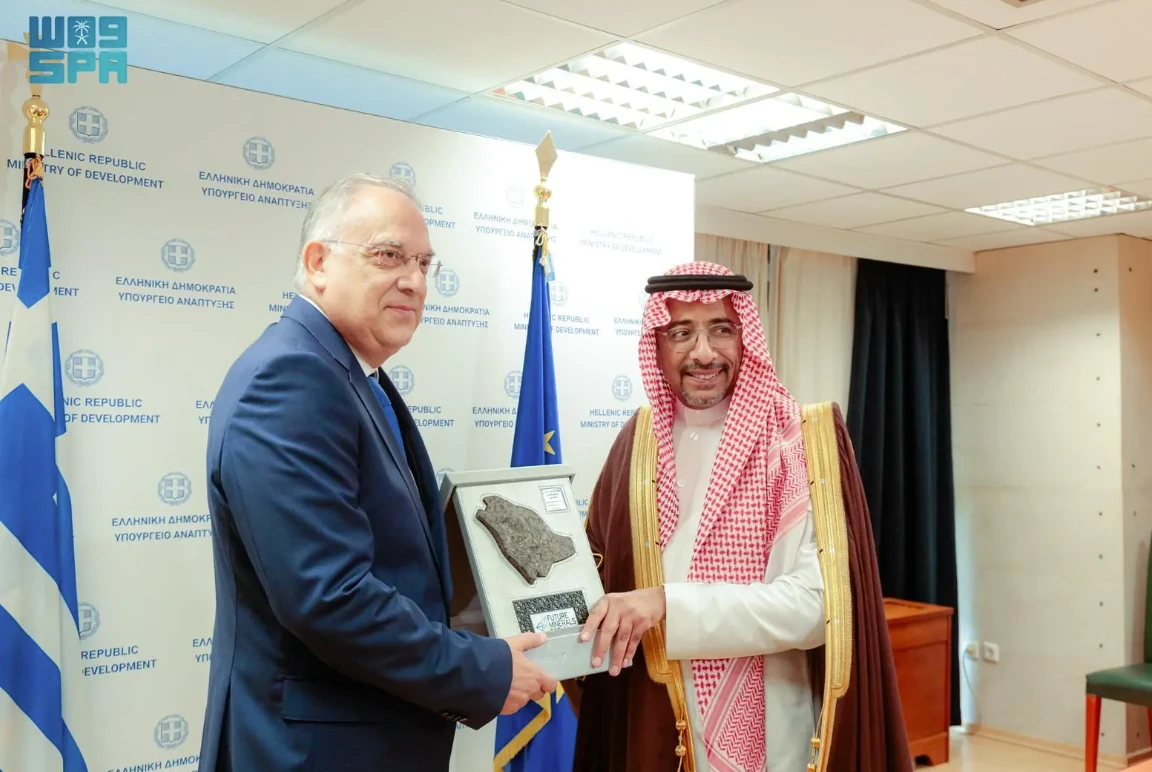
Greek Minister of Development Takis Theodorikakos with Saudi Arabia’s Minister of Industry and Mineral Resources Bandar Alkhorayef. SPA
Short Url
Updated 07 October 2025
Follow

Saudi industry minister sets out investment opportunities to Greek officials

Saudi industry minister sets out investment opportunities to Greek officials

RIYADH: Saudi Arabia and Greece are set to strengthen collaboration in industry and mineral resources following high-level talks in Athens between government officials.

The Kingdom’s Minister of Industry and Mineral Resources Bandar Alkhorayef met with the European country’s Minister of Environment and Energy Stavros Papastavrou and Minister of Development Takis Theodorikakos, with the discussions focused on expanding strategic partnerships across industrial, mining, and maritime sectors, according to an official statement. 

Both sides explored opportunities for Greek investors in the Kingdom’s fast-growing mining sector, as well as avenues for knowledge exchange and technology adoption in mineral exploration and processing. 

The meetings also highlight Saudi Arabia’s efforts to position itself as a global hub for mineral development, leveraging its vast untapped resources and the regulatory reforms introduced under Vision 2030 to attract international investors. 

In a post on its official X account, the Ministry of Industry and Mineral Resources said: “Alkhorayef discussed with the Greek Minister of Environment and Energy ways to develop joint cooperation in the mining sector and investment opportunities available in the Kingdom for Greek mining companies.”  

It added: “He also discussed opportunities for exchanging expertise and transferring the latest technologies and innovative solutions in the fields of exploration, extraction, and mine management.” 

In a separate meeting with Theodorikakos, Alkhorayef discussed expanding cooperation in industrial development, including maritime industries, infrastructure projects, and specialized industrial clusters.  

The two ministers emphasized the importance of enhancing bilateral economic ties and supporting joint ventures that can strengthen trade and industrial integration between the Kingdom and Greece. 

Alkhorayef extended an official invitation to both Greek ministers to participate in the fifth edition of the Future Minerals Forum, which will be held in Riyadh from Jan. 13 to 15, 2026.  

The visit aligns with the Kingdom’s broader strategy to accelerate growth in the mining and industrial sectors, which have become central pillars of Saudi Arabia’s economic diversification agenda.  

Mining exports have surged by about 80 percent, driven by increased production of phosphate, iron, aluminum, copper, and gold.  

Current and planned investments in the sector are estimated at SR180 billion ($48 billion), underscoring Saudi Arabia’s ambition to position itself as a global hub for mineral resources while attracting high-quality foreign investment into downstream industries. 

UAE non-oil growth steady in October as PMI hits 53.8: S&P Global 

UAE non-oil growth steady in October as PMI hits 53.8: S&P Global 
Updated 8 sec ago
Follow

UAE non-oil growth steady in October as PMI hits 53.8: S&P Global 

UAE non-oil growth steady in October as PMI hits 53.8: S&P Global 

RIYADH: The UAE’s non-oil economy maintained steady growth in October, with the Purchasing Managers’ Index at 53.8, supported by strong new orders and robust business activity, a report showed. 

The latest PMI data from S&P Global revealed that the index dipped slightly from 54.2 in September but remained above the mid-year trend, driven by solid demand growth. 

Although the pace of expansion moderated, the reading continued to signal a healthy improvement in operating conditions, driven by a notable rise in new orders and overall business activity. 

The stable PMI figures align with a broader trend across the Gulf Cooperation Council, where countries, including Saudi Arabia, are advancing economic diversification efforts to reduce reliance on crude revenues. 

In October, Saudi Arabia recorded the highest PMI in the region at 60.2, while Kuwait and Qatar posted 52.8 and 50.6, respectively. 

Commenting on the latest report, David Owen, senior economist at S&P Global Market Intelligence, said: “The UAE PMI continued to signal a steady growth rate in the non-oil private sector as we draw closer to the end of the year.” 

He added: “The pace of new business growth has recovered well since its low in August, supporting increases in output and purchasing activity.” 

The report noted that non-oil private sector activity rose considerably in October, with surveyed firms citing improved sales and new project initiations as key growth drivers.

Companies also benefited from a slower rise in input costs for the second consecutive month, helping keep output prices largely stable. 

Optimism about future business conditions weakened to a three-year low, resulting in a softer pace of hiring. 

“Employment remained a weak spot, with October data showing the slowest rise in job numbers in seven months. This partly reflected a relatively subdued level of business confidence,” said Owen. 

He added: “In fact, the latest survey revealed that firms were the least optimistic in nearly three years. Although most companies still anticipate that economic conditions will remain favorable and that order inflows will sustain activity, concerns regarding market competition and the potential impact on profit margins persisted.” 

In Dubai, business activity strengthened further, with the emirate’s PMI reaching a nine-month high of 54.5, up from 54.2 in September. 

Non-oil companies saw stronger inflows of new orders, supporting a sharper increase in output. Employment rose for the seventh consecutive month, though the rate of job creation remained modest.