RIYADH: Saudia, Alrajhi Bank, and Albaik are the top three most persuasive brands in Saudi Arabia when it comes to getting people to buy their products, according to a new survey.
A report from market research and data analytics firm YouGov analyzed shopping attitudes in the Kingdom and compiled a list of companies leading in convincing consumers to spend on their brands.
The analysis found that retail banks, beauty firms, and telecoms and handset providers are the most successful at converting people who would consider buying their products into those who intend to do so.
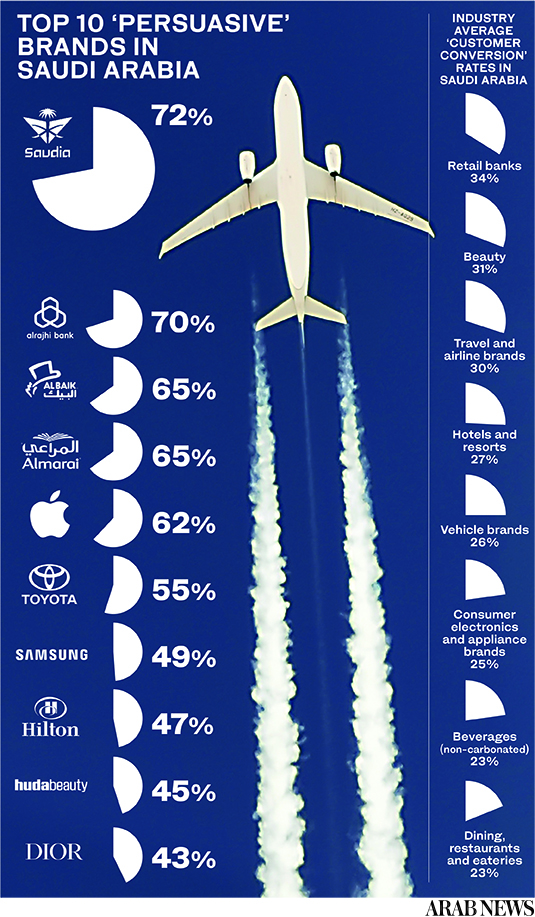
According to the report, Saudia topped all brands across every category, with 72 percent of respondents intending to use the airline once it was considered as an option.
Alrajhi Bank came second with a conversion rate of 70 percent, followed by Albaik at 65 percent, Almarai at 65 percent, and Apple at 62 percent.
Toyota followed with a conversion rate of 55 percent, while Samsung and Hilton recorded conversion rates of 49 percent and 47 percent, respectively, once customers began considering their products.
The survey also found that Huda Beauty has a conversion rate of 45 percent, followed by Dior Beauty at 43 percent.
Category breakdown
Among non-carbonated beverage brands, Almarai secured the top spot among Saudi buyers, followed by Saudia, Nadec, Lipton Ice Tea, and Nova.
Almarai’s top position comes just months after the company signed an agreement to acquire Pure Beverages Industry Co. for SR1.04 billion ($277 million), aiming to diversify its offerings and strengthen its market position.
Pure Beverages Industry Co. is a bottled drinking water producer in the Kingdom, known for its “Ival” and “Oska” brands.
In the retail banking category, Alrajhi Bank is the most successful at converting customers considering its services into those who intend to use them.
Alrajhi Bank is followed by Saudi Awwal Bank, Saudi National Bank, Alinma Bank, and Riyad Bank.
In September, Alrajhi Bank earned an “AA” rating from MSCI’s global environmental, social, and governance benchmark, becoming the only financial institution in Saudi Arabia to achieve this distinction.
The recognition also placed the financial institution among the top five banks worldwide with an “AA” or higher ESG rating, underscoring its leadership in sustainable practices.
Among beauty brands, Huda Beauty garnered the top spot for conversions, while Dior Beauty, Mac Beauty, Chanel Beauty, and Makeup Forever Beauty made up the remaining popular companies in the segment.
With a conversion rate of 38 percent, Amazon was named the most persuasive retailer in the Kingdom, followed by Al Othaim, Panda, Lulu Hypermarket, and Shein.
Apple topped the list among consumer electronics and appliances brands, with Samsung, Huawei, LG and PlayStation grabbing the remaining slots in the top five list.
Albaik was named the most persuasive brand in the dining, restaurants and eateries category. Other entrants in the list include Hungerstation, McDonald’s, Al Tazaj, and KFC.
According to YouGov, Toyota is the most persuasive vehicle brand among Saudi customers, followed by Mercedes-Benz, Land Rover, Lexus, and BMW.
Among hotels and resorts, Hilton topped the list, while the remaining entrants included InterContinental, Movenpick, Hyatt, and Ritz-Carlton.
Saudia was named the most persuasive travel and airline brand among Saudi customers, followed by Egypt Air, flynas, Emirates, and Almosafer.
Affinity toward home-made brands
According to the YouGov survey, six out of 10 residents in Saudi Arabia prefer to buy products made in their home country.
The report revealed that 63 percent of the survey participants aged above 55 prefer products made in Saudi Arabia.
Among people aged from 18 to 24, 58 percent prefer buying homemade products, and this figure rises to 60 percent among people between the ages of 25 and 34, and 61 percent among 35- to 44-year-olds.
The report further said that 58 percent of the participants between the ages of 45 to 54 prefer buying products made in the Kingdom.