Hamas will not govern post-war Gaza: Hamas source close to negotiating committee

Hamas will not govern post-war Gaza: Hamas source close to negotiating committee
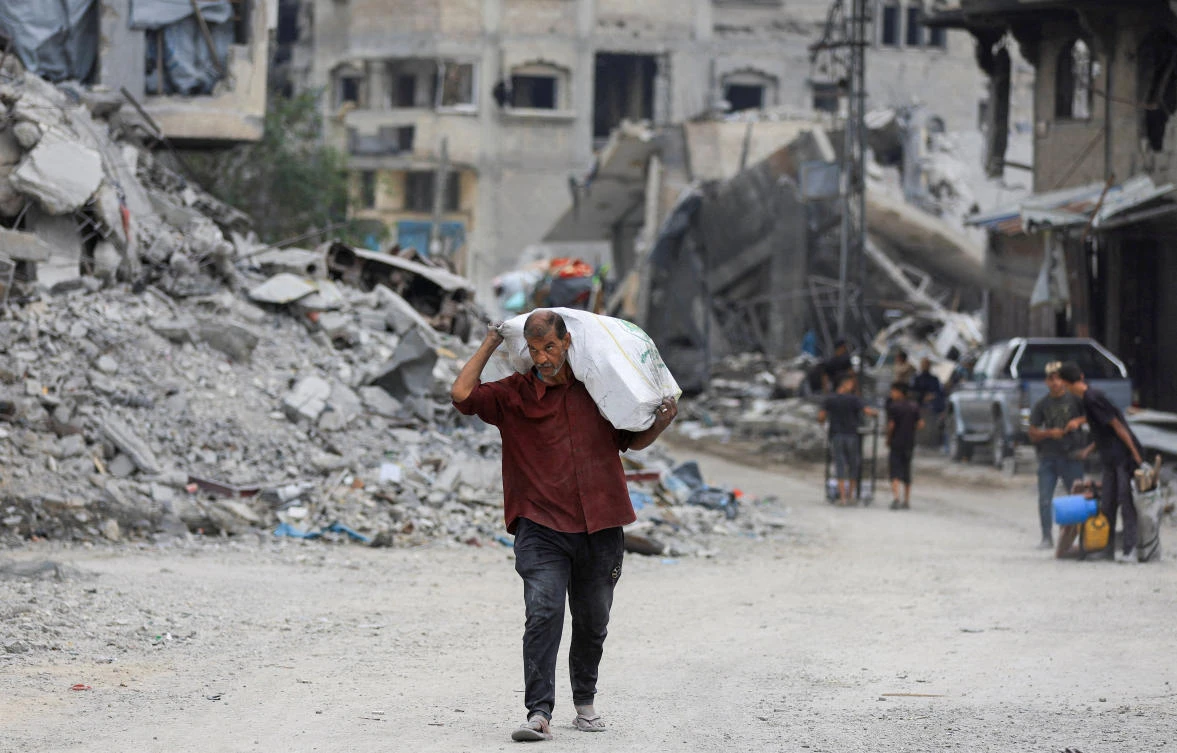
The first clause of US President Donald Trump’s 20-point plan calls for Gaza to become a “deradicalized terror-free zone that does not pose a threat to its neighbors.” (Reuters)
Short Url
Updated 12 October 2025
Follow

Hamas will not govern post-war Gaza: Hamas source close to negotiating committee

Hamas will not govern post-war Gaza: Hamas source close to negotiating committee
  • ‘For Hamas, the governance of the Gaza Strip is a closed issue’
  • Hamas’ leadership has in the past been divided on key issues, including on the future administration of Gaza

DOHA: A Hamas source close to the group’s negotiating committee told AFP on Sunday that it will not participate in post-war Gaza governance, as world leaders prepare to converge on Egypt for a Gaza peace summit.
The source’s comments come days after an Israel-Hamas ceasefire came into effect, and as both sides discuss implementing US President Donald Trump’s 20-point plan to end the war, which calls for Hamas’ disarmament and for the group not to be involved in running post-war Gaza.
“For Hamas, the governance of the Gaza Strip is a closed issue. Hamas will not participate at all in the transitional phase, which means it has relinquished control of the Strip, but it remains a fundamental part of the Palestinian fabric,” the source told AFP, requesting anonymity to discuss sensitive matters.
Unlike other more top-heavy militant organizations in the region, Hamas’ leadership has in the past been divided on key issues, including on the future administration of Gaza.
But where there appears to be no division among top members is on the question of disarmament, which the group has long described as a red line.
“Hamas agrees to a long-term truce, and for its weapons not to be used at all during this period, except in the event of an Israeli attack on Gaza,” the source said.
Another Hamas official who requested anonymity to discuss sensitive topics had earlier told AFP that Hamas’ disarmament was “out of the question.”
The first clause of Trump’s 20-point plan calls for Gaza to become a “deradicalized terror-free zone that does not pose a threat to its neighbors.”
The plan also states Hamas will not have a role in future governance of the Strip, and that its military infrastructure and weapons should be “destroyed and not rebuilt.”
Under Trump’s plan, a temporary technocratic and apolitical Palestinian committee would be charged with the day-to-day running of public services.
The source close to the negotiators said they had asked for mediator Egypt to call a meeting before the end of next week to agree on the composition of this committee, adding that “the names are almost ready.”
“Hamas, along with the other factions, have submitted 40 names. There is absolutely no veto over them, and none of them belong to Hamas,” he added.

UN secretary-general warns that war in Sudan is ‘spiraling out of control’

UN secretary-general warns that war in Sudan is ‘spiraling out of control’
Updated 6 sec ago
Follow

UN secretary-general warns that war in Sudan is ‘spiraling out of control’

UN secretary-general warns that war in Sudan is ‘spiraling out of control’
DUBAI: The United Nations secretary-general warned Tuesday that the war in Sudan is “spiraling out of control” after a paramilitary force seized the Darfur city of el-Fasher.
Speaking at a U.N. summit in Qatar, António Guterres offered a stark warning about el-Fasher and called for an immediate ceasefire in the two-year conflict that's become one of the world's worst humanitarian crises.
“Hundreds of thousands of civilians are trapped by this siege,” Guterres said. “People are dying of malnutrition, disease and violence. And we are hearing continued reports of violations of international humanitarian law and human rights.”
He added that there also were “credible reports of widespread executions since the Rapid Support Forces entered the city.”
U.N. officials have warned of a rampage by the paramilitary Rapid Support Forces after it took over the city of el-Fasher, reportedly killing more than 450 people in a hospital and carrying out ethnically targeted killings of civilians and sexual assaults.
The RSF has denied committing atrocities, but testimonies from those fleeing, online videos and satellite images offer an apocalyptic vision of the aftermath of their attack. The full scope of the violence remains unclear because communications are poor in the region.
The RSF besieged el-Fasher for 18 months, cutting off much of the food and other supplies needed by tens of thousands of people. Last week, the paramilitary group seized the city.
Asked if he thought there was a role for international peacekeepers in Sudan, Guterres said it was important to “gather all the international community and all those that have leverage in relation to Sudan to stop the fighting.”
“One thing that is essential to stop the fighting is to make sure that no more weapons come into Sudan,” he said. “We need to create mechanisms of accountability because the crimes that are being committed are so horrendous.”
The war between the RSF and the Sudanese military has been tearing apart Sudan since April 2023. More than 40,000 people have been killed, according to U.N. figures, but aid groups say the true death toll could be many times higher. The fighting has driven more than 14 million people from their homes and fueled disease outbreaks. Meanwhile, two regions of war-torn Sudan are enduring a famine that is at risk of spreading.
“It is clear that we need a ceasefire in Sudan,” Guterres said. “We need to stop this carnage that is absolutely intolerable.”