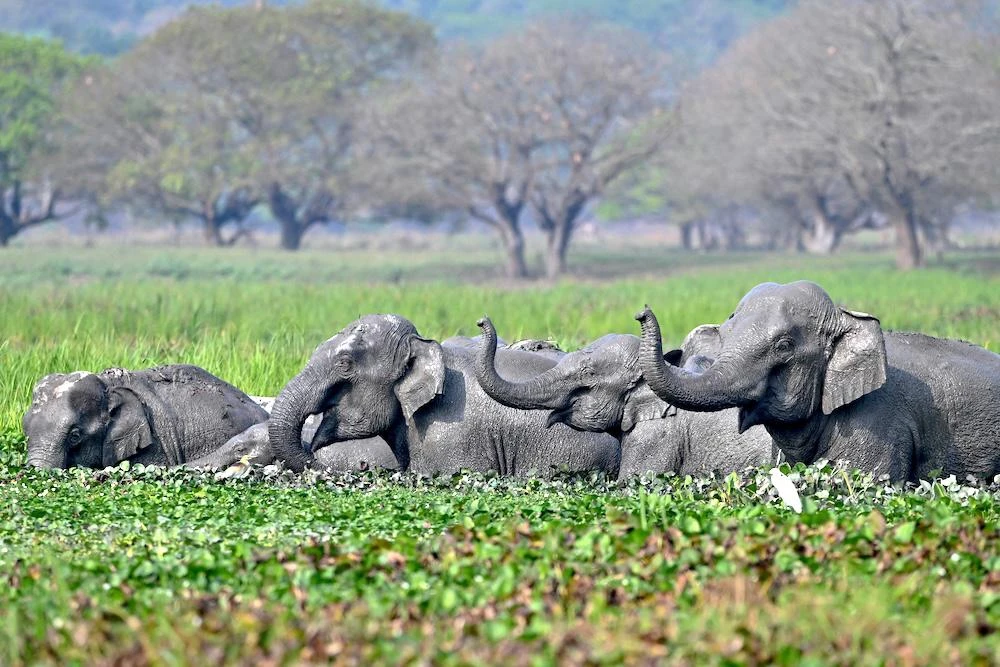
- India is home to the majority of the world’s remaining wild Asian elephants
- The species listed as endangered by the International Union for Conservation of Nature
NEW DELHI: India’s wild elephant population estimates have dropped sharply by a quarter, a government survey incorporating a new DNA system has found, marking the most accurate but sobering count yet.
India is home to the majority of the world’s remaining wild Asian elephants, a species listed as endangered by the International Union for Conservation of Nature (IUCN) and increasingly threatened by shrinking habitat.
The Wildlife Institute of India’s new All-India Elephant Estimation report released this week puts the wild elephant population at 22,446 – down from nearly 29,964 estimated in 2017, a fall of 25 percent.
The survey drew on genetic analysis of more than 21,000 dung samples, alongside a vast network of camera traps and 667,000 kilometers (414,400 miles) of foot surveys.
But researchers said the methodological overhaul meant the results were “not comparable to past figures and may be treated as a new monitoring baseline.”
‘Gentle giants’
But the report also warned that the figures reflect deepening pressures on one of India’s most iconic animals.
“The present distribution of elephants in India represents a mere fraction of their historical range,” it said, estimating they now occupy only about 3.5 percent of the area they once roamed.
Habitat loss, fragmentation, and increasing human-elephant conflict are driving the decline.
“Electrocution and railway collisions cause a significant number of elephant fatalities, while mining and highway construction disrupt habitats, intensifying man-wildlife conflicts,” the report added.
The Western Ghats, lush southern highlands stretching through Karnataka, Tamil Nadu, and Kerala, remain a key stronghold with nearly 12,00 elephants.
But even there, populations are increasingly cut off from one another by commercial plantations, farmland fencing, and human encroachment.
Another major population center lies in India’s northeast, including Assam and the Brahmaputra floodplains, which host more than 6,500 elephants.
“Strengthening corridors and connectivity, restoring habitat, improving protection, and mitigating the impact of development projects are the need of the hour to ensure the well-being of these gentle giants,” the report said.
India is home to the majority of the world’s remaining wild Asian elephants, a species listed as endangered by the International Union for Conservation of Nature (IUCN) and increasingly threatened by shrinking habitat.
The Wildlife Institute of India’s new All-India Elephant Estimation report released this week puts the wild elephant population at 22,446 – down from nearly 29,964 estimated in 2017, a fall of 25 percent.
The survey drew on genetic analysis of more than 21,000 dung samples, alongside a vast network of camera traps and 667,000 kilometers (414,400 miles) of foot surveys.
But researchers said the methodological overhaul meant the results were “not comparable to past figures and may be treated as a new monitoring baseline.”
‘Gentle giants’
But the report also warned that the figures reflect deepening pressures on one of India’s most iconic animals.
“The present distribution of elephants in India represents a mere fraction of their historical range,” it said, estimating they now occupy only about 3.5 percent of the area they once roamed.
Habitat loss, fragmentation, and increasing human-elephant conflict are driving the decline.
“Electrocution and railway collisions cause a significant number of elephant fatalities, while mining and highway construction disrupt habitats, intensifying man-wildlife conflicts,” the report added.
The Western Ghats, lush southern highlands stretching through Karnataka, Tamil Nadu, and Kerala, remain a key stronghold with nearly 12,00 elephants.
But even there, populations are increasingly cut off from one another by commercial plantations, farmland fencing, and human encroachment.
Another major population center lies in India’s northeast, including Assam and the Brahmaputra floodplains, which host more than 6,500 elephants.
“Strengthening corridors and connectivity, restoring habitat, improving protection, and mitigating the impact of development projects are the need of the hour to ensure the well-being of these gentle giants,” the report said.