UAE turns to AI to bridge legal language gaps

UAE turns to AI to bridge legal language gaps
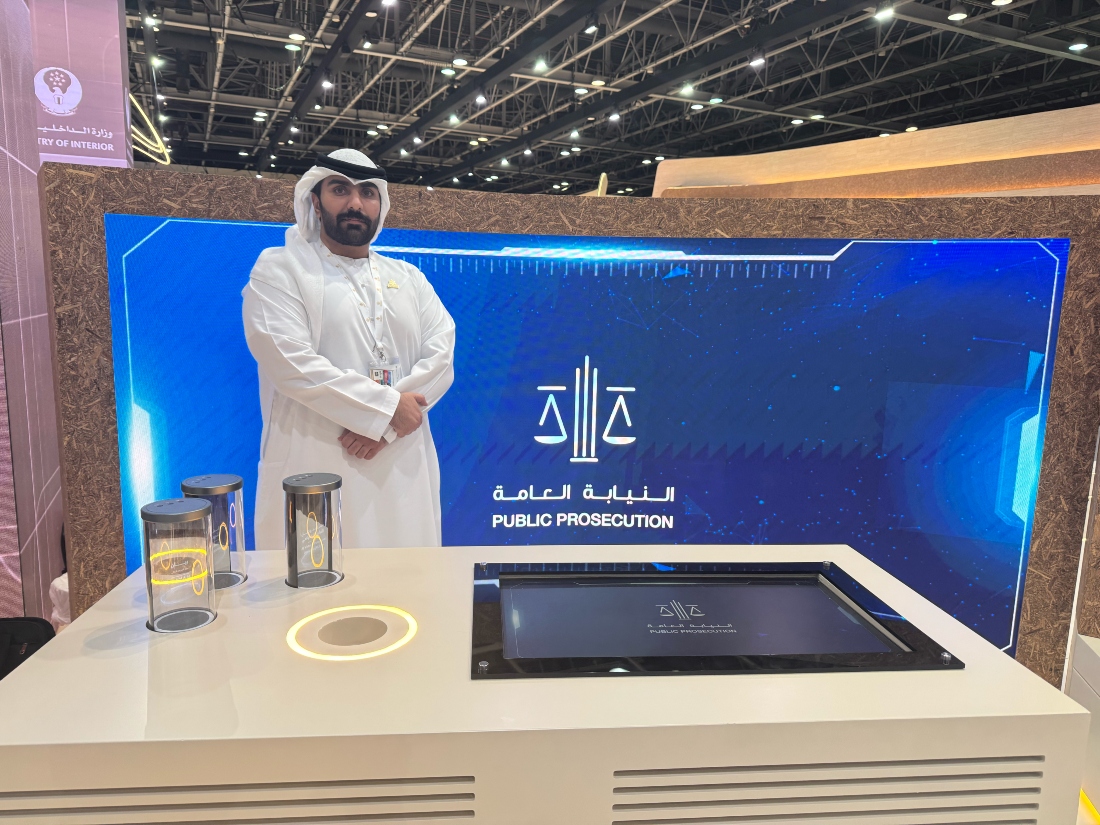
The UAE’s courts are often difficult to navigate for the country’s enormous expat population. (SUPPLIED)
Short Url
Updated 17 October 2025
Follow

UAE turns to AI to bridge legal language gaps

UAE turns to AI to bridge legal language gaps
  • A new translation tool aims to make the country’s multilingual legal system more accessible and inclusive

DUBAI: The UAE’s Federal Public Prosecution has launched a new artificial intelligence-powered translation service aimed at improving accessibility and inclusivity for non-Arabic speakers.

Speaking at GITEX Dubai this week, Khalifa Ibrahim Al Hammadi public prosecution member in the public procsecution of uae told Arab News the country hoped to become a world leader in integrating AI into the legal system. He cited the Bayan translation service, launched at the event in conjunction with Emirati AI company, Presight.

“It is designed to support investigations and trials by offering seamless two-way voice and text translation, with dialect recognition — including the Emirati dialect,” said Hammadi.

The UAE’s courts are often difficult to navigate for the country’s enormous expat population, which includes over 200 nationalities. Arabic is the official language of the UAE’s legal system, while English is common in business and commercial contracts, and translations are needed. In disputes, UAE courts give precedence to the Arabic version of any contract.

The public prosecution office hopes the new AI service will make the process much easier.

“The platform features speech-to-text and text-to-speech capabilities, extracts text from documents and images, and includes a multilingual legal dictionary,” Hammadi said.

“It also comes with an intelligent governance dashboard for auditing and quality assurance. Ultimately, it enhances translation accuracy, speeds up legal procedures, and strengthens the overall efficiency of our judicial system."

AI is being used in legal systems globally to speed up case processing, help in legal research, and improve access to justice. China has seen the rise of virtual smart courts while tools for contract analysis have rapidly gained popularity in the US.

The UAE is hoping to become a leader in the field, launching its own internal legal chatbot and undergoing a mass legal filing digitization campaign.

Some challenges remain with using AI in legal proceedings, particularly due to risks of bias, lack of transparency, data privacy concerns and unclear accountability when errors occur. However, Hammadi says he is confident the UAE’s systems will adapt and evolve.


Qatar sells $4bn in two-part debt issue

Qatar sells $4bn in two-part debt issue
Updated 5 sec ago
Follow

Qatar sells $4bn in two-part debt issue

Qatar sells $4bn in two-part debt issue

ABU DHABI: Qatar, among the world’s top exporters of liquefied natural gas, tapped global debt markets for $4 billion in a two-tranche issue which attracted hefty order books and allowed the Gulf state to achieve more favorable pricing than initially indicated.

Qatar sold a $1 billion, three-year bond at 15 basis points over US Treasuries and a $3 billion Islamic bond, or sukuk, with a 10-year tenor at 20 basis points over the same benchmark, according to a document from a lead manager.

Orders for the issuance hit $13.5 billion ahead of launch, fixed income news service IFR reported, allowing the sovereign — rated AA by Fitch and S&P and Aa2 by Moody’s — to tighten pricing substantially from earlier guidance.

In the second quarter of 2025, Qatar posted a budget deficit of 757 million riyals ($208 million) as public spending rose 5.7 percent from a year earlier and lower oil prices weighed on revenue.

It raised $3 billion from debt markets in February.

Several Gulf sovereigns have issued debt in recent weeks as strong global appetite and attractive borrowing costs have allowed governments to increase funding sources to help refinance debt, plug budget deficits, and invest in ambitious economic diversification plans.

Deutsche Bank, Goldman Sachs International, QNB Capital and Standard Chartered Bank were mandated global coordinators on Qatar’s bond issue. They were joined by Santander, Citi, Emirates NBD Capital, ICBC, IMI-Intesa Sanpaolo and SMBC as joint lead managers.

Citi, Deutsche Bank, QNB Capital and Standard Chartered Bank were global coordinators for the sukuk as well as joint lead managers along with Al Rayan Investment, Dubai Islamic Bank, Emirates NBD Capital, Goldman Sachs, Islamic Corporation for the Development of the Private Sector, IMI-Intesa Sanpaolo and KFH Capital.