Future Investment Initiative Institute announces global partners for FII9
Updated 24 October 2025
Arab News
RIYADH: The Future Investment Initiative Institute has announced its roster of global partners for the 9th edition of its flagship conference taking place in Riyadh from Oct. 27 to 30.
This year’s conference, held under the theme “The Key to Prosperity” will bring together the world’s most influential leaders, investors, policymakers, CEOs, and innovators, according to the Saudi Press Agency.
Delegates will address the paradoxes shaping today’s world to chart actionable strategies for inclusive and sustainable prosperity.
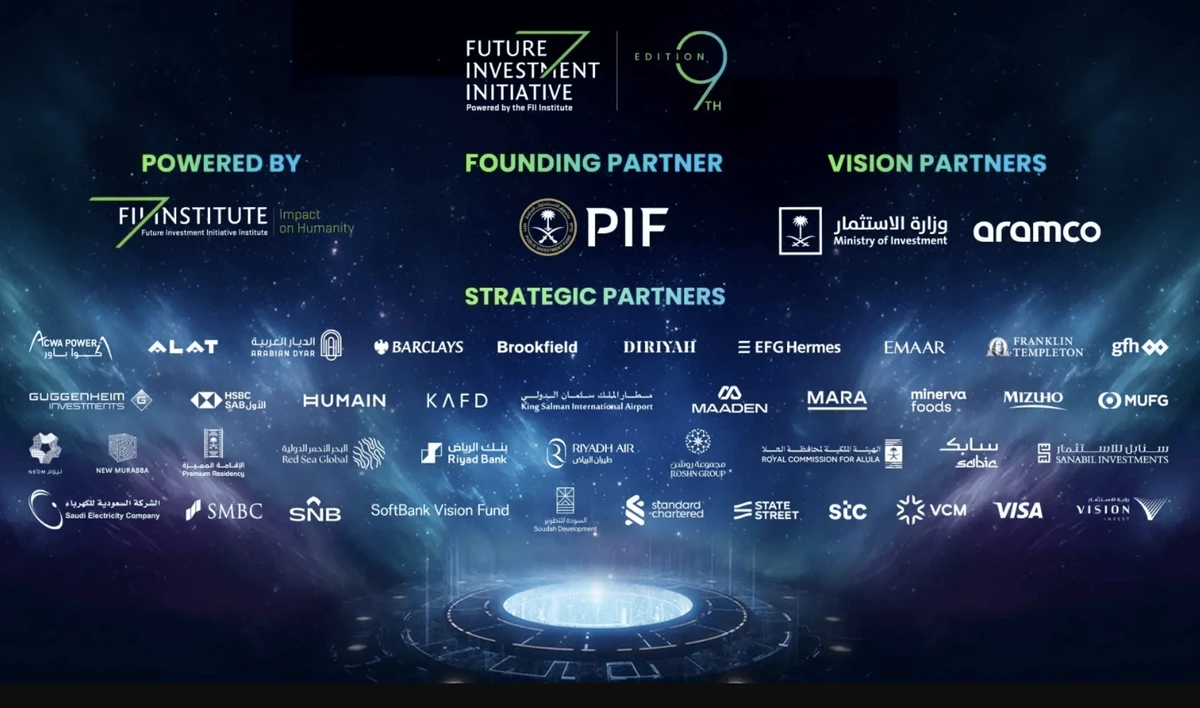
FII Institute recognized the continued support of its founding partner, the Public Investment Fund, and its Vision Partners, the Ministry of Investment and Saudi Aramco, whose leadership and collaboration remain vital to advancing the institute’s global mission, the SPA report said.
The institute welcomed this year a group of new strategic partners, including Arabian Dyar, Barclays, and Brookfield, as well as EFG Hermes, Guggenheim Investments, and HUMAIN.
MARA, Mizuho, and MUFG have also joined as partners, as have Saudi Electricity Company, SMBC Group, Soudah Development, and VCM.
FII Institute acting CEO and chairman of the executive committee Richard Attias said: “Our partners are at the heart of everything we do at FII Institute.
“Their commitment and collaboration enable us to translate vision into action, action into measurable impact, and to be sustainable.
“With over 60 partners this year, we are proud to convene a global coalition driving sustainable growth, responsible innovation, and inclusive prosperity.”
Partners already working with FII9 span investment, finance, and technology, as well as infrastructure, and energy.
These include ACWA Power, ALAT, and Diriyah, as well as Emaar, Franklin Templeton, and GFH.
Other partners include Neom, Red Sea Global, and Riyadh Air.
“Together, these partners strengthen the institute’s mission to advance impact-driven initiatives and foster collaboration across industries and borders, accelerating sustainable progress for humanity,” said the SPA report.
The FII Ventures Program welcomed a new partner, the Saudi National Technology Development Program, to support an expanding ecosystem that connects visionary entrepreneurs with global investors to accelerate innovation and drive scalable impact.

Saudi Arabia leads global tourism dialogue as Riyadh hosts UN assembly
Tourism sector a key driver of economic growth and social development, improving lives around the world — Saudi tourism minister
Updated 09 November 2025
Rashid Hassan
RIYADH: Saudi Arabia underscored its ambition to lead the global tourism transformation as it hosted the largest-ever UN Tourism General Assembly in Riyadh, marking 50 years of international collaboration in the sector.
The four-day event brought together representatives from more than 150 countries, including ministers, global tourism leaders, and industry experts, to discuss the future of travel, innovation, and sustainable development.
Speaking at the opening ceremony, Saudi Minister of Tourism Ahmed Al-Khateeb said the gathering comes at “an important juncture in the journey of international cooperation and joint action under the umbrella of UNWTO,” adding that it unites nations “to elevate the global tourism sector.”
He emphasized that the tourism industry has proven to be “a key driver of economic growth and social development,” improving lives worldwide. “As part of UNTGA26, we reaffirm our commitment to highlighting the vital role of this sector by strengthening collaboration with global tourism leaders to promote sustainability and prosperity in global tourism,” he said.
Al-Khateeb noted that this is the first time the assembly has been held in the Arabian Gulf, describing Riyadh as “the city that combines authenticity and modernity, rich history and a promising future.”
He said the session reflects shared global priorities and “highlights the vital role that the tourism sector plays in supporting the growth of the global economy and building bridges of cultural communication.”
The minister added that Riyadh is hosting the largest General Assembly session in the organization’s history, describing the turnout as a global affirmation of the growing importance of tourism and proof of what can be achieved by uniting efforts and goals.
Under the leadership of Crown Prince Mohammed bin Salman, Saudi Arabia has succeeded in transforming its tourism sector into a main pillar of the national transformation journey, achieving the objectives of Vision 2030, and serving as a key factor in showcasing the Kingdom’s authentic values, rich heritage, and national identity to the world.
Tourism is one of the pillars of modern development, integrating with several sectors — from the economy and culture to sports and art. The sector contributes more than $11 trillion to the global economy and provides more than one in ten jobs worldwide, said the minister.
The four-day event brought together representatives from more than 150 countries, including ministers, global tourism leaders, and industry experts. AN photo
He said developing human capital is essential to meeting the sector’s future workforce demand, estimated at 43 million new jobs over the next decade.
“We believe that innovation and technology are a driving force for developing the sector, and we are aware that we live in an era in which artificial intelligence has changed the landscape of global tourism,” he said, adding that Saudi Arabia is investing in AI and modern innovations “to enhance the human touch that distinguishes the tourism sector and the personal connection that visitors seek.”
At the social level, Al-Khateeb emphasized that the Kingdom is committed to strengthening the role of local communities and ensuring that inclusivity is firmly embedded in the heart of tourism by enhancing the participation of women as a key partner in tourism and economic development.
“We, in the Kingdom, work in integration with our partners in the public and private sectors to protect our diverse environmental, archaeological, and cultural treasures, and to use them to build a sustainable tourism sector that benefits future generations,” he added.
UN Tourism Secretary-General Zurab Pololikashvili highlighted the assembly’s role in setting the agenda for the future of tourism, with a focus on artificial intelligence and digital transformation driving sustainable and inclusive growth.
He praised the Kingdom for introducing the e-visa — the simple but powerful step that changed everything — and commended the Crown Prince for spearheading the reforms under Saudi Vision 2030.
“As we look around us here, we see those dreams becoming reality. Living proof of what we should be and determination can achieve. I will never forget the great things the Crown Prince invited us to be working with this year.”
He noted that collaboration with representatives from across the world is vital for sustainable and inclusive growth.
Pololikashvili said the country is “one of the most ambitious and powerful-looking nations,” investing in tourism at an unprecedented scale.
“The results speak for themselves — hosting the G20 summit, now this General Assembly, and you will see Expo 2030 and the FIFA World Cup in 2034,” Pololikashvili said.
The Kingdom's commitment to tourism has been constant, and this commitment has delivered remarkable success — 100 million tourists and most through this, he said.
Pololikashvili described establishing the UN Tourism Regional Office for the Middle East in Riyadh as one of the greatest honors of his career.
In a video message, UN Secretary-General Antonio Guterres said: “It's a milestone as the General Assembly marks 50 years of UN Tourism. Tourism is a powerful force for good. It brings people together, builds bridges between cultures and opens vessels to understanding and even peace.”
Guterres noted that global tourism arrivals are at an all-time high, with new destinations emerging across the Middle East and Africa, adding that growth must be “inclusive and sustainable,” benefiting local communities and safeguarding cultural and environmental assets.