
Saudi banks expected to enter the Syrian market soon, Damascus’ finance minister reveals

Saudi banks expected to enter the Syrian market soon, Damascus’ finance minister reveals
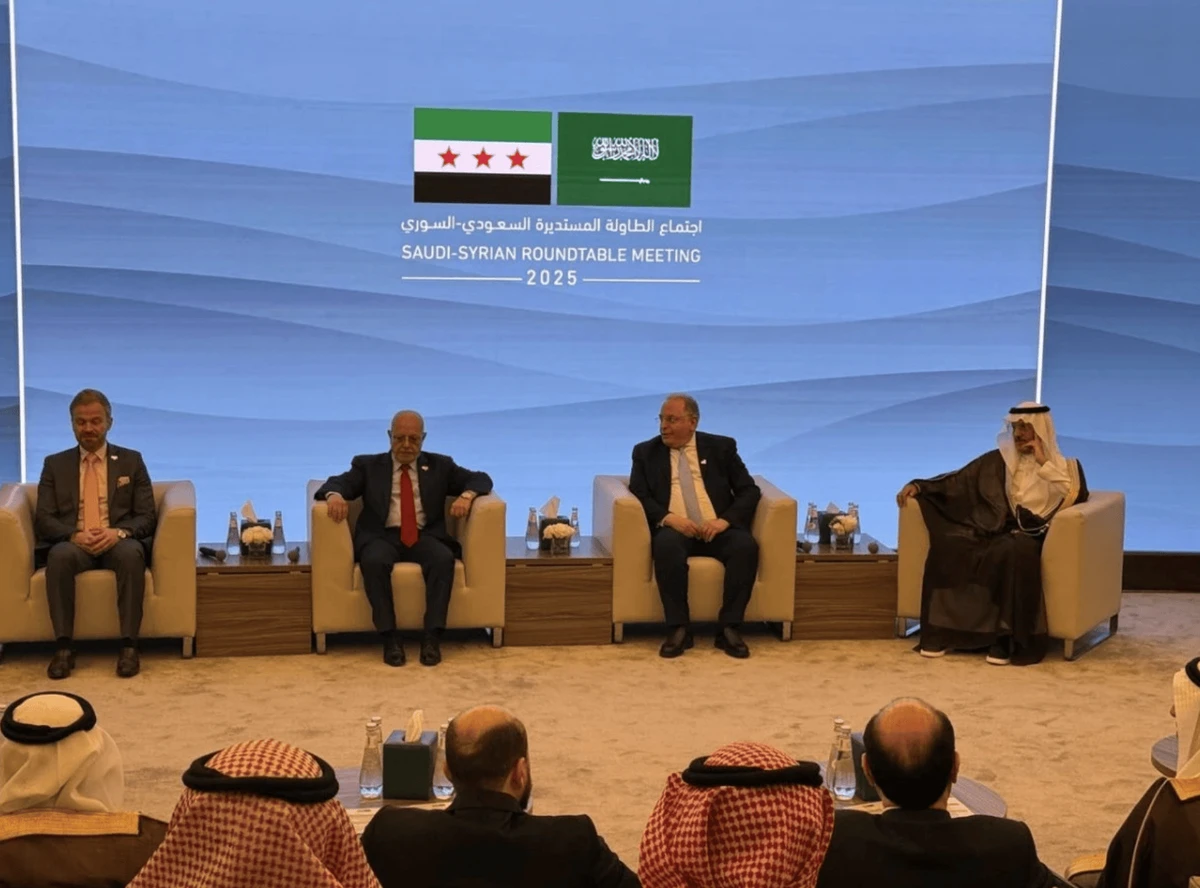
The roundtable discussed new investment opportunities in priority sectors according to Syria’s current economic needs. Al-Eqtisadiah
Short Url
Updated 28 October 2025
Follow

Saudi banks expected to enter the Syrian market soon, Damascus’ finance minister reveals

Saudi banks expected to enter the Syrian market soon, Damascus’ finance minister reveals

RIYADH: Saudi Arabia is moving toward launching a number of investment funds in multiple sectors within Syria, most notably the Elaf Fund, with an initial capital amounting to billions of riyals to finance strategic projects, according to Minister of Investment Khalid Al-Falih during a roundtable meeting held in Riyadh.   

Through the Saudi-Syrian investment roundtable, the two sides aim to achieve sustainability in their joint cooperation, strengthen investment and economic relations between the two countries, and work on implementing strategic and high-impact investment projects. 

In a related development, additional Saudi banks are expected to begin operations in Syria after two Saudi banks have already started their activities, according to Syrian Minister of Finance Mohammed Barnieh, speaking to Al-Eqtisadiah newspaper. 

Speaking on the sidelines of the Saudi-Syrian roundtable meeting in Riyadh, Barnieh said that the move comes within the framework of deepening financial and banking cooperation between the two countries. He expected the coming phase to witness an expansion in the activities of Saudi institutions within the Syrian market. 

The finance minister said that launching direct financial channels for money transfers between Saudi Arabia and Syria comes after some banks have already begun implementing direct transfer operations, a step expected to ease investors’ concerns regarding financial transactions. 

The roundtable, attended by senior officials and investors from both countries, comes as part of Saudi Arabia’s continued efforts to support the recovery of the Syrian economy and to move cooperation from the stage of “memorandums of understanding” to that of “empowerment and actual implementation.” 

Barnieh said this step serves as a message of reassurance to investors seeking entry into the Syrian market, noting that it supports efforts to develop the financial infrastructure and facilitate banking and commercial transactions. 

The minister said that the Central Bank of Syria is working to develop the financial infrastructure and to enhance integrity and transparency in order to create a safe and encouraging environment for the banking sector. 

He explained that these reforms will soon allow foreign financial institutions, particularly Saudi banks, to open branches in Syria, supporting financing and investment activities in the country. 

The roundtable discussed new investment opportunities in priority sectors according to Syria’s current economic needs, in alignment with the economic interests of both countries. 

Regarding international cooperation, Barnieh stated that Syria is currently receiving technical support from the International Monetary Fund and the World Bank, noting the presence of missions operating in Damascus to discuss mechanisms for economic revitalization and administrative reform. 

He added that this international and regional openness came as a result of Saudi and Arab efforts supporting Syria in global financial forums, which helped reactivate channels of cooperation with international institutions. 

Saudi Arabia has presented numerous initiatives to support Syria’s economic recovery, including assistance for public salaries, contributions toward settling Syria’s arrears with the World Bank Group—amounting to about $15 million—and support for the Syrian energy sector, totaling 1.65 million barrels of crude oil. 

The minister denied any current borrowing, saying it is not planned for Damascus to borrow from international institutions at present. However, he noted that the government remains open to concessional development loans that finance specific strategic projects. 

He added that Syria welcomes initiatives from the Kingdom, such as the proposal by the Saudi Fund for Development to provide soft loans to support development projects in Syria, as such efforts directly contribute to stimulating economic growth and creating job opportunities. 

Barnieh confirmed that Syrian-Saudi relations are entering a new phase of cooperation and strategic partnership across various sectors, noting that the Kingdom is providing tangible support for Syria’s reconstruction and development efforts. 

He said that Saudi interest in Syria is clear and growing, adding that several Saudi investments are currently in their final stages of preparation. 


The Syrian minister added that Syria is now in a stage of comprehensive reconstruction characterized by vast investment opportunities, particularly in the financial and banking sectors. 


He affirmed that his country welcomes the presence of Saudi companies operating in finance and services and encourages Syrian investors to expand their presence in the Saudi market, noting that cooperation between the two countries has moved beyond the political framework into a growing economic and investment partnership. 


Returning to Minister Al-Falih, he said that preparations are underway to launch the Saudi Elaf Investment Fund, which is completing the regulatory requirements for its establishment in partnership with Saudi private-sector companies and regional and international investors who have expressed willingness to participate. 


He stated that the fund will focus on projects in infrastructure, energy, real estate development, manufacturing, and logistics services, noting that this initiative is part of Saudi Arabia’s efforts to activate development financing tools and support sustainable growth in Syria. 


Al-Falih said the fund will contribute to transferring Saudi expertise to the Syrian market and strengthening partnerships between Saudi and Syrian companies, creating new job opportunities and boosting local production. 


The minister added that economic cooperation between the two countries also extends to land and railway connectivity projects, noting that the transport ministries of both sides are currently discussing reactivating the land route through Jordan to link Syria with the Arabian Gulf through an integrated logistics network. 


In the industrial sector, Al-Falih revealed discussions on establishing a Saudi industrial zone in Syria to attract small and medium-sized industries and localize supply chains.  


He also mentioned cooperation in exploring and investing in phosphate ore in eastern Syria, leveraging Saudi Arabia’s experience in the phosphate fertilizer industry to create significant opportunities for export and industrial growth. 


In the technology and digital transformation sector, he announced cooperation on projects related to smart cities and digital government, as well as developing regional internet infrastructure linking Syria, Jordan, and Saudi Arabia through networks extending to Europe and Asia. 


Teaching machines to speak Arabic

Teaching machines to speak Arabic
Updated 06 November 2025
Follow

Teaching machines to speak Arabic

Teaching machines to speak Arabic
  • Innovation is helping AI understand the region’s language, culture, and voice

JEDDAH: As developers across the Arab world work to formalize Arabic for artificial intelligence — grappling with its many dialects, limited datasets, and deep cultural nuance — English-based AI systems have continued to surge ahead. Now, industry experts say it’s time for Arabic users to gain the same technological momentum.

The performance gap between Arabic and English natural language processing is most visible in speech recognition, where pronunciation, rhythm, and vocabulary differ sharply across dialects. These variations make it challenging for one model to understand spoken Arabic with consistent accuracy.

Despite these hurdles, progress is accelerating. With rising investment and government-backed initiatives led by Saudi Arabia and other regional powers, Arabic AI is steadily closing in on English in sophistication and accessibility.

As Arabic AI evolves, experts emphasize the importance of cultural nuance and dialect diversity in future language models. (aramcoworld.com)

Amsal Kapetanovic, head of KSA at Infobip, told Arab News: “While written NLP tasks like basic chatbots can be managed with additional work, speech recognition really exposes the limitations of current models. It requires even more fine-tuning and adaptation to handle the diversity of spoken Arabic effectively. This is where the gap between Arabic and English NLP is most pronounced.”

Infobip’s recent collaborations with telecom and private sector partners across the Gulf reveal a similar pattern: Arabic chatbots and virtual assistants often require greater oversight in their early stages than English systems. However, once they are retrained using region-specific conversational data and Gulf dialects, both accuracy and customer satisfaction rise sharply.

Arabic remains one of AI’s greatest linguistic challenges. Unlike English, it is not a single unified language but a family of dialects stretching from Asia to Africa. Its complex morphology — with prefixes, suffixes, gender and number agreement, and the absence of short-vowel diacritics — poses major obstacles for tokenization and model training.

Opinion

This section contains relevant reference points, placed in (Opinion field)

Kapetanovic referenced a 2025 study published in JMIR Medical Informatics (“InfectA-Chat: An Arabic Large Language Model for Infectious Diseases”), which tested instruction-tuned models like GPT-4 in both English and Arabic. The research found that Arabic models still trail English by 10–20 percent in complex tasks.

“Arabic models still lag slightly behind English ones, particularly in areas like accuracy and sentiment analysis,” he said. “This is primarily due to the smaller size of Arabic training datasets and the complexity of Arabic dialects.”

He added: “Arabic itself is a family of languages and dialects — much richer and more complex than many others. This diversity adds another layer of challenge.”

Amsal Kapetanović, head of KSA unit at Infobip. (Supplied)

Yet optimism remains strong. “The good news is that there is significant investment happening, especially in the MENA region, with countries like Saudi Arabia leading the way,” Kapetanovic said. “Initiatives like Vision 2030 are accelerating progress, and we’re seeing more focus on localizing AI for Arabic speakers.”

Speech recognition continues to represent the most visible gap. “A Lebanese speaker and a Saudi speaker might use different words and speak at different speeds, making it challenging for a single model to recognize and process spoken Arabic accurately,” he said.

Localization, Kapetanovic explained, extends far beyond translation. “At Infobip, we are defining the evolution of communications in co-creation with our customers and partners throughout the region. Gartner has recognized us as a Leader in their 2025 Magic Quadrant for CPaaS. We are committed to delivering the next generation of AI-powered customer conversations to unlock seamless, high-impact engagement for MENA businesses. That’s why we put a strong emphasis on localizing our AI-driven platforms and tools to serve Arabic-speaking users effectively.”

Technical, cultural, and ethical challenges shape the future of Arabic AI, as developers strive for inclusion and linguistic parity. (aramcoworld.com)

Real-world applications are already bearing fruit. “For example, Nissan Saudi Arabia rolled out a WhatsApp chatbot (‘Kaito’) that handles customer queries in both Arabic and English,” he said. “These bots leverage Infobip’s Answers platform, which includes built-in NLP capabilities for Arabic — such as right-to-left text support and Arabic stop-word recognition — to interpret queries and intent.”

“For Saudi Arabia and the Gulf, we’ve gone beyond simple translation by implementing features and partnerships tailored to the region,” he continued.
“We’ve partnered with Lucidia, a leading Saudi tech company, to co-develop solutions that address local business needs and integrate with popular regional channels like WhatsApp and X.”
“We’ve also built language models that recognize Gulf-specific dialects and cultural expressions, making our chatbots and automation tools more intuitive for users. Additionally, our platform supports local payment integrations and business workflows unique to the region. These initiatives reflect our commitment to delivering genuinely localized technology, not just Arabic language support.”

DID YOU KNOW?

• Saudi Arabia is leading investment in Arabic AI, with Vision 2030 initiatives.

• AI can become biased and exclusionary if it does not speak or understand Arabic well.

• Infobip’s Arabic chatbots now ‘think’ in Gulf dialects, improving accuracy.

Cultural understanding, he added, is key to truly human-like AI. “Culturally aware AI should ideally be AI that understands the why behind the what,” he said. “It’s about deep research and understanding the background — not just giving straight answers to straight questions.”

“At Infobip, we integrate with multiple large language models and do so in an agnostic way,” he said. “We combine them and see which ones serve which purpose, giving us the flexibility to avoid pitfalls like AI hallucination or unwanted replies.”

The ethics of language and inclusion

Kapetanovic cautioned that neglecting Arabic in AI development poses not only technical risks but ethical ones.

“The ethical risk is that AI can become biased and exclusionary if it doesn’t speak or understand Arabic well,” he said. “If AI systems don’t handle certain languages or dialects properly, or if they lack enough regional data, they can exclude parts of the narrative or reinforce bias.”

“It’s essential for everyone in the AI ecosystem to contribute to making AI as inclusive and democratized as possible. Otherwise, we risk reinforcing disparities in services, information, and opportunities.”