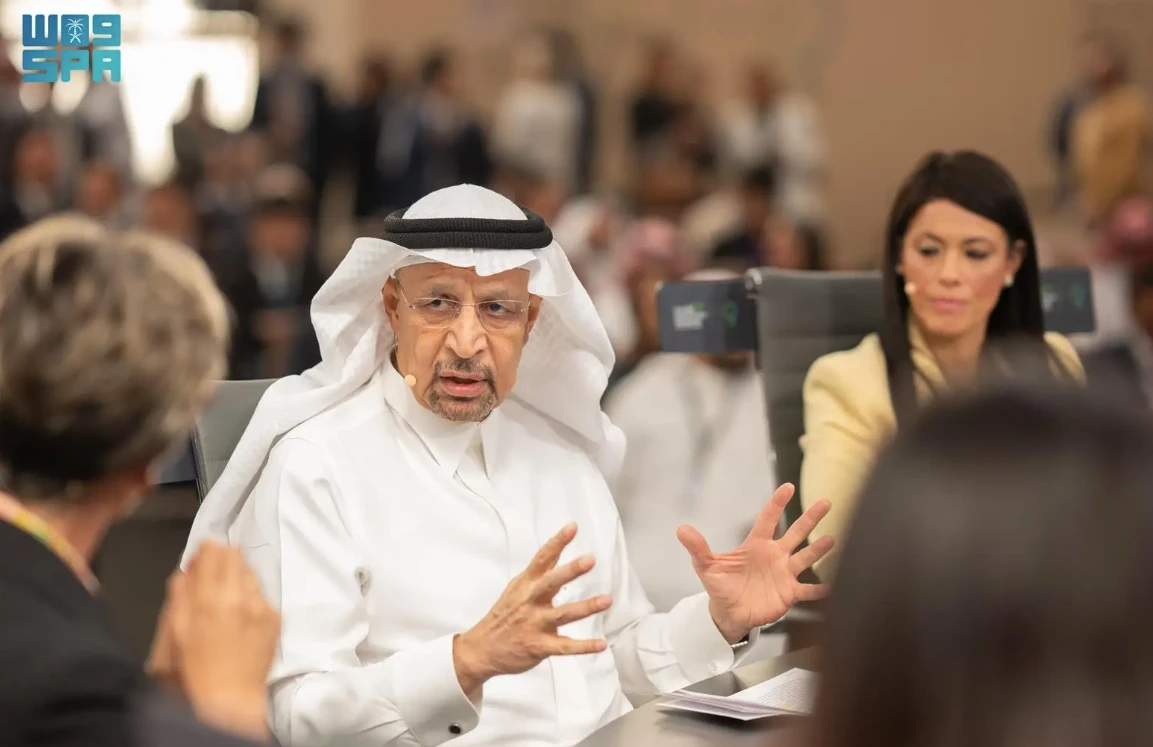
Saudi FDI quadruples, surpassing 2030 targets, says minister at FII9

Saudi FDI quadruples, surpassing 2030 targets, says minister at FII9
Saudi Investment Minister Khalid Al-Falih. SPA
Short Url
Updated 28 October 2025
Follow

Saudi FDI quadruples, surpassing 2030 targets, says minister at FII9

Saudi FDI quadruples, surpassing 2030 targets, says minister at FII9

RIYADH: Saudi Arabia’s foreign direct investment has quadrupled, surpassing its Vision 2030 targets as the Kingdom’s economy continues to diversify away from oil, Investment Minister Khalid Al-Falih said. 

Speaking at the ninth edition of the Future Investment Initiative in Riyadh, Al-Falih said the surge in investment reflects the success of Vision 2030, describing the Kingdom’s transformation plan as “a reality, not a dream,” according to the Saudi Press Agency. 

This comes as foreign direct investment in the Kingdom grew by 24 percent to $31.7 billion in 2024, establishing it as a major global destination, supported by its megaprojects and preparations to host Expo 2030 and the 2034 FIFA World Cup. 

“He pointed out that the non-oil economy has risen to (5 percent), indicating that the past two years have witnessed more new and promising investment opportunities in the Kingdom, including artificial intelligence and acceleration of digital transformation, pointing out that major national projects are continuing their work and some are preparing to open their doors,” the SPA report stated. 

The minister outlined a fundamental shift in the nation’s economic structure, revealing that 40 percent of the state’s budget and expenditures are now financed by non-oil revenues. He further emphasized that a staggering 90 percent of all FDI flowing into the Kingdom is directed toward non-oil sectors.  

Al-Falih emphasized that the Kingdom’s economy “is no longer oil-based,” highlighting rapid progress in advanced manufacturing, technology, tourism, entrepreneurship, deep tech, and venture capital.  

He also highlighted the Kingdom’s ability to navigate a series of global obstacles, including the COVID-19 pandemic, oil price fluctuations, and regional tensions. He credited this resilience to the nation’s substantial financial reserves and overall stability, which he described as a key strength.

The minister also noted that major giga-projects are continuing their work, with some preparing to open their doors. Al-Falih reaffirmed Saudi Arabia’s strong belief in powerful partnerships between the government and the private sector, as well as with foreign investors. 

According to Argaam, the minister stated that with many large-scale projects, like the Red Sea Project, now at an advanced stage, the Kingdom should scale back government and Public Investment Fund spending and allow the private sector to lead future investment. 

“These assets should now be transferred to the market to observe how they perform under private sector management,” Argaam reported Al-Falih as saying.  

Al-Falih emphasized that the Kingdom is committed to reducing barriers to doing business, signaling a continued open-door policy for international capital. 

Echoing this sentiment, other participants agreed that such collaborations are essential for achieving goals in a shorter timeframe. They stressed that sectors related to energy remain particularly promising and ripe with innovation capable of building a better future for humanity. 

‘A Paperless Event’ – the slogan of Saudi technology at the UN General Assembly for Tourism

‘A Paperless Event’ – the slogan of Saudi technology at the UN General Assembly for Tourism
Updated 07 November 2025
Follow

‘A Paperless Event’ – the slogan of Saudi technology at the UN General Assembly for Tourism

‘A Paperless Event’ – the slogan of Saudi technology at the UN General Assembly for Tourism

RIYADH: Papers are absent, and Saudi technology is present to say “a paperless event” at the UN General Assembly meetings for the tourism sector, which will be held in Riyadh, with the participation of more than 100 ministers from around the world, Al-Eqtisadiah reports.

The assembly meetings are set amidst natural green plants cultivated in the Saudi desert, surrounding the roundtable that will bring the ministers together. They will chart their plan and vision for the next 50 years, discuss the use of artificial intelligence in the global tourism sector, and ensure the human element is not marginalized.

Sara Al-Saud, the general supervisor of International Affairs for the Saudi Ministry of Tourism, said that “there is a shortage of an estimated 43 million workers in the global tourism sector.”

She clarified that the topic of AI will be one of the subjects discussed by the over 100 ministers, in addition to shaping the Assembly’s vision for the next 50 years.

She added that the Assembly meetings are expected to witness the signing of memorandums of understanding and agreements during the event, alongside a number of recommendations that will be announced in due course.

For his part, Ahmed Al-Ghamdi, the director-general of International Research and Planning, emphasized that the human element is very important in the tourism sector, and that artificial intelligence significantly helps small and medium enterprises improve their service quality and customer experience.

The Executive Director of UN Tourism, Natalia Bayona, explained that the global tourism sector is the largest employer of youth, with 60 percent of them working with AI. She added that many tourists worldwide use AI to explore tourist destinations.

Consequently, a survey was conducted with member states to ascertain if they have local AI strategies and to identify what support could be offered to develop the mechanism, especially since the tourism sector relies heavily on small and medium enterprises.

Globally, the tourism sector contributed 10 percent to the global gross domestic product in 2024, equivalent to $10.9 trillion, recording a growth rate of 8.5 percent compared to 2023, thereby surpassing pre-COVID-19 pandemic levels.

On the local front for the Saudi tourism sector, unprecedented levels were recorded in terms of visitor numbers, spending volume, job creation, and contribution to the GDP.

The direct and indirect contribution of the tourism sector to the GDP reached 11.5 percent in 2023. The International Monetary Fund predicts that the Saudi tourism sector will achieve a growth rate of 16 percent by 2034.