Finance ministers discuss international partnerships, investments, and tech security during FII9

Finance ministers discuss international partnerships, investments, and tech security during FII9
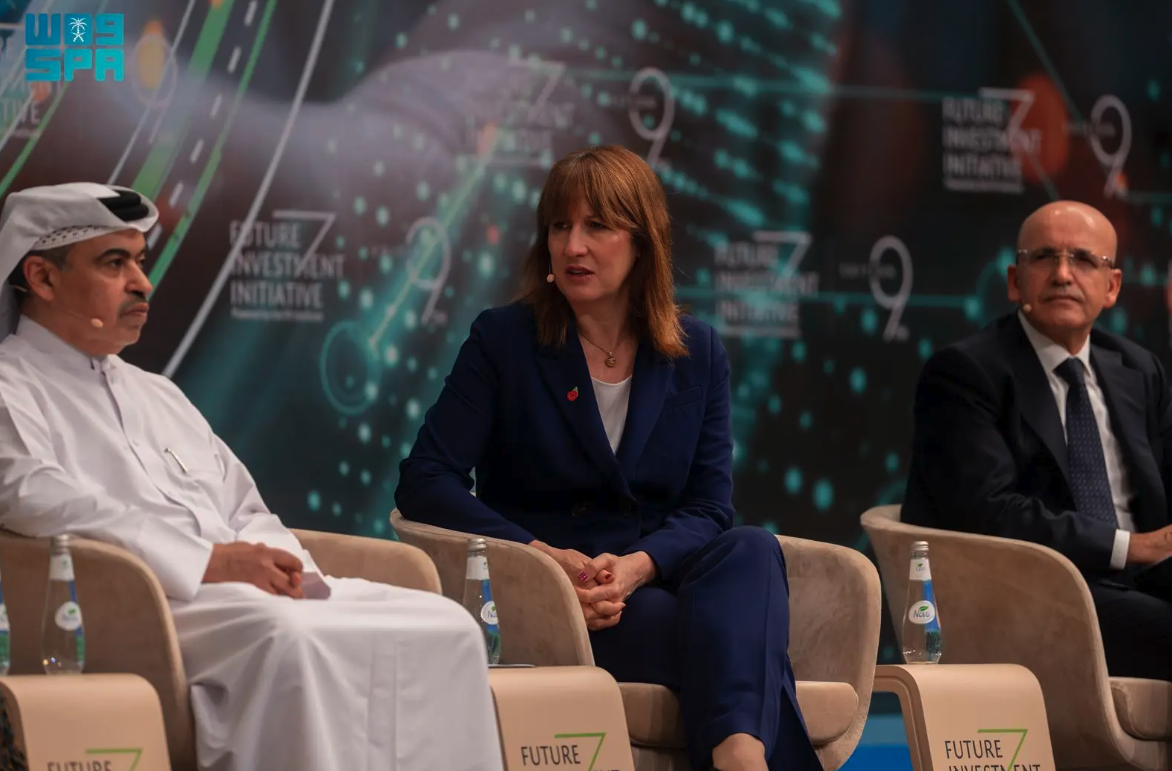
UK Chancellor Rachel Reeves. SPA
Short Url
Updated 28 October 2025
Follow

Finance ministers discuss international partnerships, investments, and tech security during FII9

Finance ministers discuss international partnerships, investments, and tech security during FII9

RIYADH: Participants in the “Sovereignty vs. Globalization” session during the ninth edition of the Future Investment Initiative conference stressed that the world needs to diversify supply chains, achieve greater energy self-sufficiency, invest in data centers, technology and artificial intelligence, and conclude more joint trade between allied and neighbor countries.

The dialogue session was attended by Qatari Minister of Finance Ali bin Ahmed Al-Kuwari, UK Chancellor Rachel Reeves, and Turkish Minister of Finance Mehmet Simsek, the Saudi Press Agency reported.

They discussed the importance of globalization, trade, artificial intelligence, and cooperation between countries, signing technical agreements and direct partnerships to find solutions to economic crises, while highlighting the importance of working to strengthen the work of multilateral organizations, especially with the work over the years to build a rules-based system based on participation and joint cooperation.

UK Chancellor of the Exchequer Reeves said: “One of the UK government’s priorities is to develop the economy. To achieve this, a solid foundation of stability is required, as is building relationships with important allies.”

She reviewed the UK’s trade deals with a number of countries and the trade agreements that confirm the country’s ability to compete.

For his part, the Qatari finance minister affirmed that his country is open to foreign direct investment, citing the 2022 World Cup, which has given great impetus to building infrastructure and identity.

Al-Kuwari added that he looked forward to benefiting from this while continuing to work to attract international investment, especially since Qatar is one of the world’s major producers of liquefied natural gas.

He noted the importance of cooperation with the entire world to build partnerships and direct investments, such as economic cooperation and trade agreements.

The minister further explained that AI and technology are part of the strategies in his country’s plan to diversify the economy, and that investing in AI and energy is important and logical, noting that Qatar possesses distinct national capabilities in data, innovation, and aviation.

In turn, the Turkish Treasury Minister highlighted the importance of countries investing in international and regional integration, given its benefits in strengthening risk-bearing areas such as energy and ensuring production security.

Simsek emphasized the importance of technology, health, and security as well as AI, data, and cybersecurity, which require more investment, noting the importance of working to reduce risks before they occur.
Saudi Arabia’s non-oil sector posts strong growth as PMI hits 60.2 

Saudi Arabia’s non-oil sector posts strong growth as PMI hits 60.2 
Updated 8 sec ago
Follow

Saudi Arabia’s non-oil sector posts strong growth as PMI hits 60.2 

Saudi Arabia’s non-oil sector posts strong growth as PMI hits 60.2 

RIYADH: Saudi Arabia’s non-oil economy accelerated in October, with the Purchasing Managers’ Index climbing to 60.2, its second-highest level in more than a decade, signaling strong business growth momentum. 

The latest survey by Riyad Bank and S&P Global showed a sharp improvement in operating conditions across the Kingdom’s private sector, underpinned by solid demand, rising employment, and robust output growth.  

The October reading, up from 57.8 in September, highlights the sustained momentum of the non-oil economy as Vision 2030 reforms continue to drive diversification away from crude revenues. 

Speaking at the Future Investment Initiative in October, Saudi Arabia’s Minister of Economy and Planning Faisal Alibrahim said the Kingdom’s gross domestic product is expected to expand by 5.1 percent in 2025, supported by continued growth in non-oil activities. 

Commenting on the latest report, Naif Al-Ghaith, chief economist at Riyad Bank, said: “Saudi Arabia’s non-oil private sector recorded a solid improvement in business conditions in October, with the PMI rising to 60.2, marking one of the strongest readings in over a decade.”  

He added: “The acceleration was driven by broad-based gains in output, new orders, and employment, reflecting sustained demand momentum and continued strength in the non-oil economy.”  

Al-Ghaith noted that the latest survey results also indicate a strong start to the final quarter of the year, supported by both domestic and external demand. 

According to the report, the pace of growth in new orders received by non-oil companies accelerated for the third consecutive month in October, with 48 percent of surveyed firms reporting higher sales. 

Participating companies attributed the sales growth to improving economic conditions, a growing client base, and increased foreign investment. 

Output and employment also expanded sharply during the month, with job creation rising at the fastest pace in nearly 16 years.

Al-Ghaith said the persistent rise in new export orders highlights the growing competitiveness of Saudi firms and the progress achieved under ongoing diversification initiatives. 

“The rise in demand encouraged firms to expand production and workforce capacity at the fastest rate since 2009, as businesses expanded capacity to meet new workloads. Purchasing activity and inventories also increased, while suppliers’ delivery times continued to improve, reflecting efficient coordination and resilient supply chains,” he added.  

October data indicated a sharp rise in input costs for non-oil firms, driven mainly by wage increases from salary revisions and bonuses. 

On the outlook, companies remained optimistic, citing strong market demand, ongoing project work, and government investment initiatives. 

“Optimism is underpinned by solid domestic demand and the momentum of ongoing projects. Although some concerns persist around costs and competition, sentiment overall remains strongly positive, reflecting confidence in the economy’s continued expansion and the strength of the non-oil private sector,” concluded Al-Ghaith.