- US-mediated talks seek to revive Israel-Syria security negotiations and prevent Israeli-Turkish rivalry from escalating inside Syria
- Damascus is caught between competing powers as Netanyahu faces pressure to contain tensions ahead of Israel’s elections
LONDON: Israeli attacks on post-Assad Syria are nothing new. But when Israeli jets bombed a Syrian airbase last week, even Washington sat up and took notice — and issued a strongly worded, and very public, reprimand.
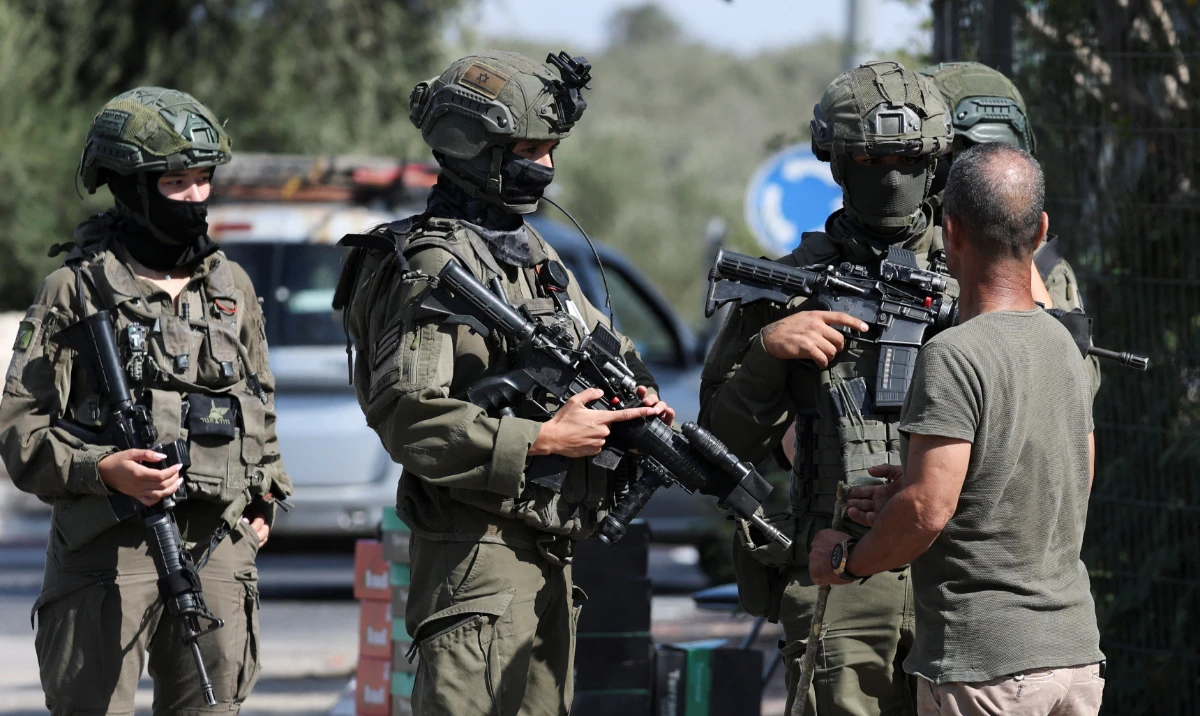
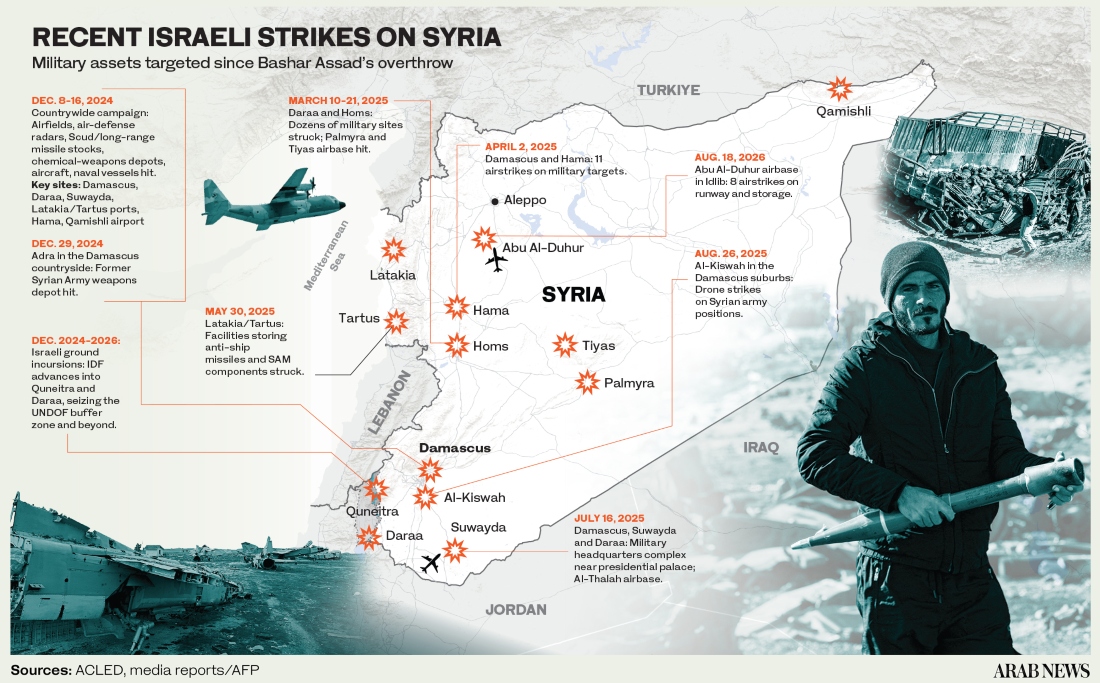
Despite repeated reassurances from Damascus that Syria poses no threat to Israel, the Israel Defense Forces have struck multiple Syrian military targets since the overthrow of President Bashar Assad in December 2024, ostensibly to prevent them falling into the hands of “terrorists.”
Then, on Aug. 18, Israeli jets attacked Abu Al-Duhur airbase near Idlib in northwest Syria. For Washington, this was a raid too far. Within hours, Tom Barrack, the US ambassador to Turkiye and special presidential envoy for Syria and Iraq, responded on social media.
“We are deeply concerned that the Israeli airstrikes on Abu Al-Duhur airbase constitute an unnecessary escalation that does not advance regional stability,” he posted on X.
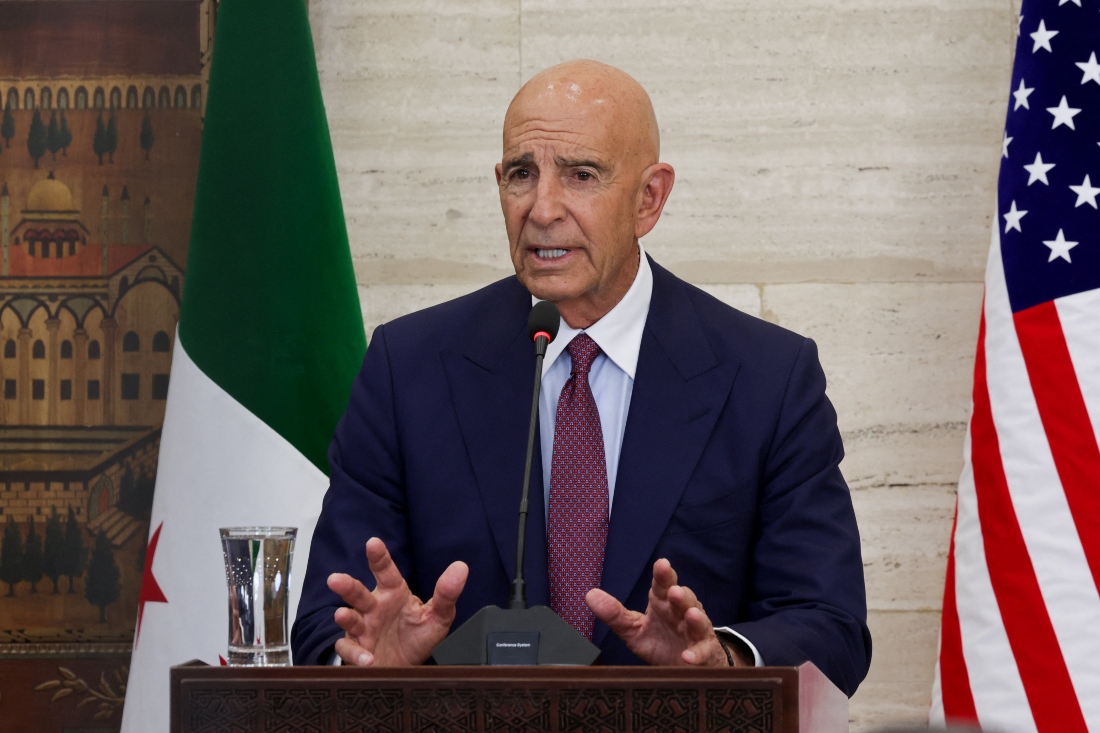
The interim Syrian government of President Ahmad Al-Sharaa, he said, “has neither adopted a predatory posture nor maintained proxy forces.” On the contrary, it had “repeatedly indicated a preference for de-escalation with Israel.”
The US, he added, “continues to believe that restraint and engagement offer the more constructive course. We encourage all parties to prioritize logical discourse over further military incidents.”
The message appears to have been heard loud and clear in Israel, where Prime Minister Benjamin Netanyahu is walking an increasingly narrow tightrope between appeasing a hawkish electorate ahead of elections and remaining on the right side of US President Donald Trump.
On Sunday, at Washington’s insistence, high-level talks were held between Syria and Israel in Jordan.
In a sense, the meeting was a return to talks that had been underway for months and were said to have been progressing well before they were terminated abruptly following the joint US-Israel attack on Iran in February.
Washington has been trying to broker a security agreement between Israel and Syria since it gave its blessing to the new post-Assad government in 2025, lifting US sanctions on the country and leading to Trump welcoming Al-Sharaa to the White House.
“The Trump administration has pushed Israel to engage with Syria and vice versa, seeking calm on that front,” Aron Lund, a Middle East analyst at the Swedish Defence Research Agency, told Arab News.
“The US does not agree with Israel’s hostile attitude to the new leadership in Damascus and there appears to have been a renewed US push for de-escalation since the US is worried about the prospect for Israel-Turkiye conflict.”
Direct Israel-Turkiye clashes, he said, “would be extremely awkward for the US, which is allied to both countries,” and “could also be destabilizing for the US-backed Al-Sharaa government in Damascus.”
Israel’s motive for attacking Abu Al-Duhur airbase was that it believed Turkiye was planning to establish a base there.
“Israel and Syria agreed to a status quo in security matters, which Syria was on the verge of breaching by permitting Turkish troops to deploy at an airbase near Aleppo,” Netanyahu’s office said in a statement following the airstrikes.
Damascus insisted the airbase, badly damaged and out of action for years, was being repaired for use by Syrian forces.
On Friday, Barrack said that by attacking the base, Israel was “baiting the Turks.
“Having jets deployed on the border without notification, without some agreement, is a very dangerous game,” Barrack told “The Mario Nawfal Show.”
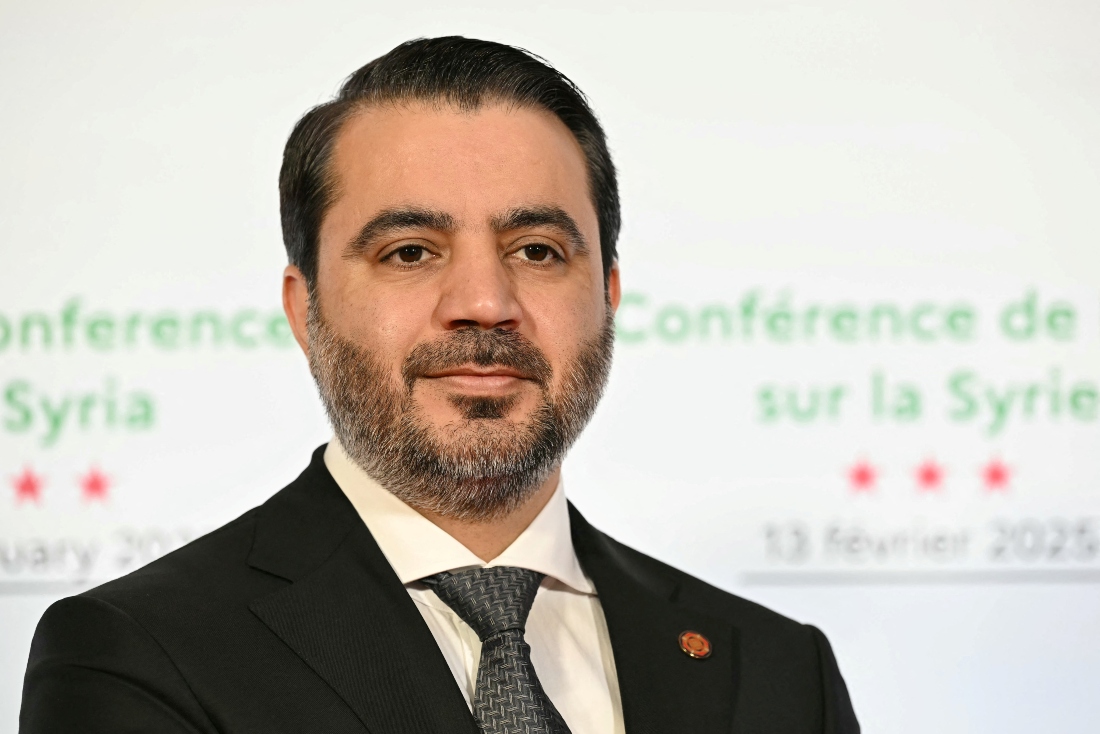
The day after the attack, Syrian Foreign Minister Asaad Al-Shaibani said a Turkish military deputation had visited the base as part of “ongoing military cooperation in the areas of training and the exchange of expertise.”
There was, he added, “no intention to establish a Turkish base there, nor to establish a permanent Turkish military presence or deploy Turkish forces at the site.”
Furthermore, Syria had notified Israel of the arrangement, but Israel had delivered what it called its “warning shot” anyway.
That same day, Reuters reported that Al-Shaibani and Roman Gofman, the director of Israel’s Mossad spy agency, had spoken four days before the Israeli attack to discuss Turkiye’s military role in Syria.
During the call, Al-Shaibani had sought to reassure Gofman that Abu Al-Duhur would not become a Turkish base.
No one was hurt in the bombing raid. But had Turkish personnel been killed, the already strained relations between Turkiye and Israel might have been pushed over the edge.
In Jordan on Sunday, Al-Shaibani and Gofman found themselves talking again, this time at the direct urging of Washington.
Within Israel, there is now growing concern that Netanyahu, for whom perpetual military action has kept domestic questions about his suitability for office at bay for years, is provoking both Syria and Turkiye for his own personal political advantage.
“Israel experts all seem to agree that Netanyahu sees political benefits in escalation right now,” said Lund. “That’s certainly what a lot of Israelis appear to think. He might find a manageable level of tension with the US to be a useful thing in the run-up to the elections.”
Charles Lister, director of the Syria Program at the Middle East Institute, said on X that Netanyahu’s own just-departed national security adviser, Tzachi Hanegbi, had written a piece for Ynet in January urging an intensification of talks with Syria to conclude a security deal.
“The Iran war then got in the way,” said Lister. “But make no mistake, Israel’s upcoming election is what’s driving today’s war talk.”
On Sunday, Israeli newspaper Haaretz pulled no punches. Since the fall of Assad, it said, “Syria has made numerous overtures to Israel, only to find a government inept at negotiation and reliant solely on military might.”
The Israeli strike on Abu Al-Duhur, it added, “has raised concerns about a potential Israeli-Turkish conflict becoming the next major escalation in the Middle East.”
In addition to multiple attacks on military targets, Israel’s provocations in Syria since the fall of Assad have extended to grabbing land in Syria east of the Golan Heights.
The territory has been held illegally by Israel since the 1967 Six-Day War. In December 2024, Israeli troops moved into the demilitarized zone adjacent to the Golan Heights that was created by the UN after the 1973 Arab-Israeli war.
The UN has condemned Israel’s incursion into the buffer zone as a violation of the 1974 Disengagement Agreement. But although the UN Disengagement Observer Force personnel remain at their posts, they lack a mandate and the numbers to try to evict the Israelis by force.
In an interview with Reuters on Saturday, days after the Israeli bombing of the Abu Al-Duhur airbase, Syrian Foreign Minister Al-Shaibani said Syria was “extending its hand for understanding, for peace, for diplomacy” with Israel.
He even suggested that while the immediate priority in talks was to “stop Israeli aggression even before reaching a security agreement … perhaps we can open the topics of peace and the Golan.”
But Israel, Lund believes, “won’t ever voluntarily give up on the Golan Heights, which it has declared to be sovereign Israeli territory.
“The UN and most of the world thinks that’s an illegal move, on a par with Russia’s annexation of occupied Ukrainian land, but Israel does not care.
“Since 2020, the US supports Israel’s claim, and the American support makes it even less likely that Israel would ever leave the Golan Heights, unless forced to do so at gunpoint.”
As for the areas seized since 2024, “their status is less clear and it’s not obvious the US will support Israeli claims to them.
“But in practice, the Israelis are likely to stay in the newly captured parts of Syria as long as no one can kick them out. They’re not going to give up something for nothing.”
Last month, UN Deputy Special Envoy for Syria Claudio Cordone told the Security Council that Israel’s military activities were a threat to Syria’s delicate political transformation.
Syria, Cordone said, had reached “an important institutional milestone with the establishment of a People’s Assembly and Constitutional Supreme Court,” while Al-Sharaa “had engaged closely with the international community and undertaken significant reforms, promising accountability for (Assad-era) atrocities.”
In the ensuing debate, several countries, including Bahrain, the UK and Pakistan, called on Israel to withdraw from Syrian territory.
“After years of devastating conflict, the Syrian people now have an opportunity to turn the page,” said Syed Tariq Fatemi, special assistant to the prime minister of Pakistan.
Fatemi condemned Israel’s occupation of Syrian territory and violations of sovereignty, adding: “It is important that Syria is not drawn into a wider regional turmoil that could undermine its stability.”