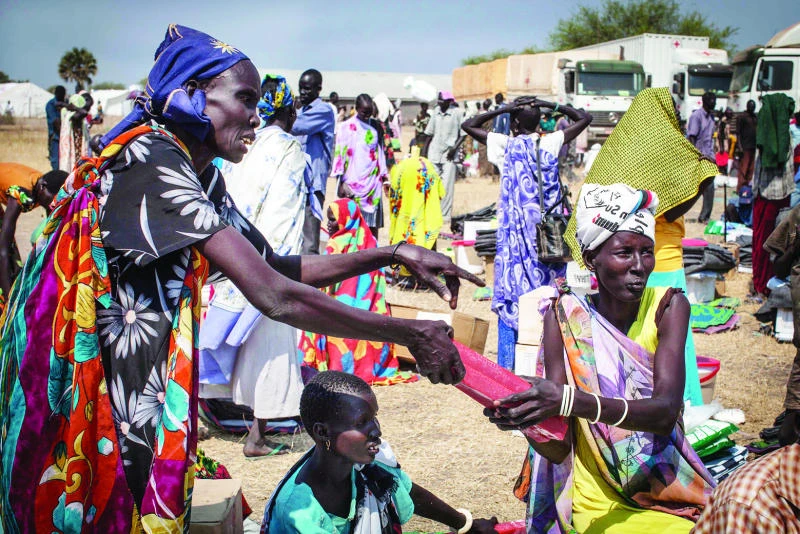
In long lines, women waited for fresh water, pumped out of the muddy Nile before being treated as part of efforts by aid agencies to support rising numbers fleeing South Sudan’s conflict.
“The children are sick... they have been sleeping outside, eating poor food and drinking straight from the river,” said Mary Acouth, who fled when rebel soldiers who had joined up with an ethnic militia raided and then torched her village on the other bank of the river.
Almost 400,000 people have been forced from their homes in a month of fighting. Some 350,000 are still in South Sudan; the remainder have headed as refugees into neighboring countries.
Over 60,000 people are packed into UN peacekeeping bases, too frightened of attacks to leave the security offered by the razor wire fences and guns.
Here in Minkammen, the largest single collection of displaced people according to the UN, over 84,000 rest in the shade of trees, having crossed the swamplands of the White Nile river often carrying only the clothes on their back and dodging bullets. The aid agency Oxfam was one of the first into Minkammen to support those arriving, setting up basic offices under a tiny open-sided thatch roof hut.
A small but thumping generator provides power to charge aid workers’ computers and telephones for brief periods each day.
Just like many of the displaced people outside the basic dirt yard compound, the aid workers sleep under basic tents or mosquito nets, to ward off the swarms of insects that plague the swampy riverside.
“The main problem is to provide water to this huge amount of people... you have the Nile river, but obviously the water is not drinkable, so the challenge is to treat it,” said Ferran Puig, a country director of Oxfam.
“Secondly, there are no sanitation facilities here so there is a risk of cholera.”
Oxfam has set up water systems to filter and clean the river water.
Many of those here are deeply traumatized, having fled brutal fighting in the key town of Bor, now the last major town in rebel hands after almost a month of heavy conflict.
Boats loaded with those fleeing the fighting continue to arrive each morning.
Aid agencies ramp up efforts for South Sudan conflict