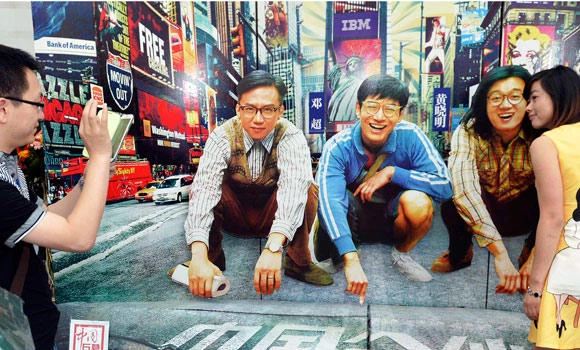
In “American Dreams in China,” Cheng Dongqing is giving a lecture in an abandoned factory in Beijing. Snow falls through the damaged roof and a power cut sends students reaching for their flashlights.
The movie, about how young Chinese in the 1990s tried every means to learn English so they could study overseas, is part of a boom in domestic productions that is outpacing foreign films at the box office in China — the world’s second-largest market after the United States and Canada.
Revenues remain far smaller than in North America, but China looks set for another record year as screens are added rapidly, cinemas expand into more cities and themes switch from martial arts to depictions of ordinary people.
“The past half year has seen the Chinese audience identify with and feel proud of their own lives,” Peter Chan, the director of “American Dreams in China,” said in a recent newspaper interview. “They want to watch their own lives in the cinema, watch realistic themes.”
Based on real stories from Yu Minhong, founder of New York-listed New Oriental Education & Technology Group Inc. , and his partners, “American Dreams in China” raked in more than 100 million yuan ($16 million) in its first three days.
The fifth-highest-grossing film in China this year, it has helped total box office sales reach nearly 11 billion yuan ($1.8 billion) in the first six months, according to the government agency that tracks all forms of media.
“This is a big boost to the market and it set the tone for the year-round revenue to exceed 20 billion yuan,” said Kady Yang, senior analyst at entertainment consulting firm EntGroup.
If China hits that full-year mark, equal to $3.3 billion, it would eclipse the official tally of $2.8 billion in 2012.
Hollywood blockbusters remain hugely popular in China, but the success of local content is being driven by a bigger and broader audience as cinemas expand into second- and third-tier cities, where movie-goers tend to watch domestic films.
“For viewers who grew up watching TV and videos from the Internet, they are more familiar with and more receptive to movies with local culture and human interest elements,” said Yin Hong, director of the Center for Film and Television Studies at Tsinghua University.
China now has more than 15,000 movie screens, with about 10 having been added each day since early last year, EntGroup says. That compares with 39,718 screens in the United States in 2012, according to the National Association of Theater Owners.
China’s movie market booms with local content