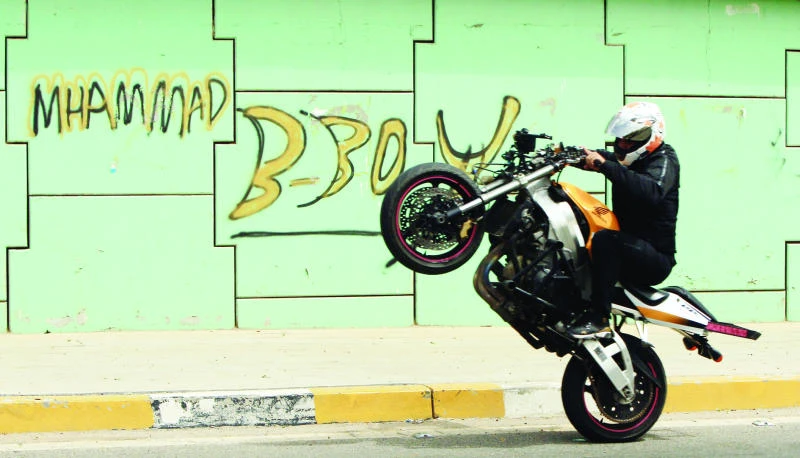
After a quick glance in his rear-view mirror, Mustafa smiled confidently. With a flick of the wrist, the 22-year-old launched his motorcycle into a wheelie for the delighted crowd.
But then, moments after he revved his bike and shifted into gear, sirens blared and suddenly police were everywhere as the assembled youths dispersed manically in all directions.
“It’s always like this — the police don’t want us to have any fun,” muttered Ahmed, an organizer of the weekly gathering of young Iraqi motorcycle enthusiasts in the capital’s up-scale Jadriyah neighborhood.
Almost dismissively, he added: “They say it is part of their strategy to secure Baghdad.”
Mustafa added that he wanted Iraq “to be like other countries.”
“Abroad, there are clubs where people can follow their passions.”
And so, every Friday, the motorcyclists and police play cat-and-mouse, reflecting a widespread frustration among Iraqi youths over what they say is an inter-generational lack of understanding, a decade after ex-dictator Saddam Hussein was ousted.
The police say daredevil two-wheeler stunts may be fun to watch, but they are also dangerous for passing motorists, as the event organizers have never been able to get permission to close off the street.
“I would love if they had a place to do this,” said one of the policemen who shut down the event, speaking on condition of anonymity. “But we cannot do anything. We cannot close the road, and also this is a dangerous hobby.”
According to the CIA World Factbook, 57 percent of Iraq’s population is under the age of 25, and many of these are struggling against the often heavy-handed societal rules held in place by the country’s leaders, as well as their elders.
Faced with innumerable problems and difficulties and grappling with still-high levels of violence, the government of Prime Minister Nuri Al-Maliki has often prioritised other issues over promoting Iraq’s youth.
So while Baghdad, a city of some six million people, currently holds the title of “Arab Capital of Culture” for 2013, there is still a long way to go in terms of promoting youth culture.
The Iraqi capital lacks concert halls that are open to all, and most of its cinemas have a reputation as places gay men go to watch pornographic films, while the few that are seen as wholesome are out of reach to most, situated in exclusive members-only clubs.
Even mundane, day-to-day freedoms that are often taken for granted among young people elsewhere in the world are off limits in Iraq.
“It is not possible to walk down the street with a female friend,” complained Hisham, a 25-year-old music student who asked that his real name not be used.
“Why?” he asked rhetorically, before exclaiming in frustration “Welcome to Iraq!“
“The people, our parents, the government, the tribes — they all think that this is all really bad, and that is it.”
Young Iraqis grapple with authority