
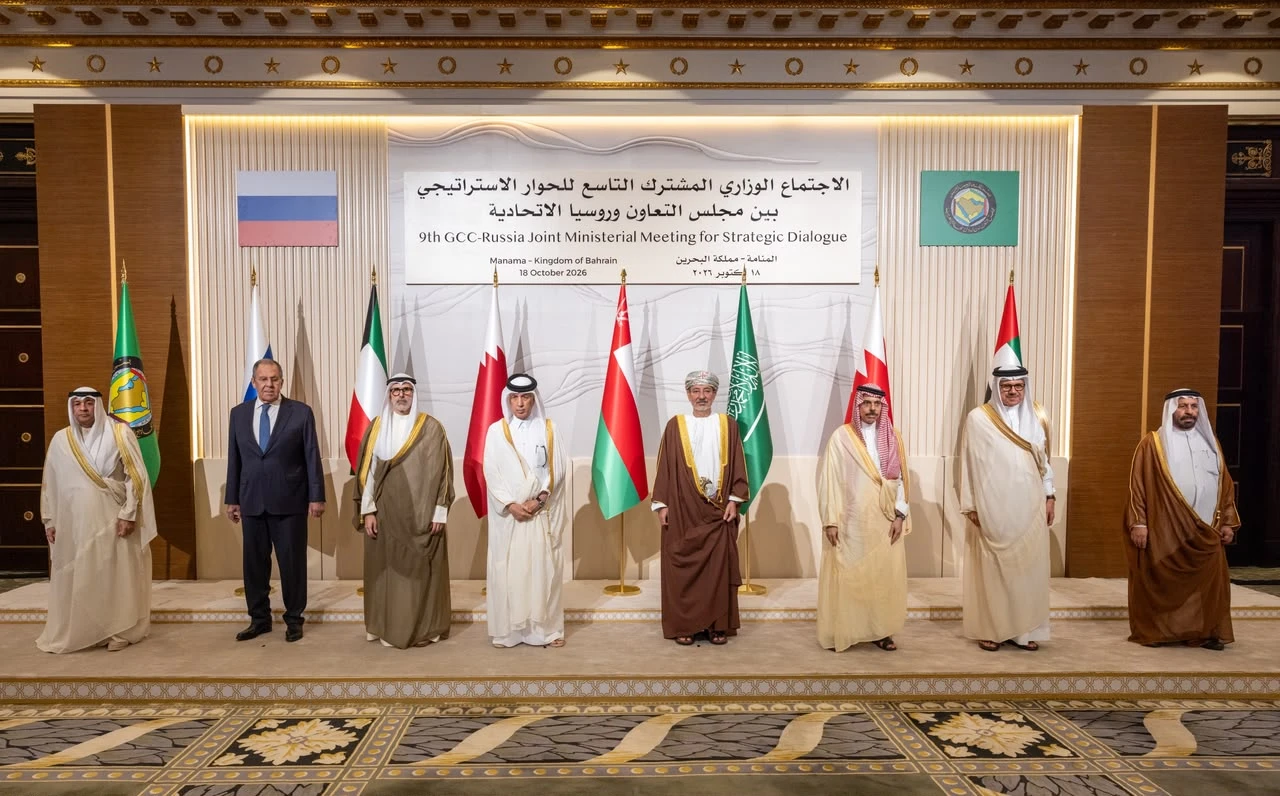

The Gulf Cooperation Council-Russia Strategic Dialogue, held in Bahrain on Sunday, was an opportunity to discuss regional crises collectively after months of bilateral consultations since the last meeting in Sochi in September 2025. These discussions between Russian and GCC foreign ministers have been taking place regularly since November 2011, when this process was started. Originally focused on growing economic and cultural ties between the two sides, discussions in subsequent meetings evolved to focus on regional crises, of which there have been plenty since the inaugural meeting of the strategic dialogue was held in Abu Dhabi 15 years ago.
For several years, Syria dominated the discussions, as the two sides took opposing positions. The issue was settled in December 2024 with the departure of the Assad regime, thus removing an obstacle to progress in GCC-Russia engagement. Trade flourished, exceeding $24 billion in 2025, a jump of about 60 percent in one year and 200 percent since 2021, before the Ukraine war started. The dramatic increase in two-way trade and investment was accompanied by many high-level meetings between leaders and officials and the signing of agreements to deepen that engagement.
Then, in 2026, the US-Iran war started and the two sides took gradually diverging views toward the conflict. The Bahrain meeting was meant to narrow the gap. Russia looks at the conflict from the prism of its confrontation with the West. It blames the US for starting the war on Feb. 28, calling it an “unjustified aggression,” and thus tends to minimize Iran’s role in expanding the conflict to engulf the whole region, directly and through its proxies.
Russia tends to minimize Iran’s role in expanding the conflict to engulf the whole region, directly and through its proxies
Dr. Abdel Aziz Aluwaisheg
When the GCC side tabled UN Security Council Resolution 2817 in March, Russia abstained and allowed it to pass. The resolution demanded that Iran immediately halt strikes against Bahrain, Kuwait, Oman, Qatar, Saudi Arabia, the UAE and Jordan. It also deplored the targeting of residential areas, airports, energy facilities and civilian infrastructure and condemned threats by Iran to obstruct international navigation and commerce through the Strait of Hormuz and the Bab Al-Mandab.
That was probably the height of GCC-Russian engagement on the conflict because, when Iran persisted in closing the Strait of Hormuz, Moscow shielded it from censure by blocking a second draft resolution presented by the GCC side in April, which was focused on securing freedom of navigation. Since that time, the UNSC has been paralyzed from taking further action to restore the situation in the waterway to its prewar situation, giving Iran a free hand to wreak havoc in the region.
Regardless of how the conflict started, the GCC side believes Iran bears all the blame for attacking GCC civilian targets, including energy installations, and for closing the Strait of Hormuz, thus strangling local economies and disrupting oil and gas supplies around the world.
On Monday in Tehran, Russian Foreign Minister Sergey Lavrov once again spoke about Russia’s proposal for a regional security architecture in the Gulf, an idea that goes back “years, indeed decades,” as he said. The proposal went through several iterations but, according to the minister, “the goal is to build trust, rely primarily on the principles and arrangements agreed upon by the littoral states — including transparency in military affairs and the exchange of information on matters that are relevant to each country’s security — and gradually expand joint activities that will further strengthen trust, which is critical in this region.”
Trust is at the core of Iran’s problem not only with the Gulf littoral states but with the international community at large
Dr. Abdel Aziz Aluwaisheg
It “allows for and envisages participation, in a supporting and facilitating capacity alongside the littoral states, of permanent members of the UN Security Council and senior officials from the League of Arab States and the Organization of Islamic Cooperation. Their role would be to help create the conditions for the littoral states to reach agreement among themselves.”
The idea was always too ambitious but has now become even more farfetched, especially the part about “transparency in military affairs and the exchange of information on matters that are relevant to each country’s security.” Such transparency requires trust, which is at the core of Iran’s problem not only with the Gulf littoral states but with the international community at large.
Iran’s nuclear program is only one example, with others being its closure of the Strait of Hormuz and the damage Iran’s attacks have inflicted on the production and export facilities and supply chains that meet the world’s energy needs. Iran’s continuing attacks, directly and through proxies, on civilian targets in GCC countries have eviscerated what little trust existed before Feb. 28.
So, any regional arrangements will need to be considered only after regaining that lost trust, starting with a firm commitment by Tehran to stop attacking its neighbors. After thousands of attacks causing massive casualties among GCC civilians and the destruction of civilian life, Iran’s commitment to international law, including the UN Charter, is in doubt.
Contrary to the implications in Lavrov’s remarks in Bahrain and Tehran, those attacks are not directed at the US or Israel, neither of which have been affected by them. It is Russia’s friends, the GCC countries, which are on the receiving end. The US and Israel are also not affected by the closure of the Strait of Hormuz — instead, the GCC and the rest of the world are.
Russia’s close relationship with Tehran can help secure Iran’s commitment to refrain from attacking its neighbors. Russia’s help is also needed to persuade Tehran to respect freedom of navigation through the Strait of Hormuz and restore the status quo ante. Iran needs to rein in its proxies in Iraq, from which half the attacks on GCC states have been launched, and in Yemen, where the Houthis are threatening Bab Al-Mandab, attacking Saudi Arabia and disrupting energy supplies in the Red Sea.
Dr. Abdel Aziz Aluwaisheg is the GCC assistant secretary-general for political affairs and negotiation. The views expressed here are personal and do not necessarily represent those of the GCC. X: @abuhamad1


