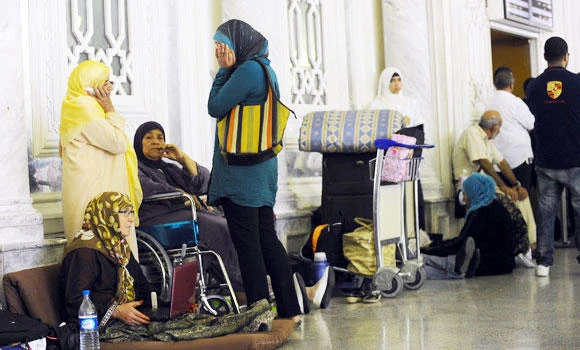
Security measures kept illegal Hajis to a minimum as thousands of pilgrims traveled to Makkah and Mina, according to Lt. Gen. Mansour Al-Turki, spokesman for the Ministry of Interior.
“We have not detected security violations as security men are vigilant and we will not allow anyone to hinder pilgrims’ security and rituals,” Al-Turki said during the first Haj press conference in Mina on Saturday.
Security men were deployed in heavily crowded sites to direct pilgrims and maintain law and order, he added. The master Haj plan this year is focused on streamlining the safe movement of pilgrims across the holy sites.
“We have noticed public adherence to Haj permit regulations this year by local pilgrims,” Al-Turki said. “We are continuing our crackdown on illegal pilgrims across Makkah’s entry points.”
The official number of pilgrims during this year’s Haj will be announced after the Eid holidays by the Central Department of Statistics and Information.
Twenty-five percent of pilgrims will start pouring into Arafat as early as Sunday morning and the majority will follow to the holy site on Monday amid a range of services facilitating their movement and accommodation.
Pilgrims arrived in Makkah Saturday by 5,000 buses with no single traffic accident for the first time, said Lt. Gen. Abdulrhaman Al-Miqbel, assistant Haj security commander for traffic affairs.
While over 20,000 buses have been checked for safety to transport around 1.5 million pilgrims, trains at the holy sites will transport around 370,000 pilgrims across the holy sites, he said. Meanwhile, authorities have impounded 1,400 violating motorcycles and about 4,000 vehicles for trying to smuggle illegal pilgrims into Makkah.
Authorities have sent back 31,294 illegal local Saudi and foreign pilgrims over the past six days, said Lt. Gen. Mohammad Al-Basami, spokesman of the Haj Security Forces. Around 27,227 vehicles have been denied entry for different reasons, he said.
The Health Ministry’s hospitals conducted 103 arterial catheter operations, seven open heart surgeries, 24 endoscopic surgeries and 263 kidney dialysis sessions, said Khaled Al-Mirghalani, spokesman for the Ministry of Health.
Meanwhile, the Saudi Red Crescent has readied seven air ambulance services and over 300 ambulance vehicles for emergency medical cases, said Khaled Al-Hibshi, spokesman for the Saudi Red Crescent. The medical agency has treated over 3,200 cases thus far, he said, a 12-percent decline compared to last year.
Clampdown sees fewer illegals at holy sites