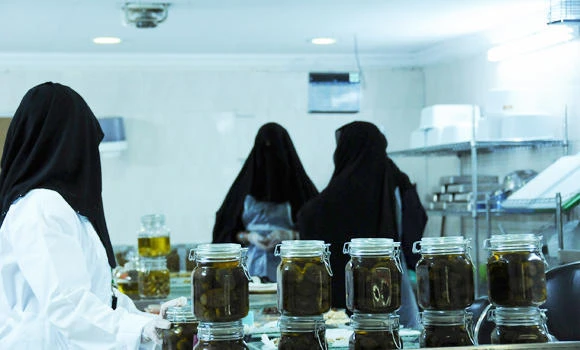
Around 25 Saudi women employed at a date quality testing laboratory in Al-Ahsa Municipality have achieved a record in terms of the volume of dates tested and sent on to the annual date festival at the governorate.
The festival received 300 vehicles, each loaded with 400 to 600 tons of different kinds of dates, which needed to be tested every day.
At the time of their employment 12 months ago, the girls took 10 minutes to test the samples, but have narrowed the gap almost five-fold now. Samples do not take more than two-and-a-half minutes to be examined.
Nowair Al-Zalfawi, director of the date quality lab in Al-Ahsa, said the lab receives random samples from daily date shipments. Women examine one kg for every 1,000kg. “These are categorized electronically according to farmers’ data and lab technicians then put the samples through a four-stage testing process to uncover any pest infections. Dates are then classified according to size to limit tampering with prices,” she added.
The municipality’s lab plays an important role in protecting consumers from cheating in the market after it was discovered that some farmers were adding a chemical substance to increase the size of the dates, she said.
The lab began working on this phenomenon to try and curtail it, measure dates’ suitability for sale and define the percentage and type of chemical substance added. This in addition to ruling out dates that have been mixed with impurities and following up on date production and marketing, which will encourage farmers to improve their production, she said.
Al-Zalfawi said she would like to see the number of women technicians increase gradually during this year in preparation for the launch of the King Abdullah City for dates, which is the biggest city that sells dates in the world.
Female lab workers acquired high skills in completing sample testing in record timings of two and a half minutes per sample during the past six months, she said.
Stating that the number of female operators in the lab would go up by 40 by mid-season, she said the 25 female workers currently employed held university degrees in agricultural economics and nutrition, in addition to biology and chemistry, which provided women of the province with good employment opportunities.
Some of the employees who have secondary school certificates, went through intense training workshops to raise their professional and technical skills. The training session were organized by the Palm Research Center and Al-Ahsa municipality.
Adel Al-Melhim, Al-Ahsa mayor, told Al-Iqtisadiyah that the date festival created job opportunities for Saudi females. “Women who complete one year in service are then absorbed officially, which in turn creates more job opportunities at the lab for other girls, especially with the launch of King Abdullah date city, which will conduct its business from a space of one million square meters,” he said.
This will create more job opportunities for women, and facilitate their employment, particularly since it is not a tiring job. Women have already been given training to operate the equipment. The municipality’s support encouraged date factories to employ more females on their production lines, he said.
The municipality took up the promotion of agriculture and Al-Ahsa dates to maintain the agricultural heritage in the province and encourage farmers to take more care of their date farms. “The municipality is striving to make Al-Ahsa a ‘date home’ and we expect the date festival to go on for 45 days because of the abundant harvest. The festival contributes to raising the culture of farmers and merchants, as well as consumers,” he added.
Farmers were able to raise the quality of their dates with the experience they gained from last year’s festival. The number of farmers increased this season because of the increased purchasing power in the market, he said, adding that their sales increased by 40 to 50 percent last year in comparison with other markets.
Al-Milhim said the market doesn’t allow the entry of foreign farmers but only expats who load and pack the goods. The market only allows the entry of Saudi farmers by controlling the entry process electronically, but merchants from other Gulf States like Qatar, the United Arab Emirates and Kuwait, are also allowed entry.
‘Dates undergo quality testing by team of 25 Saudi women’