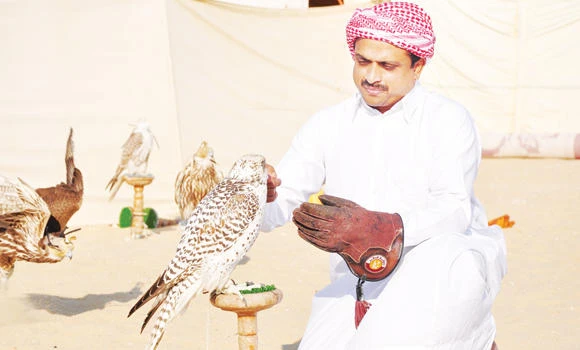
A falconologist, who has conducted extensive studies on the prized bird, has urged authorities in Saudi Arabia and other GCC countries to take extra care in protecting falcons from bird flu, other infectious diseases and possible extinction.
“About one-third of falcons die due to preying on birds that are exposed to pesticides while many die of bird flu,” said Medammal Zubair, assistant professor at Calicut University in Kerala, adding that bird flu epidemic in some countries threatens the precious bird’s extinction.
Speaking to Arab News, he warned the owners of falcons in the UAE of the serious ecological risks the birds face.
Zubair obtained a doctorate in falconology from Calicut University in 2002, visited GCC countries, Germany, Pakistan, Sri Lanka and Iran for his research and has received special training in artificial falcon breeding from Stuttgart.
“Extra care should also be taken while feeding falcons as many birds in the various countries have died as a result of feeding on bird flu-affected food and preying on infected birds,” the researcher said.
Falcons — a symbol of force and courage — usually prey on birds such as houbara, pigeon and quail.
Falcons are closely linked with Arab culture and tradition, he said, adding that Arabs constitute one-third of the world’s falconers. It is believed that Arabs have hunted with falcons for the past 2,000 years. Being the national bird and symbol of culture of most Middle Eastern countries, falcons are given immense importance. “There are exclusive hospitals with advanced facilities for the treatment of falcons.”
Falcon is the only bird which requires a passport to cross the border of a country, said Zubair. “The UAE started this system in 2002 to stop smuggling in falcons which have a good market value.”
Falcons have uses other than hunting. Burj Al-Arab in Dubai, the world’s tallest building, had been making use of falcons to protect it from birds that leave their droppings on top of the building, he said.
Zubair disclosed plans to produce a documentary on falcons, focusing on their wide use in GCC countries. A brochure on the documentary was released by Prince Faisal bin Musaed bin Saud, a Saudi businessman, by giving a copy to Abdul Haq Thirurangadi, a singer, during a function in Jeddah recently. “The film will be made available in Arabic, English and Malayalam,” he said.
“Falcon is the national bird of Saudi Arabia and we would like to collect more information from Saudi falcon centers and clinics to produce the documentary. We are also looking for prospective sponsors in Saudi Arabia to make the film project a reality,” he said.
About his research, Zubair said: “I took it as a challenge and decided to study more about falcons, but it was not as easy as I thought. Since falcons fly and live at great heights, it is very difficult to watch their movements and observe their behavior. To observe the falcons, one has to travel in an airplane. I flew 42 times around the world for the purpose.”
Zubair is the first non-Arab to be granted membership in the Emirates Falconers’ Club, the organizer of the annual Arab International Hunting Show in the UAE.
Expert calls for extra care to protect falcons