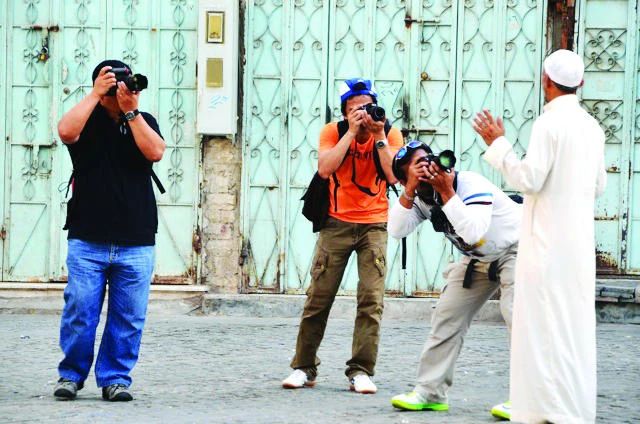
For the first time ever, several Filipino photographers living in the city are going to showcase their work at the Jeddah Art Week (JAW) from Feb. 1 to 6.
Richard, an information technology professional at a private company and one of the artists, said he started taking photographs to show his friends and family living in the Philippines the “beauty of the city.”
“I wanted to change stereotypes and share photos of the beautiful Jeddah fountain, the malls and the scenery. Our work shows that we embrace Saudi culture and respect the rules. Our photos clearly reveal what our community is all about behind closed doors,” he said.
It all started when Lina Lazaar, founder of the JAW, was introduced to an underground community of Filipino photographers who were highly passionate about the medium, but had never exhibited before.
“A very interesting spectrum of the Jeddah art scene was unfolding organically. These artists tend to be quite discreet about their work because most of them hold full time jobs.”
She said that the photographers had kept their hobby a secret for a long time and were now thrilled at having the chance to exhibit. “The situation of the wider migrant community and the kafala system are obviously not the best bases on which to foster talent and creativity. But things are clearly improving, praise Allah, allowing all communities in Saudi to have a platform to express themselves.”
“Until now the Filipino artistic community was not entrenched within the formal Saudi arts and culture scene, but this is changing. We’re terribly excited that the general public has started to embrace and support exhibitions by artists from other minority groups. Kakaibang Jeddah! is therefore a testament to the diversity and cultural awareness slowly emerging in Jeddah.”
Rodolfo, an electrical engineer at a private company and one of the photographers, said there were many challenges when he first started out.
“When I first came here, photography was almost completely forbidden in public areas and we couldn’t take photos of the city. But now with the development of new technology, and people starting to take photos on their phones, it is easier for us photographers to practice our hobby.”
“We are really grateful to the JAW for giving us the opportunity to exhibit our work in public after years of closed exhibitions for only the eyes of the Filipino community,” he said.
He said many members of the Filipino community keep their hobbies secret fearing their employers would not take them seriously. “We’ve never wanted to share our work with the locals because we thought our employers would say that we are wasting our time and being distracted from work,” said Rodolfo.
“We don’t want our life to be a boring routine. We want to have a life like other people on this planet. This is why we have so many activities apart from our daily jobs,” he said.
“No one can live a life of working, eating and sleeping. If we did that, we would end up fat and sick so we need to have other activities without crossing boundaries or disrespecting Saudi culture,” said Rodolfo.
Lazaar said the exhibition might bring the Filipino community closer to Saudis. “There isn’t a day that goes by without some sort of talk about the condition of migrant workers in GCC countries. Art may be the softest and most interesting way of creating a sensible and powerful dialogue on the subject.” She said even a cursory glance at some of the images on display would demonstrate the photographers’ love for the city and their sense of belonging here.
Richard said that the photographers used social networking sites to connect. “Facebook is why we all know each other. We created a photography group and shared our photos and then decided one day to print them out and share our experiences.” He said they started holding regular workshops to teach each other about photography.
He said other members of the Filipino community in Jeddah are also looking forward to sharing their hobbies with local people. “We have other interests such as diving and volunteering and we would love to have the local and other communities also enjoy these experiences with us.”
Filipino photographers’ exhibit focuses on ‘spectacular’ Jeddah