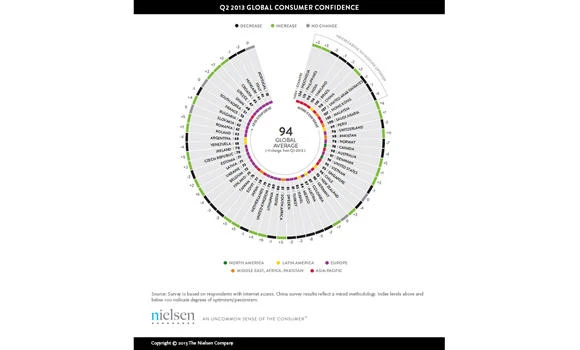
Saudi Arabia ranks eighth among the world’s top ten countries in consumer confidence, with an index reading of 100, exceeding the global consumer confidence average of 96 in the second quarter, a survey shows.
“The index is a good measure of consumer confidence,” says Mohammed Shams, chairman of the Economic Feasibility Center. “When people spend more, it means that they have great confidence and interest in the economy. Hence, this is actually one of the most important indicators of consumer confidence.”
Shams says that people in Saudi Arabia spend 90 percent of their income, which he believes is detrimental in the long run.
“There is a good level of spending in the Kingdom,” says Shams. “Consumer confidence translates to confidence and trust in the economy. Our GDP is about $ 700 billion; that indicates a staunch confidence in the economy.”
“Government spending continues to expand every year insofar as prices tend to increase incrementally. Oil exports are also on the rise. All these indicators show that consumer confidence is increasing year after year. Besides, the projects the government is putting up instill more confidence and trust in the economy.”
Shams adds that the level of national security in the Kingdom is very high. “Comparing our national security to that of other countries like Syria, Egypt and Iraq, it shows that we are in a much better position than any other country in the Middle East in terms of national security. National security is also a good measure for consumer confidence.”
Indonesia bagged the highest global ranking with an index of 124, portraying its consumers as the most jaunty worldwide, according to Nielsen’s Global Survey of Consumer Confidence.
The Philippines came after Indonesia, with an index of 121, followed by India at 118, Thailand at 114, Brazil/China at 110, the UAE and Hong Kong tied at 107, Peru at 99 and Switzerland at 98. The UAE and Saudi Arabia, with an index of 107 and 100, were the only Middle Eastern nations to make it to the top 10 in consumer confidence.
Consumer confidence improved in four of six Middle East/Africa markets, as Pakistan, at 98, claimed the largest three-month rise of 11 index points, followed by an increase of four points in Saudi Arabia (100), three points in Egypt (77) and South Africa (81). Confidence declines were reported in United Arab Emirates (107) and Israel (83), which fell one and eight points, respectively.
A consumer confidence index exceeding 100 reveals a level of optimism. On the whole, the index went up at one point in the second quarter to 94, after going up two points in the previous quarter. A reading below 100, however, specifies consumers are negative overall about the outlook.
“While confidence in Europe remained consistently high as financial conditions stabilized, perceptions about jobs, personal finances and spending intentions increased in the world’s three largest economies — US, China and Japan — which has had a beneficial effect around the world,” said Venkatesh Bala, chief economist at The Cambridge Group, a part of Nielsen. “However, concerns remain that macroeconomic events, such as too sharp a rise in interest rates, can impair consumer recovery, including lowering demand for home purchases and spending on big-ticket items.”
“When consumers feel richer and more secure about getting a job or keeping their job, that naturally makes them more confident. It’s the opposite of what happened in 2008-09, when job redundancies soared and house prices collapsed along with the flattening of the stock market,” said Bala.
The countries in the bottom 10 according to the survey were: Poland, 63; Slovakia and Romania, each with 62; Bulgaria, 61; France, 53; South Korea, 51; Spain, 48; Greece, 47; Croatia, 45; Hungary and Italy, 41; and Portugal, 33.
KSA ranks eighth in consumer confidence survey