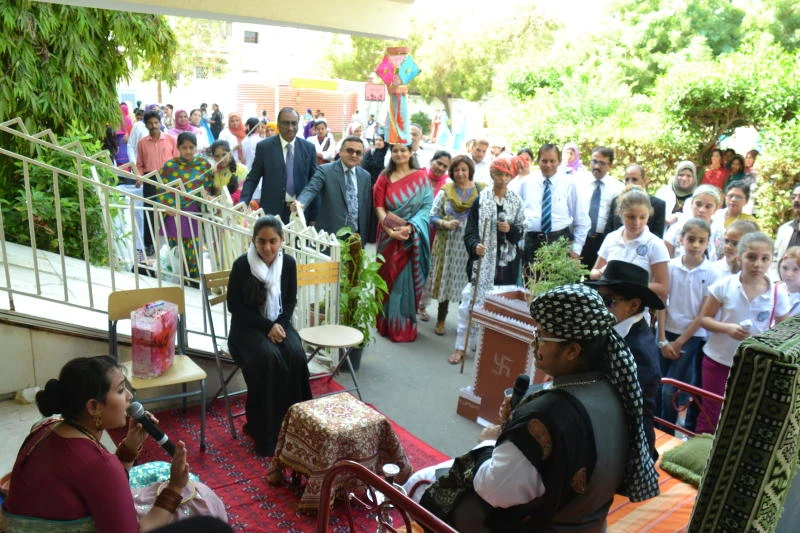
A local school here staged the functioning of a traditional village council to educate students about India’s laws and administrative system.
Female students from the science department of the International Indian School-Jeddah (IISJ) showed how the Indian government decentralizes several administrative functions to local councils. The system is known as the “panchayati rajw.”
The students portrayed the activities and challenges of villagers, and the functioning of a council in an imaginary village named Khushipur.
Among those who attended the event were Faiz Ahmed Kidwai, the Indian consul general; his wife Kausar; Mohammad Raghib Qureshi, a school observer and head of the chancery at the Indian consulate; Haroon Rashid, chairman of the school’s managing committee; Syed Masood Ahmed, the school principal; Farhadunnisa, vice principal of the girl’s section; and Chaman Raheem from Dar Al-Hekma College. There were also children from an Italian school present.
The guests could walk down the lanes of the village and see women drawing water at a well, people washing in the morning in the open field, a typical rural Indian family engaging in household chores and women bargaining with a vegetable vendor. There was also a shrewd moneylender, a village post office, school, health center without a doctor, scenes of domestic violence, and the bonding of people of different religions.
The dignitaries also visited a rich person and his family, stopped by Chandu’s Tea Stall, watched a potter at work, and saw village belles dancing to celebrate a bountiful harvest. The dignitaries were welcomed in a traditional rural fashion by the sarpanch (village headman) with homemade shawls.
There was also a power point presentation on the evolution of the council from the Vedic period to the present day.
Kidwai praised the staff and the students for their hard work and said India’s 70,000 villages form the backbone of the country. It was a unique part of the largest democracy in the world, he said.
He said the program had evoked nostalgic memories of his own village, childhood and youth. The program concluded with a vote of thanks from Jerlin Christina, the junior head prefect.
Students showcase Indian village life