- Founder Jan Tops speaks to Arab News about his vision for the future of show jumping and equestrian sport
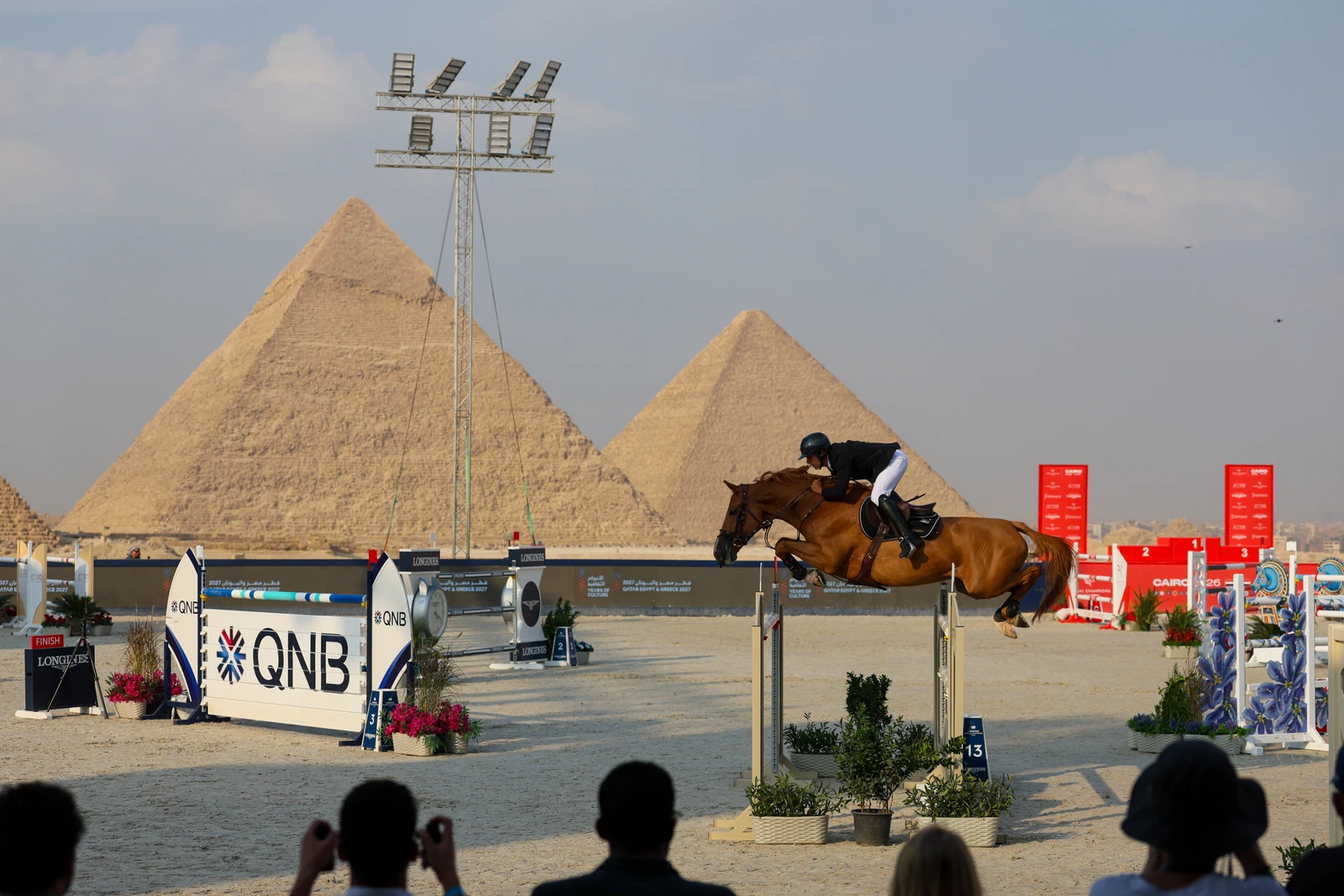
CAIRO: When Pieter Devos first arrived in Cairo last week for the Egyptian debut of the Longines Global Champions Tour, the Belgian rider turned his gaze to the pyramids and thought about how cool it would be to win the Grand Prix against a backdrop like that.
A few days later, Devos manifested that scenario, as he topped the podium with his horse, Casual DV Z, at the inaugural Cairo Grand Prix, pocketing a handsome $370,000 prize check after achieving the fastest clear round in the 12-rider jump-off.
“I must say I was a little overwhelmed with the setting, with the pyramids here, it’s just amazing and then to be on the podium now, that podium stands there just in front of the pyramids,” said Devos after his win.
“I was thinking the first day, I said it would be nice to be on that podium in the Grand Prix and then have a nice picture with the pyramids on the side. I’m very, very happy today.”
Devos’ picture-perfect moment bookended a special three days at the Pyramids of Giza, where 50 of the best riders on the planet, along with almost 100 of the best show jumping horses in the world, gathered to compete in a GCT event in Egypt for the first time.
“It’s really special to be honest, especially for us as Arabs,” said Qatari rider Bassem Mohammed, who jumped two clear rounds in the Cairo Grand Prix and finished in seventh place.
“It’s really unique to be competing here. It’s the first time for me in Egypt and I'm really impressed with how the show is going,” he told Arab News.
“But that’s nothing new to us, in our Arab culture, when we need to organize something that big, we know how to pull it off.”
The new show in Cairo is the latest milestone in the 20-year journey of the GCT, which was founded by Dutch former Olympic champion Jan Tops back in 2006.
Tops envisioned a tour that elevated the sport, took it to new markets and iconic locations, attracted more broadcasters and sponsors, and offered more prize money.
Over the past two decades, his vision came to life one step at a time, with a Grand Prix by the pyramids the latest cherry on top of an ever-evolving cake.
What started as a six-stop series offering €2.5 million ($2.7 million) and €600,000 in bonuses in 2006 has become a truly global circuit with 17 events held in 15 countries, offering more than €36 million in prize money in 2026.
Last weekend’s leg in Cairo alone had a €1.75 million prize pot.
A strong bond with the Arab world
The GCT landed in the Gulf for the first time with an event in Doha in 2008 and the relationship between the tour and the Middle East and North Africa region has gone from strength to strength ever since.
Cities like Rabat, Riyadh and now Cairo have all popped up on the calendar, with the Saudi capital meant to alternate hosting duties of the GCT Playoffs (a concept introduced in 2018) with Prague annually between 2024 and 2029.
This year’s playoffs had to be relocated from Riyadh to Verona, Italy, due to “significant logistical challenges associated with staging the event” but Tops says he is looking forward to returning to the Kingdom in the future.
“It’s very sad for us, but more sad for the country. Obviously, we wish to no one to have this, and we hope that very soon there will be peace again, which we will expect,” Tops told Arab News in an interview in Cairo.
“We are for the next couple of years again going back to Riyadh, as the event goes. We are very happy to be part of this region, and when the stability goes back, we are back.
“We feel that now having an option in Italy is a bittersweet option.”
Tops says he has witnessed tremendous growth in the sport in the MENA region over the past 20 years, be it from an organizational standpoint or a competitive one, highlighting Saudi Arabia’s bronze-medal showing at the London 2012 Olympics and Qatar’s Sheikh Ali bin Khalid Al-Thani placing sixth in the individual event at the Rio 2016 Olympics.
“I think the whole region is very into horses, growing a lot, and I expect a lot of growth still for the future. They are playing a big part on the highest level,” he added.
Overcoming challenges and raising awareness
The GCT has made a habit of showcasing the sport at iconic locations, whether the Eiffel Tower in Paris, Miami Beach in Florida, the Campo Marte in Mexico City, or equally impressive venues in cities like Shanghai, Rome, London or Madrid.
Adding a stop like Cairo by the pyramids is no mean feat and it involved massive efforts from both the GCT, and the Egyptian government and military.
Getting the horses safely from Belgium to Cairo was a grueling process, one Tops is proud to have navigated in record time.
“We had to have a special permit for Europe to get the horses in and out as quarantine restrictions,” he said. “Normally, it takes maybe a year, a year and a half to get all these things done. We did it in three, four months with the help of the federation, the president, the people in the European Commission. There were a lot of people and a lot of stakeholders involved to get that done in such a short time to be here. Next year, it will be easier.”
The horses are flown on a jumbo jet, in what Tops describes as “business class for horses,” and animal safety remains the tour’s top priority.
The GCT utilized the event in Cairo to raise awareness of the poor conditions of the working horses ridden by tourists around the pyramids and a five-year equine welfare initiative spearheaded by the Egyptian Equestrian Federation, the GCT and their partners, has just been announced to improve conditions for working horses in Giza.
It will initially focus on about 700 horses, with a second phase intended to extend support to about 2,000.
“This week also highlighted a difficult reality,” Egyptian rider Nayel Nassar, who competed at the GCT event last weekend, wrote in a social media post this week.
“Just a short distance from some of the most privileged and well cared for horses in the world are working horses and other animals living in devastating conditions. It’s a contrast that’s impossible to ignore, and we must use the spotlight this event has brought to Egypt to catalyze meaningful and lasting improvements to their welfare. That would be a legacy worth celebrating even more than the event itself.”
Eye on the future
As the tour celebrates its 20th anniversary season, Tops is already thinking about the future. A decade ago, he introduced a team competition to the tour, called the Global Champions League, realizing that a team can be more attractive to a sponsor than an individual rider.
Teams include six riders, three of which compete at each of the GCT stops at the start of every competition weekend.
“I think the league is one of the most important things. It’s a different strategy,” says Tops. “I always see today’s sports, the most followed are team sports. Also sponsors-wise. If an individual gets injured, you’re out. If sponsors have a team, when one rider is out, they still have their team. They are more diverse in the way of putting their strategy to explore themselves.”
Another key attraction for the sport of show jumping, in general, is the fact that men and women compete against one another on a level playing field — a rarity in the world of professional sport.
“Of course, I see the evolution of the horses; 40, 50 years ago, they were more heavy and strong. Now it’s more about finesse. It’s more you ride with the feeling than only the strength,” said Tops.
“If you see nowadays how many top women are in the world on a high level and consistency, it has changed in the breeding of the horses.”
Tops’ vision for the future of the GCT is to maintain the highest standards of care for the horses, while attracting the very best rider-horse combinations in the world.
He hopes for the sport of show jumping to become “more mainstream,” visit the best locations and reach wider audiences.
Is there a sporting model he draws inspiration from?
“Of course, when you see F1, their way of going; of course, we have to consider totally different things because of the car and the horses, but there is a lot of synergies we can use, a lot of ways,” he said.
“If you want to grow, you always look around and see what fits in your package, in your story, what is the best for the sport and, obviously, for the riders, too. And innovate things without losing the tradition.”