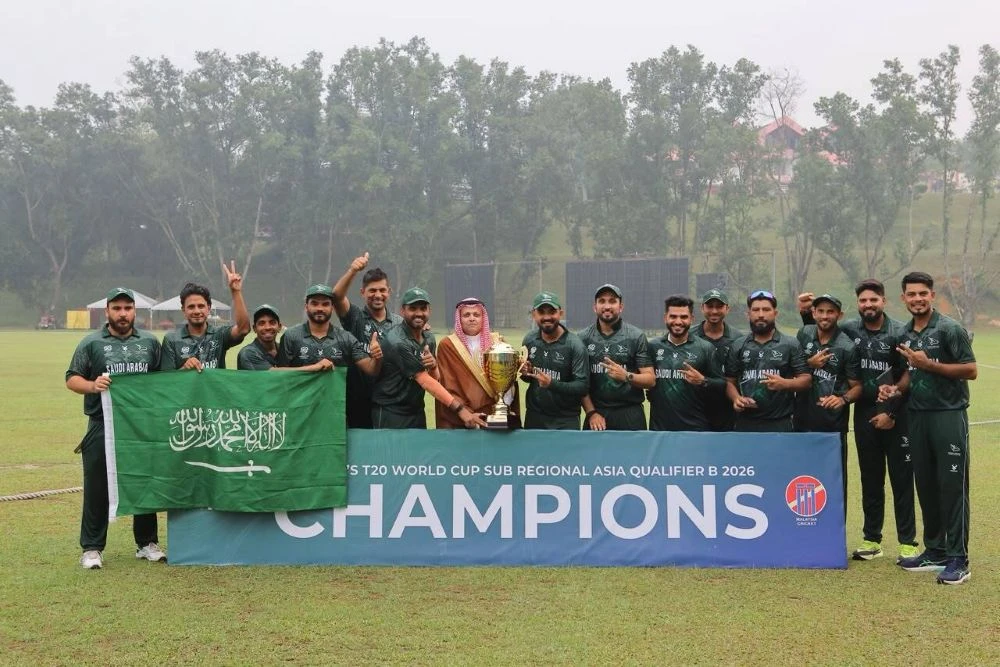
- The impressive performance of the Saudi team in the sub-regional qualifier, winning all 5 of their matches to top their group, will have given them hope of making further progress in the regional qualifier next year
In Asia, Sub-Regional Qualifiers took place between Oct. 5 and 14, 2026, at three venues in Kuala Lumpur, Malaysia, with 13 teams divided into two groups.
Qualifier group A featured Bahrain, Bhutan, Kuwait, Mongolia, Myanmar, Qatar and Thailand, whilst Group B comprised China, Hong Kong China, Malaysia, Maldives, Saudi Arabia and Singapore. A total of 36 matches were played in a single round-robin format.
The top three teams from each qualifier group have progressed to the next stage of the Asia qualification pathway in 2027. In Group A, they were Kuwait, Bahrain and Qatar, whilst Saudi Arabia, Hong Kong and Malaysia progressed from Group B. Those six teams will meet in 2027 in an Asian Regional final to determine which two teams will progress to a global qualifier playoff.
This will comprise 16 teams, eight of which have already been determined. They are Canada, Italy, Namibia, Nepal, Netherlands, Oman, UAE and US, who all featured in the ICC Men’s T20 World Cup 2026 but did not secure automatic qualification for 2028.
The remaining eight places will be earned through regional qualification. In addition to the two teams from Asia, there will be two from Africa, two from Europe, one each from the Americas and the East Asia-Pacific.
In what will undoubtedly be a fiercely contested tournament, eight of the 16 teams will qualify for the 2028 T20 World Cup. Five of these will be the highest-placed team from each region, alongside the next three highest-placed teams overall, subject to minimum performance criteria.
Each of the eight teams which played in the 2026 T20 World Cup will want to be there again, whilst those which progress via the regional qualifiers will seek to press their case strongly.
One of these will be Scotland, which stepped in at short notice after Bangladesh’s withdrawal from the 2026 T20 World Cup. The team finished bottom of their group, thus missing out on automatic progression to the global qualifier for the 2028 T20 World Cup.
However, the ICC has determined that “in recognition of these exceptional circumstances,” Scotland will progress directly to the Europe Regional Final, instead of having to participate in sub-regional qualifiers. They should progress against Denmark, Guernsey, Jersey, Portugal and Spain, but it does illustrate how competitive it is to qualify for the T20 World Cup as an Associate country.
It is reasonable to assume that the impressive performance of the Saudi team in the sub-regional qualifier, winning all five of their matches to top the group, will have given them hope of making further progress in the regional qualifier next year.
Out of the five teams which they will face in that event, two — Hong Kong and Malaysia — were beaten in the sub-regional competition. The other three — Kuwait, Bahrain and Qatar — have been beaten in the past.
Since 2019, the Saudi Arabia men’s team have played 62 T20 internationals, winning 56 percent of them. Only seven were played in the COVID-19 pandemic years of 2020 and 2021, with the highest number, 15, played in 2024. The tournaments have been a mix of Asian Cricket Council Cups, ICC T20 World Cup regional qualification pathways, tours and quadrangular series.
All of these have been played outside of Saudi Arabia because, as yet, there is no ground of sufficient standard capable of hosting international matches. The majority of matches have been played in Qatar or Oman, with Bangkok and Kuala Lumpur making up the balance.
In head-to-head rivalry with the three neighboring countries who will be faced in the 2027 Asia regional final, Saudi Arabia do not have a winning ratio. Out of the 11 matches against Qatar since 2019, they have won three, with one tied. In seven matches against Kuwait, they have won three and in six against Bahrain they have won two.
These teams have also played more T20Is than Saudi Arabia’s 62. Bahrain have played 134, Qatar 90 and Kuwait 88. There is a need for Saudi Arabia to move to the next level if ambitions to be one of the top two teams in the 2027 regional final are to be realized.
In this context the interview last week by my Arab News colleague, Rashid Hassan, with the general manager of the Saudi Arabian Cricket Federation, Iqbal Sikander, provided updated insights into the next stages for cricket’s development in the Kingdom.
Sikander, who was appointed by the SACF in January 2025, played four ODIs for Pakistan, all of them in the 1992 World Cup, which was won by Pakistan. He has worked as the ACC’s development officer, during which time he helped to establish cricket in Afghanistan. Therefore, Sikander has experience of building cricket from the roots.
He said that the game in the Kingdom “is now entering a more structured phase with a focus on improving standards, strengthening competition and creating a more professional cricket environment.” He is well aware that the players need to play more, especially against stronger opposition, at all levels. In addition to ICC and ACC tournaments he is looking for more bilateral, triangular, quadrangular series.
Assistance in this phase of development is being guided by a strategic memorandum of understanding signed between the SACF and the Pakistan Cricket Board in July 2026. This provides the basis for cooperation in exchanging technical expertise, facility planning and adopting best operational practices to enhance the Kingdom’s readiness to host international tournaments and competitions.
The link with Pakistan has been expanded by the coaching appointment of Saleem Jaafar, who played in 14 Tests and 39 ODIs for Pakistan between 1986 and 1992.
One element of the men’s player development strategy has been the partnership between the SACF and the DP World ILT20, whereby each of its franchises must have one Saudi cricketer in their squad. This was first achieved for season four, when the players were acquired at auction. A repeat of the process occurred on Oct. 1, 2026, prior to season five.
None of the Saudi Arabian players acquired in 2025 could be retained before the auction, so they had to be bought through it, with a base price of $10,000. Four of the six Saudi players from 2025 were bought for the 2026 season, three of them by the same franchise. Ishtiaq Ahmed, who was with the Gulf Giants in in 2025 was bought by the Desert Vipers for $12,000.
This looks to be good business as he claimed four wickets, including a hat trick, in Saudi Arabia’s narrow 10-run win over Hong Kong on Oct. 11. The two new Saudi players bought at auction were Imtiaz Khan and Mohammad Saqib, by the Gulf Giants and Sharjah Warriors, respectively.
Gradually, the building blocks are being put in place to establish cricket for men and women in the Kingdom. Unfortunately, one international women’s tournament and the Dunes 20 men’s franchise league have been postponed for “technical reasons.”
Together, they would have raised the profile of the Kingdom’s cricket significantly and given the opportunity for more Saudi cricketers to experience playing and training alongside established international players.
As Sikander said, the focus in the immediate future lies in “improving standards, strengthening competition and creating a more professional cricket environment.”