- Team members tell Arab News what it took to face the Philippines, China and world No. 1 Japan, and what it means to them to represent Palestine on the international stage
- Palestine’s baseball movement began as a grassroots initiative in Gaza in 2017, before expanding to include players living in many countries
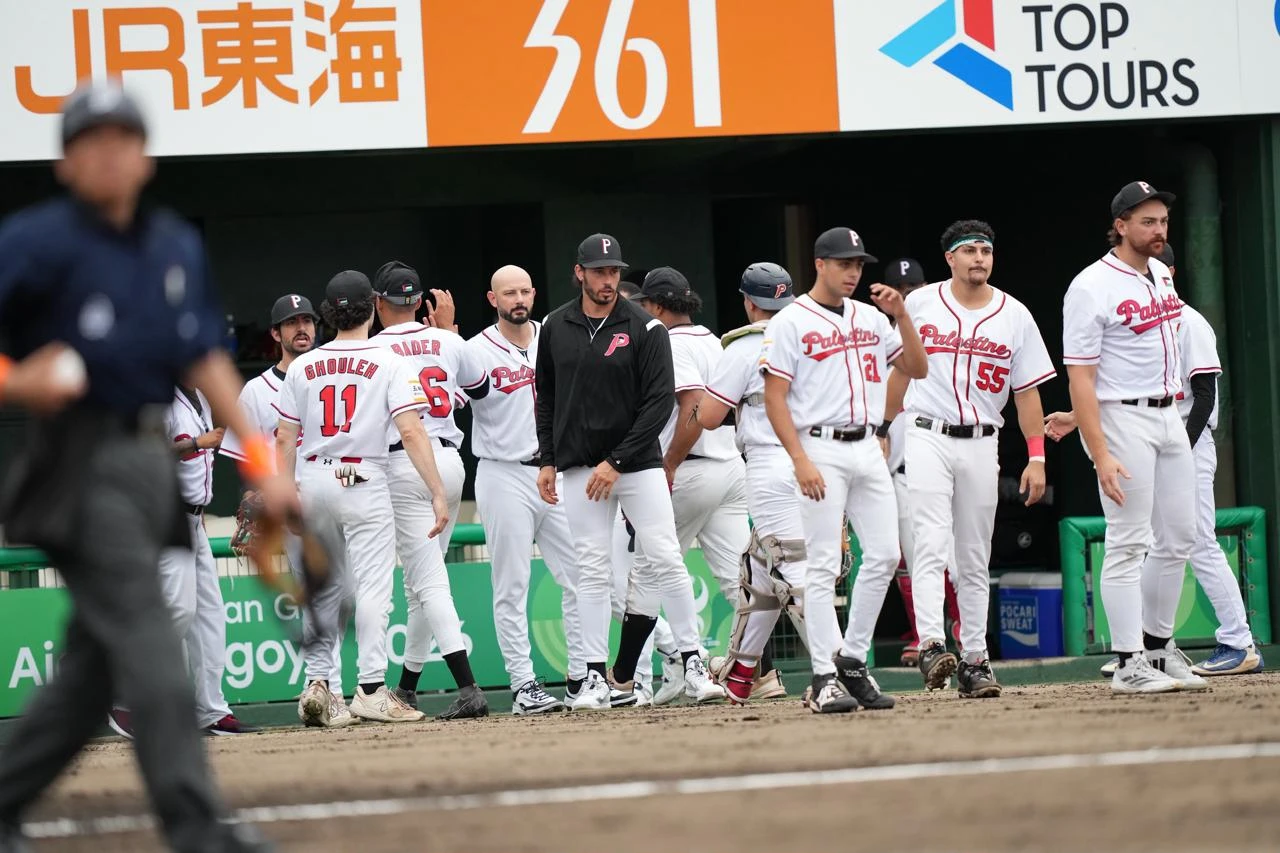
DUBAI: Palestine’s first-ever baseball campaign at the Asian Games came to a close on Wednesday, completing a historic participation the players said carried a significance that extended far beyond the results on the field.
A 9-1 defeat to China brought their Group A campaign to an end at Aichi-Nagoya 2026, with Yunis Halim driving in Palestine’s only run of the game.
Drawn alongside hosts Japan, the world’s No. 1-ranked baseball nation, as well as the Philippines and China, the Palestinian team faced a demanding introduction to the Games, and an opportunity to test themselves against some of the continent’s best-established baseball programs.
Simply being there was a significant milestone for a national program the roots of which stretch back less than a decade. Palestine’s baseball movement began as a grassroots initiative in Gaza in 2017, before the national setup expanded to include Palestinian players living in other countries, many of them with experience of college and professional baseball in North America.
Progress followed; Palestine finished runners-up at the 2023 West Asia Cup, losing out 11-3 to Pakistan in the final, but got their revenge in 2025 when the teams once again met in the final, and this time Palestine won 5-4 in a dramatic extra-innings victory. They also finished fifth at that year’s Asian Baseball Championship.
Aichi-Nagoya was their next step, and the biggest stage yet. Baseball was also the only team sport in which the 67 Palestinian athletes at the Games were competing.
The players who assembled in Japan took many different routes to get there, but Luke Shahin said those differences quickly disappeared once the squad came together.
“Honestly, it’s instant chemistry,” the 23-year-old told Arab News. “We come from all over — different cities, different college programs — but the second we get together, it feels like family. We’re all connected by the same roots and the same drive.
“With this group, nobody needs extra motivation. It is an absolute blessing to wear this jersey on this stage and represent. We’re playing for the people back home in Palestine who paved the way for us to even have this opportunity. It’s way bigger than just a ballgame.”
This connection between baseball and identity runs throughout the squad. Tariq Suboh, 34, has played the sport since he was a child and competed at the college and independent professional levels in the US before becoming involved with the Palestine national program.
“Representing Palestine on the baseball field is a dream come true and a massive honor for me,” he said. “I have played baseball since I was 7 years old, and being Palestinian is a part of my identity, so mixing the two is something I hold with pride.”
At the other end of the age spectrum is 19-year-old Yacoub Rayan, whose appearance at the Asian Games came just three years after he first represented Palestine at the age of 16.
“This is a huge honor for me and my family to represent my country while playing the game I love,” Rayan said.
“From the time that I started playing with Palestine Baseball at 16 years old, being able to compete in such a prestigious event just a few years later is a huge accomplishment and speaks to the resilience, strength and determination of the Palestinian people.”
Once the competition began, the scale of the challenge facing the players quickly became clear. In their Asian Games baseball debut match against the Philippines on Monday, Palestine lost 12-0. A day later, they lined up against the No. 1 team in the world, Japan, who were playing under the lights on home soil.
The hosts won that one 15-0 in five innings, but for a young team still building its international experience, the night offered the Palestinian players a close-up view of one of the world’s leading baseball cultures.
“Being under the lights, playing in Japan against Japan was a surreal experience, with thousands of people chanting and cheering the entire game,” Rayan said. “Their baseball culture is one of a kind and is something I would hope to be able to instill into our young and growing team.
“Three major takeaways from the game were their sportsmanship, discipline and execution.”
The atmosphere at the game also stood out to Suboh.
“Playing in Japan in this type of environment is a dream come true,” he said. “The fans know baseball very well and showed us a lot of respect, even though the result wasn’t nearly in our favor.”
The heavy defeat was difficult for the players to swallow but Shahin took the more philosophical view that simply the opportunity to share a field with Japan was evidence of how far Palestinian baseball had come.
“Taking a loss like that hurts; nobody wants to sit through a game like that,” he said. “But experiencing that level of pitching against a top-tier squad was to be expected.
“Nonetheless, it was a blessing to be playing against Japan, in Japan, in the Asian Games. It feels like we made it. To have Palestine Baseball playing against Team Japan on the biggest international stage in Asia, though we didn’t get the result we wanted, we definitely do belong.”
That was perhaps the clearest measure of success for Palestine Baseball’s week in Japan. The results showed the gap that remains between them and Asia’s established baseball nations, but the opportunity to compete against them was also an indication of just how much a program founded less than a decade ago had progressed.
The Games also gave the players something they repeatedly described as important: a wider international audience.
“Putting on this jersey hits completely different than any game I’ve ever played,” Shahin said. “Just playing against other national teams that have been around for ages gives you chills. But more than that, it gives us a global platform.
“Knowing people back home and across the world are watching gives us that extra support, because every time we take the field, we’re spreading awareness and keeping Palestine in the global conversation.”
The significance of this extends beyond the development of the team itself.
Speaking before the final game of the campaign, against China, Rayan said: “This tournament is a great opportunity for us to compete and get better as a team while also bringing awareness and attention to Palestine and the struggle and injustice our people face every day. When we step onto the field, they are in our hearts.”
Suboh also spoke from the heart about the people the players felt they were representing on the world stage.
“We came here to compete but, most importantly, we came here to honor our country and our people, especially in this difficult time,” he said.
“Whenever we step on the field, our goal is to win and represent the people of Palestine, especially the children. We are their voice on the diamond.”
The three games ultimately resulted in three defeats, but the Palestinian team left Aichi-Nagoya having reached a stage that must have seemed a very distant dream when the national baseball program was launched less than a decade ago. For the players, the challenge now is to build on it.
“Taking hits and standing right back up is the core of who we are,” Shahin said. “We aren’t here to hide when things get tough. Our backs are against the wall, which is exactly what we are used to.
“We’re here to grow, to compete and to remind the world on every pitch that Palestine is alive, thriving and standing tall.”