
- Institutional links and global partnerships are key to developing local talent
RIYADH: Saudi Arabia is preparing to launch commercial operations at the world’s largest green hydrogen production facility in Neom’s industrial city of Oxagon in 2027, with plans to produce up to 1.2 million tonnes of green ammonia annually for export, according to Acwa.
Saudi Arabia’s ambitions to become a global clean hydrogen producer must be matched by a coordinated education system that can prepare its national workforce for the industry’s long-term future.
Speaking to Arab News, Sebastian Sons, a senior researcher at German think tank CARPO specializing in the Saudi labor market and European-German cooperation, said the Kingdom had made significant progress in hydrogen production but needed stronger coordination between educational institutions and industry.
“When it comes to production, as you already mentioned, there are very positive developments when it comes to the hydrogen industry in Saudi Arabia,” he said.
“When it comes to the educational system, I think there is still some room for improvement, in particular when it comes to institutionalization and also linking the different research perspectives and institutes together with each other.”
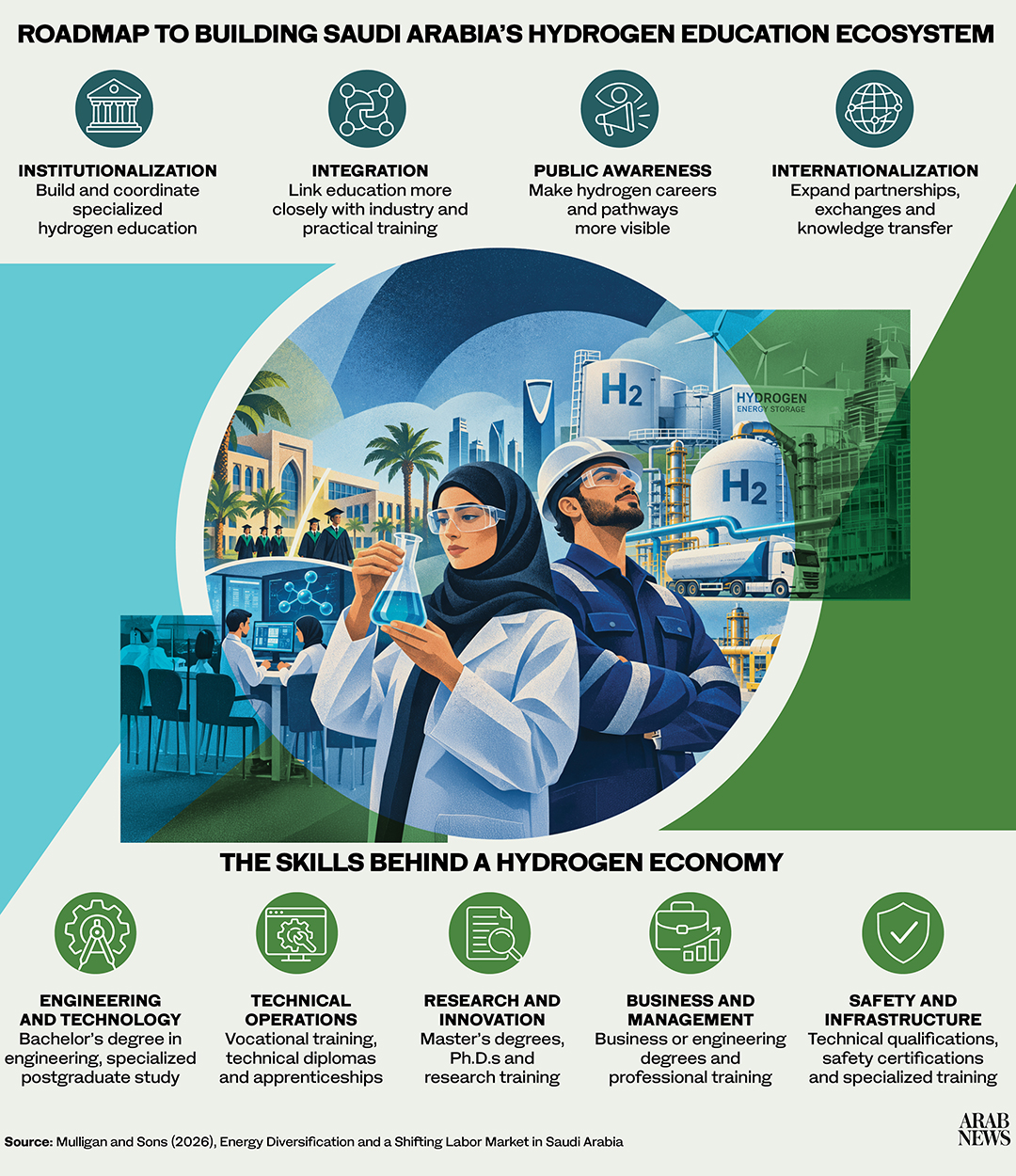
Sons proposed a four-pillar framework for hydrogen education: institutionalization, integration, public awareness and international cooperation. His research, co-authored with Cian Mulligan, “Energy diversification and a shifting labor market in Saudi Arabia: Green jobs and education potential in the development of a clean hydrogen sector,” identifies gaps in specialized training, vocational education and institutional coordination.
Building on existing capabilities
Rather than creating entirely new education systems, Sons argued that Saudi Arabia should expand the hydrogen-related activities of its existing universities, research centers and industrial institutions.
Several universities already offer relevant academic and research programs. King Saud University’s master’s program in renewable energy includes hydrogen-related courses, while its Sustainable Energy Technologies Centre researches hydrogen production, storage and utilization.
King Fahd University of Petroleum and Minerals offers an undergraduate concentration in hydrogen mobility, covering fuel cells, production, storage and infrastructure. Its Interdisciplinary Research Centre for Hydrogen Technologies and Carbon Management also conducts research in the field.
At King Abdullah University of Science and Technology, hydrogen technologies feature in graduate-level chemical engineering education and specialist training, including the KAUST Academy’s Energy Transition Specialization.
Dr. Husain Baaqel, a postdoctoral fellow at KAUST’s Clean Combustion Research Centre, said the Kingdom already had a substantial technical foundation on which to build.
“I believe Saudi Arabia does not need to build its hydrogen workforce from scratch. Much of the technical foundation already exists within its universities, technical colleges, and established energy and petrochemical industries,” he said.
He pointed to a collaboration between Neom Green Hydrogen Co. and the Energy and Water Academy, which includes one- to two-year training programs for technicians and engineers in renewable energy and green hydrogen technologies.
Sons said universities and companies, including ACWA Power, were already providing capacity-building courses, but greater coordination was needed to avoid fragmented efforts.
“When it comes to harmonization, and of course also coordination, there seems to be still some opportunities left to improve this kind of coordination between the different institutions,” he said.
The Kingdom’s established oil and petrochemical industries also offer a foundation for developing hydrogen expertise, he added.
“Saudi Arabia is, in this regard, better prepared than maybe any other country in the world, because the Kingdom is so well experienced when it comes to oil production, when it comes to petrochemicals, when it comes to the energy industry itself,” he said.
Matching skills with employment
Developing a hydrogen workforce will require academic qualifications as well as practical and vocational training.
“Not everybody needs to have an academic degree. Vocational training is, in particular in this field, I think also very attractive to develop labour skills relatively fast and also bring them to the job market and have skilled or semi-skilled workers available,” Sons said.
The study identifies skills requirements across hydrogen production, storage, transportation, operations and maintenance. It also notes that 26 percent of Saudi high school graduates enrolled in technical and vocational education programs in 2022.
Baaqel said students needed greater practical exposure to electrolysis, purification and storage, alongside dedicated hydrogen safety training. Other emerging requirements include techno-economic analysis, life-cycle assessment and process simulation.
Economist Talat Hafiz said aligning education with labor-market requirements was essential to matching graduates with available jobs and advancing Saudization.
“Close cooperation between educational institutions and employers would help match graduates’ qualifications with available jobs,” he said.
A 2025 study published by Germany’s H2-diplo office estimated that Saudi Arabia would need between 91,000 and 127,000 skilled workers across the wider renewable energy sector by 2030.
However, employment patterns in hydrogen projects make workforce planning particularly important. The Sons-Mulligan study, citing international research, notes that operational employment can account for less than one-tenth of the jobs generated during construction.
Hafiz warned that if hydrogen capacity expanded faster than local skills development, dependence on foreign expertise could increase costs, delay projects and undermine operational efficiency.
“Without a clear plan for training Saudis and transferring knowledge, the Kingdom could miss an important opportunity to develop local talent and retain more of the industry’s economic benefits within the domestic economy,” he said.
Sons stressed the need for better data on graduate numbers and future occupational requirements to ensure training programs reflect actual industry demand.
“To really know exactly how many engineers are needed to really build a local green hydrogen industry in Saudi, that is key,” he said.
Raising awareness of hydrogen careers
Public awareness is another part of the proposed framework. Sons said young Saudis needed a clearer understanding of the professions and employment opportunities emerging in the sector.
“People need to see hydrogen as a real industry offering identifiable professions and employment opportunities, rather than an abstract future ambition,” he said.
Uncertainty over the sector’s commercial prospects could discourage students from pursuing specialized qualifications. Career guidance highlighting technical occupations, vocational pathways and entrepreneurship opportunities could help address this challenge.
Expanding international cooperation
The fourth pillar focuses on international partnerships through scholarships, joint research, technical exchanges and knowledge transfer.
“Germany offers one example, particularly given the existing cooperation between the two countries on hydrogen. However, Saudi Arabia should also examine educational models and expertise from the United States, the United Kingdom, South Korea and other countries,” Sons said.
He also called for closer cooperation with Gulf countries, including Oman, Qatar and the UAE, through regional exchanges and scholarships.
“Saudi Arabia doesn’t have to invent everything on its own and develop everything alone. There is also an opportunity maybe to bring different capacities and resources together. And in the end, that would make it maybe more efficient and also less expensive,” Sons said.
Hafiz said universities should provide scientific and engineering foundations, while vocational institutions prepare technicians for practical roles. International partnerships and structured knowledge transfer could complement these efforts, helping Saudi nationals progress into technical and leadership positions.
Ultimately, translating Saudi Arabia’s hydrogen ambitions into lasting economic benefits will depend not only on building production capacity but also on developing the national skills base needed to operate, maintain and expand the industry.