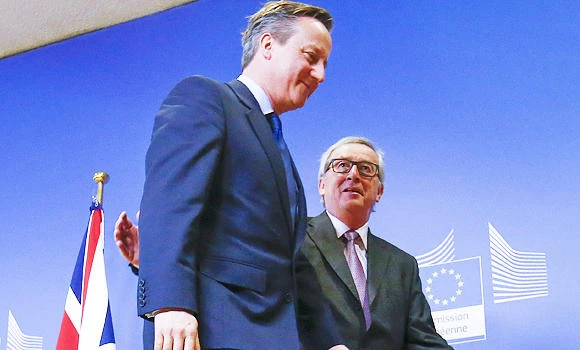
BRUSSELS: British Prime Minister David Cameron is kicking off a high-stakes weekend of diplomatic negotiations on European Union reforms with a visit to EU headquarters.
Cameron is seeking a deal on immigration controls and launching three days of talks that could deliver a draft EU reform package that might keep Britain in the European Union.
Over lunch with European Commission President Jean-Claude Juncker, Cameron will discuss in detail how an EU proposal to meet his demands for curbs on other Europeans working in Britain might work, sources close to the negotiations told Reuters.
On Sunday, Cameron will host Tusk for more talks at Downing Street as the Feb. 18-19 EU summit on the issue is drawing near.
Cameron has said he will back staying in the EU if the reform will allow Britain more independent decision-making, and that he was heartened by recent talks.
“What I was previously told was impossible is now looking like it is possible,” he told the BBC.
“We have made progress. It is encouraging that people like the European Commission are coming forward with ideas,” he said ahead of his meeting with Commission President Jean-Claude Juncker.
Speculation is mounting that the EU will offer Britain an “emergency brake” which would allow the UK to place temporary curbs on benefits for migrants if the British welfare system is under strain.
The proposal could satisfy Britain’s goal of regaining some control over immigration, and other countries’ desire to maintain the key EU principle of free movement among member states.
Pro-EU Conservative lawmaker Nick Herbert told the BBC that Britons would be willing to consider the idea, “because what we want is a solution.”
But Euroskeptic Tory legislator John Redwood said the proposal was “simply a bad joke” that would not give Britain control of its borders.
If the prime minister and the Union’s chief executive can come to terms on a new “emergency brake,” letting any state cut benefits to workers arriving from the EU if other leaders agree its welfare system is at risk, then the draft package could be circulated to all EU governments on Monday, giving time for wider negotiations until a summit three weeks from now.
Cameron could give a green light to that process, raising the prospect of an accord in mid-February and a referendum on British EU membership as early as June, over a Downing Street dinner on Sunday with European Council President Donald Tusk.
Brussels officials see this as a “crucial” weekend and it is likely that Juncker, whose executive would have to agree to initiate the necessary legislation for the emergency brake, will describe it to Cameron as the best offer he will get and by no means certain to win warm endorsement from other states.
The proposals reported by Reuters on Thursday were welcomed by Cameron’s office as a sign of “constructive” talks. But aides insisted there was no urgency on a deal and that Cameron was sticking for now with his demand to be able to simply bar EU workers from benefits for at least four years.
“I am encouraged that ideas are coming forward that have some force but we are not there yet, they are not yet strong enough,” Cameron told BBC Radio Scotland on Friday.
“The question with these brakes and ideas, it is very important how they are pulled, how long they last, how much strength they have and those are all of the things that I’ll be talking about in Brussels.”
As it stands, the EU proposal would cap it at four years and give every other member state a veto on pressing the “brake.”
Facing tight opinion polls on a referendum he must hold by the end of next year, and with deep Euroscepticism within his own party and cabinet, Cameron must decide when to compromise and launch a campaign to keep Britain in the EU. Signs that a summer flare-up in Europe’s refugee crisis could swing Britons against staying in the bloc could also affect his calculation.
Without a deal, Cameron has threatened to campaign the other way, but fellow EU leaders insist they will offer him the best they can to avoid losing the second-biggest economy from a Union that is already beset with profound crisis.
EU powers including Germany and France have made clear they sympathise with efforts to reduce what Cameron says is an unsustainable number of poor east Europeans taking jobs in the West. But they dismissed Cameron’s opening gambit on benefits as a crude measure that would breach treaties on free movement.
Several states in the euro zone are also resistant to giving Britain all it wants in the package to be able to protect its sterling-based economy from decisions by the EU currency union.
Some east European leaders, anxious not to see their people discriminated against, have said they could accept the emergency brake idea on migration. Although the new, Eurosceptic foreign minister of Poland, the leading power in the east, said on Friday he was against such a measure, on which detail is scant.
Those committed to ending Britain’s 43-year membership of the bloc also dismissed it as not going far enough to restore national control over who comes in to work in the country.
Cameron kicks off high-stakes weekend on EU reform talks