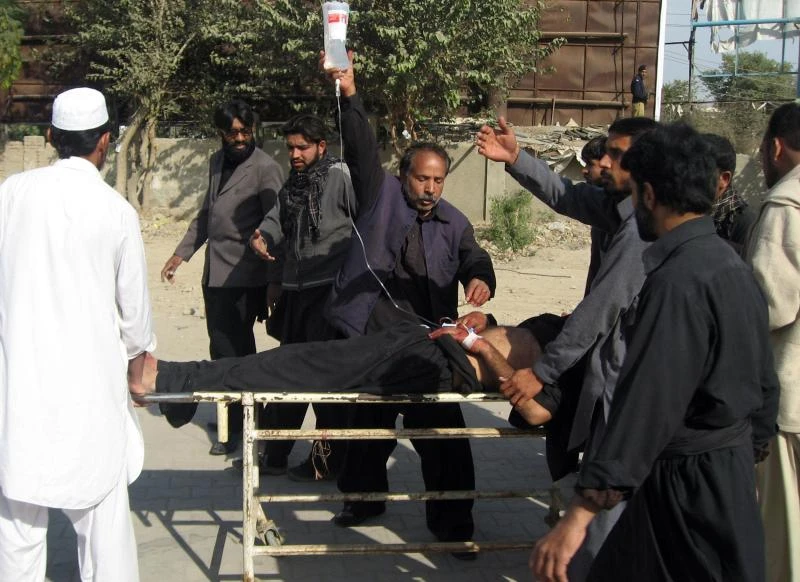
DERA ISMAIL KHAN, Pakistan: A bomb killed at least five people and wounded about 70 near a Shiite procession in Pakistan on Sunday, police said, as the sect braced for major sectarian attacks by Sunni militants during a critical event in their religious calendar.
Television footage showed the wounded being carried away in the northwestern city of Dera Ismail Khan, where a bomb targeting Shiites killed at least seven people, including four children, on Saturday.
Sunday's blast followed another attack on the outskirts of Dera Ismail Khan, in which seven people, including four children, were killed and 30 others wounded when a remote-controlled bomb exploded near a procession. The Pakistani Taleban claimed responsibility.
Last Thursday, another suicide attack also claimed by the Pakistani Taleban killed 23 people in the garrison city of Rawalpindi.
Sunday's bomb, planted in a shop beside a street market, also wounded five security officials, said senior police official Malik Mushtaq.
A doctor at a hospital in Dera Ismail Khan said five people were killed and 70 wounded. “There is a lack of ambulances and not enough hospital beds,” he said. “People brought many of the injured to the hospital on rickshaws.”
Hard-line sectarian Sunni groups, which are becoming increasingly dangerous, have threatened more attacks as the Shiite morning month of Muharram comes to a climax on Sunday.
Security officials say organizations such as Lashkar-e-Jhangvi (LeJ) are stepping up attacks on Shiites, who they regard as non-believers, in a bid to destabilize nuclear-armed, US ally Pakistan.
Al Qaeda, which is close to LeJ, pushed Iraq to the brink of a sectarian civil war several years ago with large-scale suicide bombings of Shiites.
More than 300 Shiites have been killed in Pakistan so far this year in sectarian conflict, according to human rights groups. The campaign is gathering pace in rural as well as urban areas such as Karachi, Pakistan’s biggest city.
Shiites account for up to 20 percent of this nation of 180 million.
The growing death toll has discouraged some Shiites from taking part in processions this year during one of their most sacred rituals, when people flagellate themselves with chains and other items.
“If I were to compare with last year, the fear has definitely increased,” said Sadia Fatema, 28. “Just last night me and my mother were asking my father and brother if they really had to go to the procession. We are worried.”
Others say the pressure has made Shiites stand up to Sunni hard-liners.
“There is fear, but there is also anger and defiance among Shiites,” said one, who asked not to be named.
“Shiites never felt like a minority in Pakistan but now they are slowly being turned into a real minority. And Shiites will not let this happen.”
Washington, a critical source of financial aid for cash-strapped Pakistan, has been pressuring the South Asian nation to crack down on militants based in tribal areas who cross the border to attack American-led forces in Afghanistan.
Pakistan, meanwhile, faces major domestic security challenges from a wide range of groups, including the Taleban, who capitalize on issues such as unemployment, official corruption and poverty to boost recruitment.