LONDON: British Prime Minister Theresa May acknowledged the “reality” of her weakened position Monday by appealing to other parties to help implement Brexit, as she sought to relaunch her year-old premiership.
One month after losing her parliamentary majority in a snap election, the Conservative leader said she was still committed to “bold action” to fulfil her promises of change.
But as fresh rumors swirled of plans to oust her, May accepted that “the reality I now face as prime minister is rather different” than it was.
Her comments came in excerpts of a speech due to be delivered on Tuesday, the anniversary of her winning the Conservative Party leadership race after last year’s referendum vote to leave the EU.
“In this new context, it will be even more important to make the case for our policies and our values, and to win the battle of ideas both in parliament as well as in the country,” May will say.
“So I say to the other parties in the House of Commons... come forward with your own views and ideas about how we can tackle these challenges as a country.”
May has been struggling to maintain her authority since the June 8 election, which she called three years early only to lose seats, leaving her with a minority government.
The Mail on Sunday reported that former Conservative chief whip Andrew Mitchell had told a private meeting of MPs that May was “dead in the water” and must quit.
Justice Secretary David Lidington said this and other rumors were the result of politicians enjoying “too much sun and too much warm Prosecco” at summer parties.
May’s de facto deputy Damian Green insisted Monday that her call for cross-party cooperation was a “grown-up way of doing politics.”
A new cross-party parliamentary group was launched on Monday calling for the “closest possible relationship” with the EU and demanding that “all options are kept on the table” in the negotiations, which began last month.
It is co-chaired by opposition Labour MP Chuka Umunna and Conservative former minister Anna Soubry, both outspoken pro-Europeans, and backed by the smaller Liberal Democrats.
‘Damp squib’
The premier’s fresh appeal came as Guy Verhofstadt, the European Parliament’s chief Brexit negotiator, threatened to veto a plan by her government on the status of EU nationals after Britain leaves the bloc, calling it a “damp squib.”
Verhofstadt signed the letter published in Britain’s Guardian daily and other European newspapers, along with the leaders of the main center-right and center-left groupings in the European Parliament.
“The European Parliament will reserve its right to reject any agreement that treats EU citizens less favorably than they are at present,” the letter said.
It said Britain’s plan “would cast a dark cloud of vagueness and uncertainty over millions of Europeans” by giving EU citizens living in Britain fewer rights than those of British citizens in the EU.
“It was a damp squib,” the letter said, adding that the risk was of “creating second-class citizenship.”
Under the proposals, EU nationals who have been resident in Britain for five years would earn permanent residency rights as is currently the case.
But, like non-EU immigrants now, they would lose the right to vote in local elections in Britain and would be subject to minimum salary requirements to be able to bring family members into the country.
The MEPs said the proposals also left it “unclear what the status of post-Brexit babies would be.”
Children born to EU nationals who do not have permanent leave to remain will have to apply for it.
There are estimated to be around 3.2 million EU nationals living in Britain and around one million British nationals in other parts of the EU.
Also Monday, Australian Premier Malcolm Turnbull expressed confidence in Britain’s plans to forge global trade deals once it leaves the EU.
After talks with May, Turnbull said Australia stands ready “to enter into a free trade agreement with the United Kingdom as soon as the UK is free to do so.”
Turnbull backed May’s assertion that Britain will be able to prosper after Brexit by striking new free trade deals around the world.
He said Brexit would bring “big horizons, big opportunities” for Britain.
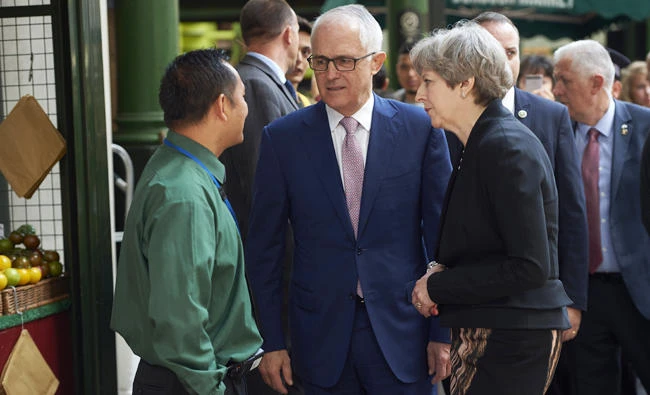
May and Turnbull also visited London’s Borough Market, site of an attack last month that killed eight people, two of them Australians.
One month after losing her parliamentary majority in a snap election, the Conservative leader said she was still committed to “bold action” to fulfil her promises of change.
But as fresh rumors swirled of plans to oust her, May accepted that “the reality I now face as prime minister is rather different” than it was.
Her comments came in excerpts of a speech due to be delivered on Tuesday, the anniversary of her winning the Conservative Party leadership race after last year’s referendum vote to leave the EU.
“In this new context, it will be even more important to make the case for our policies and our values, and to win the battle of ideas both in parliament as well as in the country,” May will say.
“So I say to the other parties in the House of Commons... come forward with your own views and ideas about how we can tackle these challenges as a country.”
May has been struggling to maintain her authority since the June 8 election, which she called three years early only to lose seats, leaving her with a minority government.
The Mail on Sunday reported that former Conservative chief whip Andrew Mitchell had told a private meeting of MPs that May was “dead in the water” and must quit.
Justice Secretary David Lidington said this and other rumors were the result of politicians enjoying “too much sun and too much warm Prosecco” at summer parties.
May’s de facto deputy Damian Green insisted Monday that her call for cross-party cooperation was a “grown-up way of doing politics.”
A new cross-party parliamentary group was launched on Monday calling for the “closest possible relationship” with the EU and demanding that “all options are kept on the table” in the negotiations, which began last month.
It is co-chaired by opposition Labour MP Chuka Umunna and Conservative former minister Anna Soubry, both outspoken pro-Europeans, and backed by the smaller Liberal Democrats.
‘Damp squib’
The premier’s fresh appeal came as Guy Verhofstadt, the European Parliament’s chief Brexit negotiator, threatened to veto a plan by her government on the status of EU nationals after Britain leaves the bloc, calling it a “damp squib.”
Verhofstadt signed the letter published in Britain’s Guardian daily and other European newspapers, along with the leaders of the main center-right and center-left groupings in the European Parliament.
“The European Parliament will reserve its right to reject any agreement that treats EU citizens less favorably than they are at present,” the letter said.
It said Britain’s plan “would cast a dark cloud of vagueness and uncertainty over millions of Europeans” by giving EU citizens living in Britain fewer rights than those of British citizens in the EU.
“It was a damp squib,” the letter said, adding that the risk was of “creating second-class citizenship.”
Under the proposals, EU nationals who have been resident in Britain for five years would earn permanent residency rights as is currently the case.
But, like non-EU immigrants now, they would lose the right to vote in local elections in Britain and would be subject to minimum salary requirements to be able to bring family members into the country.
The MEPs said the proposals also left it “unclear what the status of post-Brexit babies would be.”
Children born to EU nationals who do not have permanent leave to remain will have to apply for it.
There are estimated to be around 3.2 million EU nationals living in Britain and around one million British nationals in other parts of the EU.
Also Monday, Australian Premier Malcolm Turnbull expressed confidence in Britain’s plans to forge global trade deals once it leaves the EU.
After talks with May, Turnbull said Australia stands ready “to enter into a free trade agreement with the United Kingdom as soon as the UK is free to do so.”
Turnbull backed May’s assertion that Britain will be able to prosper after Brexit by striking new free trade deals around the world.
He said Brexit would bring “big horizons, big opportunities” for Britain.
May and Turnbull also visited London’s Borough Market, site of an attack last month that killed eight people, two of them Australians.