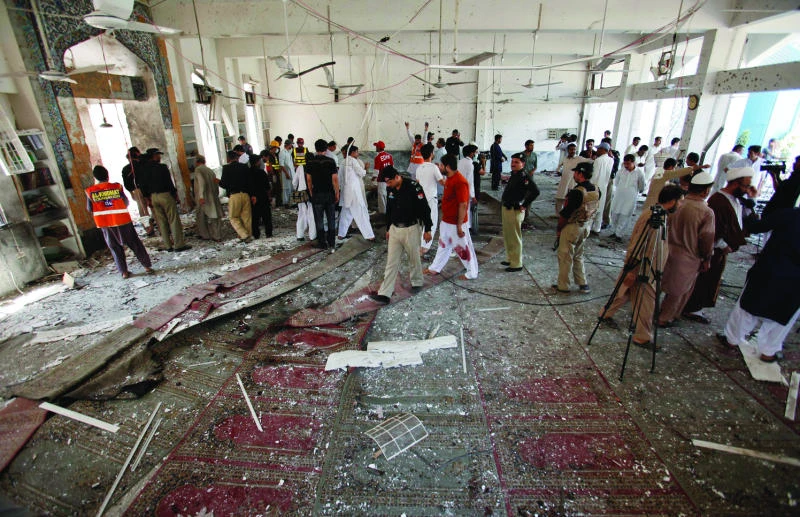
PESHAWAR: Militants opened fire on a mosque where worshippers were gathering for prayers, and then a suicide bomber detonated his explosives inside, killing 15 people in the latest attack, police said.
The attack hit the city of Peshawar, which is on the outskirts of Pakistan's tribal area, the main sanctuary for militants. They have targeted the city with scores of bombings in recent years.
Three militants initiated the attack on the mosque, located inside a religious school, by firing on a policeman who was standing guard outside, said senior police official Shafiullah Khan. The policeman was critically wounded, Khan said.
The militants then entered the mosque, where one of them detonated his suicide vest. The other two militants escaped, and police have launched a search operation to find them, Khan said. Fifteen people were killed and scores more wounded, he said.
Zawar Hussain, who was inside the mosque when the attackers struck, said their firing set off panic among the roughly 300 worshippers inside. Then came the explosion.
"After the blast, I fell down. People were crying for help," said Hussain. "I saw bodies and badly injured worshippers everywhere."
Local TV video showed blood splattered everywhere. Broken glass littered the floor, and there were holes in the walls and ceiling caused by ball bearings packed in with the bomber's explosives to cause maximum damage and casualties. Relatives at a local hospital wailed in grief as rescue workers wheeled in wounded victims, their clothes soaked in blood.
No one has claimed responsibility for the bombing.
Last Saturday, a bomb ripped through a bus carrying female university students in the southwest city of Quetta, killing 14 people. Militants then attacked a hospital where wounded victims were taken, killing more people.
The militant group Lashkar-e-Jhangvi claimed responsibility for the attack in Quetta and could be suspected in yesterday's Peshawar attack as well. The group has carried out many of the attacks in recent years, especially in Baluchistan province, where Quetta is the capital.
Last year was one of the most deadly in Pakistan's history, according to Human Rights Watch, which said more than 400 people were killed. This year is shaping up to be even deadlier. Two attacks carried out by Lashkar-e-Jhangvi in Quetta at the beginning of the year killed nearly 200 people.
The sectarian violence presents a significant challenge to Pakistan's new government, which took power earlier this month under the leadership of Prime Minister Nawaz Sharif.
Human rights activists and members of the Shiite community criticized the last government for failing to do enough to stop the attacks. The new government has promised to do more, but some critics have questioned whether Sharif will follow through. His party has done little to crack down on Lashkar-e-Jhangvi and other militant groups in its home province of Punjab in central Pakistan, even though the party controlled the provincial government for the last five years.
Also yesterday, four gunmen on two motorcycles shot to death a provincial lawmaker and his son in the southern city of Karachi, police officer Amir Farooqi said. Sajid Qureshi was a lawmaker for the Muttahida Qaumi Movement, the party that controls Karachi. Karachi has a long history of political, religious and criminal violence. Much of the violence is carried out by gangs allegedly affiliated with the city's main political parties, including the MQM.
Militants strike again in Pakistan; 15 killed