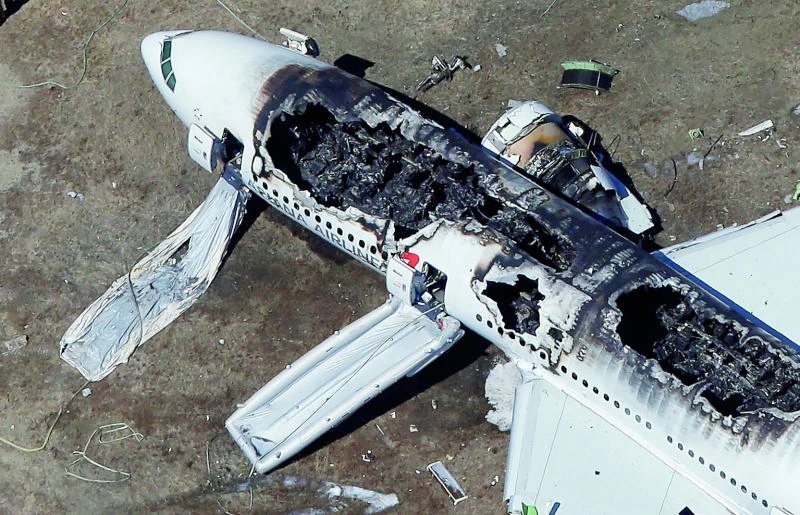
SAN FRANCISCO: Police officers threw utility knives up to crewmembers inside the burning wreckage of Asiana Airlines Flight 214 so they could cut away passengers’ seat belts. Passengers jumped down emergency slides, escaping from thick billowing smoke.
And amid the chaos, some urged fellow passengers to keep calm, even as flames tore through the Boeing 777’s fuselage.
As investigators try to determine what caused the crash of Flight 214 that killed two passengers Saturday at San Francisco International Airport, the accident left many wondering how nearly all 307 people aboard were able to make it out alive.
“It’s miraculous we survived,” said passenger Vedpal Singh, who had a fractured collarbone and whose arm was in a sling.
Investigators took the flight data recorder to Washington, D.C., overnight to begin examining its contents for clues to the last moments of the flight, officials said. They also plan to interview the pilots, the crew and passengers.
“I think we’re very thankful that the numbers were not worse when it came to fatalities and injuries,” said National Transportation Safety Board chief Deborah Hersman on NBC’s “Meet the Press” on Sunday. “It could have been much worse.”
While authorities have said very little about the investigation at this early stage, clues have emerged in witness accounts of the planes approach and video of the wreckage, leading one aviation expert to say the aircraft may have approached the runway too low.
Mike Barr, a former military pilot and accident investigator who teaches aviation safety at the University of Southern California, said it appeared that something on the plane in its low approach may have caught the runway lip — the seawall at the foot of the runway.
San Francisco is one of several airports around the country that border bodies of water that have walls at the end of their runways to prevent planes that overrun a runway from ending up in the water.
Since the plane was about to land, its landing gear would have already been down, Barr said. It’s possible the landing gear or the tail of the plane hit the seawall, he said.
Passengers describe terror at tail end of trans-Pacific flight