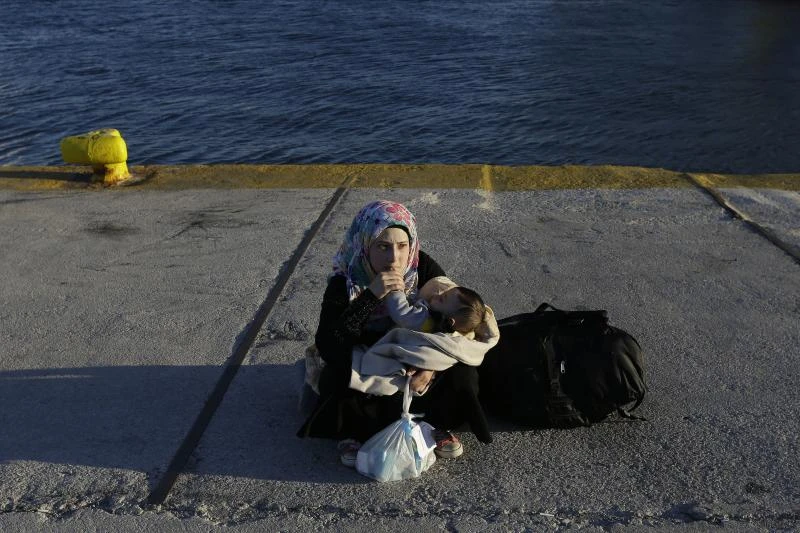
GENEVA: More than 218,000 migrants and refugees crossed the Mediterranean to Europe in October — a monthly record and more than during the whole of 2014, the United Nations said Monday.
“Last month was a record month for arrivals,” UN refugee agency spokesman Adrian Edwards said pointing out that “arrivals in October paralleled the entire 2014.”
In October, 218,394 people made the perilous crossing — all but 8,000 of them landing in Greece — compared to 216,054 Mediterranean arrivals during all of last year, UN figures show.
The soaring numbers of arrivals last month brought to over 744,000 the number of people who have made the journey so far this year.
The October figures show that despite the increasingly harrowing conditions at sea at the onset of winter, refugees from Syria and other trouble spots continue to pile into boats heading west, fearing that Europe is about to close its borders.
Among the more than 600,000 migrants and refugees who have crossed to Greece since the beginning of the year, 94 percent come from the world’s top 10 refugee-producing countries.
The ballooning number of crossings has had dire consequences, with the numbers of deaths piling up by the day.
Some 3,440 people have died or gone missing trying to cross the Mediterranean to Europe so far this year, according to UNHCR numbers last week.
The figures do not take into account the latest tragedy, with at least 15 migrants and refugees, including six children, drowning off Greece on Sunday when two boats making the hazardous crossing from Turkey capsized.
Most of the Mediterranean deaths this year have happened on the longer, more dangerous route to Italy, but with surging numbers attempting the far shorter crossing from Turkey to Greece, the death toll along that route has been mounting.
The latest tragedies bring the migrant death toll in Greece’s waters in the past month to over 80, many of them children, according to AFP’s count.
Police say a total of 307,000 refugees and other migrants have passed through Croatia since the surge of people spilled over from neighboring Balkan states.
Police spokesman Domagoj Dzigumovic said Monday that 8,400 entered on Sunday alone, which made it one of the busiest days since Sept. 16 when Hungary sealed its border with Serbia and the migrant route was diverted to Croatia.
Greek authorities have increased to 43 the number of deaths from last week’s sinking of an overloaded wooden boat carrying more than 300 refugees and economic migrants from Turkey to the Greek island of Lesbos.
The coast guard said Monday that rescuers have so far recovered the bodies of 20 children, 17 men and six women who drowned after the battered vessel capsized off the eastern Aegean Sea island in rough seas Oct. 28.
A total of 274 people survived the accident, which was the worst in Greek waters during the mass refugee influx following the war in Syria.
At least 90 people have drowned in the Aegean Sea over the past five days, while thousands have crossed to the Greek islands on frail, unseaworthy craft provided by smuggling gangs.
Germany says it expects the so-called hotspots for migrants in Greece to begin functioning by the end of the month.
The European Union agreed to set up the processing centers in those countries where the biggest numbers of migrants arrive. Those deemed likely to get asylum or some other form of protection are then meant to be redistributed across the EU.
Tobias Plate, a spokesman for Germany’s interior ministry, said the centers were at various stages of completion but “we expect this to proceed rapidly.”
Plate told reporters in Berlin on Monday that Germany “expect that in November...the hotspots, particularly in Greece, will become fully operational.”
Germany, meanwhile, is close to completing work on two “waiting zones” capable of housing 5,000 migrants each at its border with Austria, Plate said.
The Czech Republic is sending a unit of 20 police officers to Slovenia to help the tiny Alpine nation cope with the influx of thousands of migrants and protect the external border of Europe’s visa-free Schengen zone.
Interior Minister Milan Chovanec says Monday’s decision by the government follows a request by Slovenia and the officers are expected to be deployed along the border with EU member Croatia in a week.
Chovanec says they should stay there at least a month but that could be extended if Slovenia needs them for a longer time.
The Czechs already sent 50 policemen to help Hungary last week.
Slovenia has said its capacities are stretched to the limit with thousands of migrants crossing its territory in hopes of reaching Western Europe.
Ambulance workers are protesting on the Greek island of Lesbos, where state budget cuts have left only three vehicles in operation despite a massive daily influx of refugees.
The drivers protested in the island’s capital of Mytilene, then handed out clothes to refugee children.
Costas Filis, head of the island’s ambulance workers association, told The Associated Press that five ambulances were awaiting repairs and that staff shortages had forced rescuers to work up to 16 hours at a time.
Greece’s coast guard says it has rescued more than 1,400 people in 39 separate search-and-rescue operations in the eastern Aegean over the weekend.
The wave of people fleeing conflict and poverty to come to Europe is continuing unabated despite worsening weather conditions. High winds churned the Aegean over the weekend.
The coast guard said it had picked up 1,431 people near the islands of Lesbos, Samos, Farmakonissi, Kalymnos, Kalolymnos, Symi and Rhodes between Friday morning and Monday morning.
Bavaria’s governor is declaring himself satisfied, for now, with a weekend compromise with fellow conservative Chancellor Angela Merkel’s party on how to handle Europe’s migrant crisis.
Horst Seehofer has been the most prominent critic of Merkel’s welcoming approach to the refugees and had demanded government action by Sunday to limit the influx. Leaders of Merkel’s governing coalition didn’t agree on new action Sunday but agreed to meet again on Thursday.
The mayor of the Greek island of Lesbos says there’s no more room to bury the increasing number of asylum-seekers killed in shipwrecks of smuggling boats coming in from nearby Turkey.
Mayor Spyros Galinos told Greece’s Vima FM radio Monday there were more than 50 bodies in the morgue on his eastern Aegean island that he was still trying to find a burial location for. Galinos said he was trying to fast-track procedures so a field next to the main cemetery could be taken over for burials.
Hundreds of thousands of people have made the short but dangerous crossing from Turkey to Greek islands this year. With rougher fall weather coming on, the bodies of 19 people were recovered from the Aegean in three separate incidents on Sunday alone.
Record 218,000 migrants crossed Mediterranean