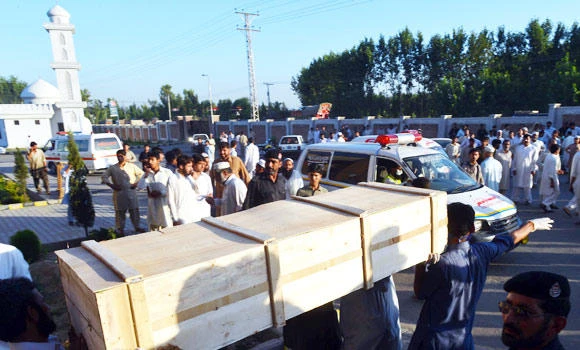
PESHAWAR: A suicide bombing at a funeral in Pakistan yesterday killed at least 27 people including a provincial lawmaker, police said, the deadliest attack to hit the country in more than three months.
The attack in Shergarh town in Mardan district, 145 km (90 miles) northwest of Islamabad, came during prayers for the owner of a local fuel station.
Police said the politician appeared to be the target of the blast, which highlights the security challenges facing the new government of Prime Minister Nawaz Sharif, sworn in earlier this month after winning the May 11 general election.
Local police chief Tahir Ayub said “at least 27 people were killed and 55 others wounded in the blast” and that it was a suicide attack.
Another local police official, Jaffer Khan, confirmed the toll.
“The bomber came on foot and blew himself up near Imran Khan Mohmand, who seems to have been the target,” Khan said.
Mohmand was elected last month to the provincial assembly in northwestern Khyber Pakhtunkhwa province, where former cricketer Imran Khan’s Pakistan Tehreek-e-Insaaf party heads the new coalition government.
More than 150 people died in militant attacks during the election campaign but yesterday’s bombing is the deadliest since a blast in a Shiite Muslim area of Karachi on March 3 killed 50 people.
The attack comes three days after 25 people died when militants blew up a bus carrying female students in the southwestern city of Quetta and stormed a hospital where survivors were taken for treatment.
Malala Yousafzai, the Pakistani schoolgirl shot by the Taleban for promoting girls’ education, denounced the attack on the Quetta bus as “cowardly.”
Searches over politician’s murder
In London, British counter-terror police yesterday searched two residential properties in London as part of an investigation into the murder of Pakistani politician Imran Farooq almost three years ago.
The 50-year-old, a founding member of the Muttahida Qaumi Movement (MQM), was attacked as he returned home from work in September 2010.
He died from multiple stab wounds and blunt trauma to the head, a post-mortem examination found.
The searches represent the first public sign of progress in the case in more than a year, although London’s Metropolitan Police Service insisted the investigation remained “active.”
“The searches are continuing. There have been no arrests,” the police said in a statement.
In September 2011, one year after Farooq’s murder, police offered a reward of £ 20,000 ($ 31,000, 23,000 euros) for information that helps lead to a prosecution, and this still stands.
“We remain committed to finding those responsible,” a police spokesman said.
Detectives had previously said that while they were open-minded about the motive, the attack would have required careful planning and that Farooq’s killers may have had help.
Suicide bomber kills 27 at Pakistan funeral