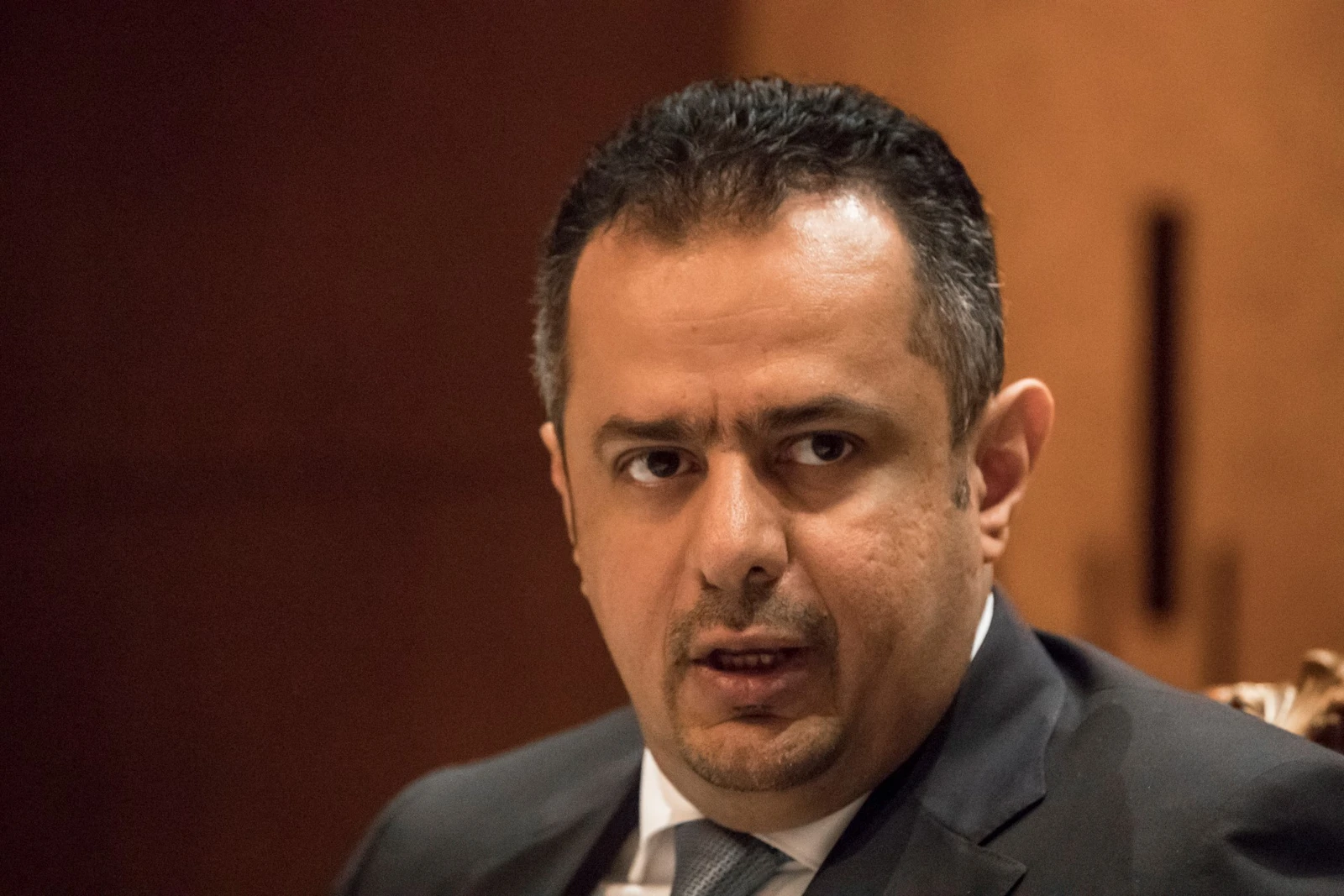
- Maeen Abdulmalik Saeed: Houthis seek to seize all of country and ‘help Iran expand chaos’
- He warns of ‘new era of radical terrorism’ shaped by militias using cheap, precise drones and missiles
LONDON: The security of the West is being fought over in the mountainous region surrounding the Yemeni city of Taiz, the country’s former prime minister has warned.
If the key city falls to the Iran-backed Houthis, Western security will suffer enormously, said Maeen Abdulmalik Saeed, now adviser to Yemen’s president, The Guardian reported on Friday.
He highlighted the importance of Taiz in the context of control over the Bab Al-Mandab Strait and the road to Aden, the seat of Yemen’s internationally recognized government.
Saeed’s comments came as part of an appeal for help from the West. He said the Houthis’ ambitions are to seize all of Yemen and “help Iran expand the chaos.”
He added that his government is under pressure in part due to the Houthis’ steady acquisition of long-range drone and missile technology, a threat that had not been fully appreciated.
“The battle around Taiz is not just a battle for Taiz, but a broader battle that involves the whole of the Western world, and one of the most important maritime straits,” he said.
“The Houthis know controlling Taiz is controlling the straits and it’s the highlands before the straits and the coastal city of Mokha and the Gulf of Aden.
“If Taiz is lost, access to the strait will be lost. The rest of the country will come later. The Houthi plan is to control the whole of Yemen.”
He added: “The Houthis bleed a lot, they suffer a lot, but they always want quickly to use their gains or any collapse to gain more land.”
It is “a matter of days” before “there will be a full siege” of Taiz, and the Houthis “will try to enter the city,” Saeed said. “It will be much worse than the siege of 2015 — it will be catastrophic.”
He added: “The loss of Taiz would have a very significant symbolic impact on the idea of the modern state in Yemen and of resisting the Houthi project, which relies on tribal networks and extremist religious education.
“I hope now that the knife has come to our neck, and the Houthis represent a critical threat, the priority would be to come together to defeat the Houthis, and then to discuss other demands and guarantees.”
He said the Houthi offensive toward the Red Sea last month was intended to relieve the heavy pressure facing its sponsor Iran.
“Its (Iran’s) airplanes and airports cannot operate; 90 percent of the oil was coming out of Hormuz. That is why they attacked the Saudi East-West pipeline,” he added.
“The Houthis, by talking about a Saudi blockade, have found a reason to hit the Saudi oil installations, airports and they want to do it now because the only thing Iran can do is to keep expanding the consequences of the war for America.”
Saeed spoke of the Houthis’ growing missile and drone capabilities, much of them provided by Iran. “In 2017, the Houthis had nothing but blind missiles to fire at us that missed their targets,” he said.
Highlighting a December 2020 attack on Aden International Airport that killed 28 people, Saeed said the militia has quickly developed missiles capable of precisely striking targets at least 300 km away.
“We thought even then they did not have that many missiles, but since then the Iranians have expanded their manufacturing lines,” he added.
In January 2022, the Houthis attacked Abu Dhabi oil tanker trucks more than 900 miles away using ballistic missiles.
By the time of the US Operation Rough Rider against the militia last year, “it was clear the Houthis had dozens of targeted missiles, land-sea missiles and drones. They had become a unified front with Iran, and developed their missile base,” Saeed said.
“This is a new era of radical terrorism. It is not the old chaotic one of Isis (Daesh) and Al-Qaeda. It is semi-state actors and militias threatening powerful states with cheap technologies, and smuggled third-party components,” he added.
“The way Iran has invested in the Houthis could become a model for threatening navigation elsewhere.
“It is a new model of war, without traditional armies, needing different air defences. Gulf countries have to reshape and rethink their defences.”