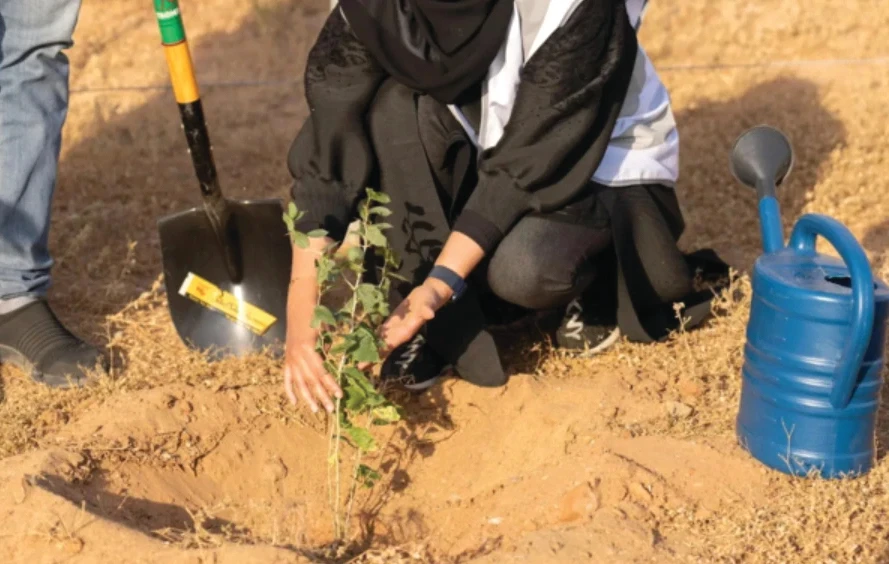
Living in a desert country has made our relationship with greenery an impulsive one. We can be suddenly seized with respect and admiration for anything green only to see the feeling will just as suddenly fade away and disappear.
Whenever I see uprooted and chopped-up trees lying in front of homes with trunks and leaves littering our streets, I think of what the Palestinians did recently when they had a funeral for an olive tree.
It was an expression of anger and protest at what the Israeli occupation forces are doing in the occupied lands; the Israelis systematically uproot and destroy Palestinian olive groves. The funeral was an expression to show the strong bond between man and his environment and the love the Palestinians have for their land and what it holds.
It is sad to see people cutting down trees around their homes in order to build some marble or stone structure. We destroy the very trees that are our lungs and which filter and clean the air we breathe.
We kill the trees that provide shelter and nesting places for beautiful small birds. We uproot the trees which give us shade and protection.
To justify the crime, we say trees block and obstruct the entrance to our homes and their fallen leaves litter the whole area. We tend to forget that the tree is our only guarantor against further encroachment by the desert whose sandstorms will bury the very marble buildings we erected in place of a tree.
A special week celebrating trees and their place in the environment is marked with predictably monotonous outbursts — by individuals and in the media.
We should develop and articulate a clear strategy and course of action to govern our relationship with trees and to engage our children’s care and interest. Our school gardens, if they exist at all, are dry, deserted and damaged by students.
They should be taught the value of trees and how to take care of them. They and the society of which they are a part would be the beneficiaries.
In many countries, families devote much of their time to creating and looking after home gardens. We, on the other hand, prefer to live in air-conditioned concrete bunkers which not only separate us from one another but also further damage our already precarious relationship with the environment.
Arab News From the Local Press 24 December 2002