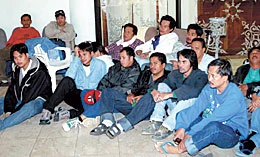
RIYADH, 22 December 2003 — A group of 16 Filipino workers, on hunger strike for the eighth day at the Philippine Embassy, were picked up by Saudi police last night.
The police took them to Shumaysi Central Hospital for a checkup because some of the workers had complained of health problems including chest pain, fever and bleeding.
“No force was used to move the strikers out of the chancery,” said Bahnarim A. Guinomla, the Philippine ambassador.
Guinomla said some 20 policemen led by Col. Muhammad Al-Mohayyed were allowed to enter the embassy’s reception lounge to arrest the striking workers.
“After initial medical examination at the hospital, the workers will be sent to the immigration detention center,” the diplomat said.
Mariano A. Dumia, a minister at the Philippine Embassy, said the mission made arrangements at Shumaysi Central Hospital for their treatment. He also said the Philippine mission had been trying to arrange for their early repatriation.
“A request has been sent to Riyadh Governor Prince Salman and a note has been forwarded to the Saudi Ministry of Foreign Affairs seeking urgent intervention in the matter,” he said.
But Dumia added: “Staging a hunger strike on the embassy premises violate the rules of the chancery while also contravening the laws of the host government.
“The strikers are seeking a general amnesty from the Saudi government without giving us a chance to negotiate with the employers and the Saudi authorities.”
Some of the workers’ employers accuse them of various crimes.
“One of the striking workers has been accused by his employer of embezzling SR100,000 from his company. There are other cases which will also need more time and effort to solve.”
However, the workers say they ran away from their employers because of harassment, unpaid salaries, refusal to provide residence permits, physical assault and maltreatment.
Three of the men — Danilo Morales, Jeesulito Merginio and Roberto Victorillo — ran away from Qasim in September where they say they worked for two years without being given iqamas.
“We have refused to be taken to hospital or accept shelter outside the embassy because of threats,” Domingo D. Yalung, a spokesman of the workers, said earlier. He did not say what threats the men received. Yalung said he developed health problems including blood in his stool and urine.
Froilan P. De Guzman said he collapsed Saturday night “because of high fever.” He looked worn and pale when talking to Arab News yesterday.
Relatives and friends of the hunger strikers in Manila are also asking for their early repatriation, adding to the pressure on the embassy, which has said the men must go through the Saudi legal system individually.
The families together with Migrante International, a global alliance of overseas Filipino groups, also picketed a director-level meeting of the Overseas Workers Welfare Administration (OWWA) in Manila, while renewing their demands for repatriation of the men.