
Childhood
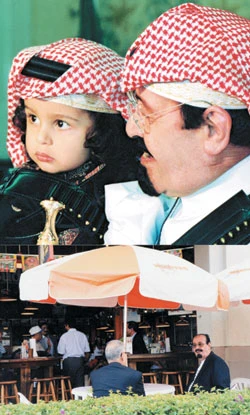
Prince Abdullah was born in Riyadh in 1924. His religious, physical and moral discipline were crucial in shaping his personality. The 13th son of King Abdul Aziz, the Kingdom’s founder, the young prince lived under the care and guidance of his father. He had the rare opportunity to become a witness to many historical events, including the tribal and intellectual conflicts in the Arabian Peninsula.
His uncles are leaders of the Shimmar clan. Aasi ibn Kulaib ibn Hamdan ibn Shuraim, his grandfather on the maternal side, and Matni ibn Al-Aasi ibn Shuraim, his uncle, were well-known Arab horsemen. King Abdul Aziz was his first teacher and immensely influenced his life and thinking.
Prince Abdullah says he benefited enormously from his father’s schooling.
It was King Abdul Aziz who taught his son the first lessons in governance, politics and leadership. But Prince Abdullah was also educated by senior Islamic scholars and thinkers.
The crown prince is an avid reader, a quality that has been instrumental in shaping his thinking. He sees reading as indispensable mental exercise. “Those who do not read or listen to modern science and knowledge will find themselves isolated in an abandoned world,” he says.
Dialogue
A tireless advocate of dialogue, Prince Abdullah was the brain behind the King Abdul Aziz National Dialogue Center, established earlier this year. “We have achieved our security and prosperity thanks to our Islamic faith, our commitment to national unity and our belief in the equality of all citizens. Any fruitful dialogue must be based on these two pivotal points,” he says.
“We have no life except under Islam and no dignity except through national unity. We will allow no one to harm the Islamic faith; we reject all attempts to undermine our national unity.”
Prince Abdullah, however, warned against exploiting the platform to settle personal accounts and work for vested interests.
The Crown Prince has always advocated modern approaches to protecting society. “We are part of the world, and it is no longer possible to protect the country and society from deviant ideas and destructive trends either by covering up or by banning things as we did in the past. We have to think of new ways of protecting our religion and citizens effectively.”
Dialogue opens a new channel for responsible expression of opinion, which in turn will contribute to the fight against bigotry, extremism and terrorism.
Stressing that Islam is a religion of kindness, mercy and tolerance, he says a minority of deviant terrorists should not be allowed to tarnish the image of the religion. “The bullets that kill women and children, terrorize people in their homes and destroy innocent communities do not come from rifles but from deviant thoughts and misguided interpretations of our great religion and its noble message,” he says.
Globalization
A staunch supporter of moderation, the crown prince has urged Saudis to prepare to deal with the new challenges and changing times. “The real challenge today is that we — both individuals and institutions — have to prepare to play our new roles in situations controlled by the forces of the global market and regional blocs without relinquishing our identity as a conservative Muslim society.”
Arab and Muslim countries must deal with globalization from a position of self-confidence, the prince believes.
“We welcome globalization of trade and investment but reject globalization of destructive ideas...Our hearts and homes are open to every useful things and are closed to the winds that undermine our faith,” he said.
“Ours is an age of international, regional and economic blocs and Islamic countries must unify their activities and strengthen their cooperation,” he adds.
Blaming Others
Prince Abdullah believes Islamic countries must stop blaming others for their own mistakes. “We are accustomed to blaming others instead of facing the challenge...Conspiracies and intrigues against Islam are not a new thing. They are present today and will continue in the future. It is time to take the blame before pointing the finger of accusation on others.
“A healthy body will be able to withstand incoming dangers. The most important challenge facing the Islamic nation is its weakness compared with industrially and technologically advanced countries,” he says.