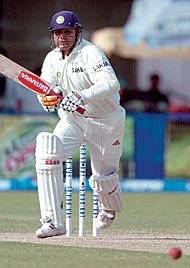
MULTAN, 29 March 2004 — The first day of the first cricket Test match between India and Pakistan could be summed up in one word — inexplicable.
The only thing that could be explained straight away is that India’s Virender Sehwag was Sehwag.
Playing true to form, his fusillade from the time India captain Rahul Dravid won the toss and unleashed him at the Multan Cricket Stadium, and the crowd was treated to his rollicking batting.
India finished the day at 356 for two as Pakistan sweltered and wilted in the face of some majestic batting from the Delhi opener.
He ended his record-breaking day at 228 not out as Sachin Tendulkar quietly went about his way in racking up 60 not out in 198 minutes.
Sehwag’s effort was the third double century against Pakistan by an Indian, while it was also his first. The other two double centuries were scored by Anshuman Gaekwad (201) and Sanjay Manjrekar (218).
It was ironic that another Indian should begin this friendship series with a smasher of an innings after the last tour by India here, nearly 15 years ago, had seen Manjrekar graft out 218 over two and a half days, and that only a handful of spectators were at hand to witness this knock yesterday.
The low turnout, after the record crowds for the One-Day Internationals, was inexplicable.
Also inexplicable was the make-up of both the teams on a wicket that held nothing for the bowlers.
Both the teams have a 3-1 combination with each playing one spinner while opting for pace.
Also inexplicable was Pakistan captain Inzamam ul-Haq’s strategy of using his fast bowlers in short spells on a fixed rota, rather than continuing with his main weapon — Shoaib Akhtar, the world’s fastest bowler.
Shoaib was extremely effective in his first spell of five overs, sticking to a nagging line and sustained speed.
He conceded only 13 runs then.
Also inexplicable was his use of all-rounder Abdul Razzaq, who was the only bowler to move the ball in the morning.
He got only two overs.
If his role in the team is only as a batsmen, Pakistan could have profited by including leg-spinner Danish Kaneria, thus lending more variety to the attack. Two factors begged Kaneria’s inclusion.
One he has performed in Multan and the second the Indians have not faced him. It all worked to India’s gain as Sehwag was in full flow expect for a brief hiccup in his otherwise classic innings.
Twice Pakistan dropped him, once at 68 and the other at 77, and he punished them for these lapses.
Sehwag reached his fifty with a flashing cut toward the third man in 60 balls, and with the other opener Aakash Chopra content to wait it out the Pakistan attack was slowly worn down.
India’s hundred came at a fast clip as Chopra too opened up, but by then Muhammad Sami had put Sehwag down in deep mid-wicket off Saqlain.
Then once again Sehwag offered a way out for Pakistan from their predicament at 77.
A lofted drive to mid-on was not accepted by Saqlain and the bowler to suffer was Shoaib.
Despite the two chances Sehwag did not curb his strokeplay and in one over knocked 15 off Saqlain.
With Sehwag and Chopra complementing each other India looked well on their way to a massive total.
And just when Chopra seemed ready to get going, he was deceived by the pace of a Saqlain delivery, and offered a simple bat-pad catch to Imran Farhat.
By then the partnership had yielded 160 runs, just two short of the 162 shared by Pakistan’s Hanif Muhammad and Imtiaz Ahmad in Madras in 1960-61.
Dravid failed to take advantage of a perfect batting strip and was snared in the slips by Yasir Hameed off Sami for just six runs.
The fall of “the Wall” might have raised the Pakistani hopes briefly.
But Tendulkar and Sehwag effectively shut the door on them.
Sehwag’s innings contained 30 fours and five sixes as he not only made the Pakistan players dance but also umpire David Shepherd.
On his way to his double century, he first caused Shepherd to do his famous jig on the Nelson (111) and again when he reached 222. The only time Sehwag was not his usual self was when he had reached 190.
The ten runs to the milestone came slowly but surely. But once he had reached that, he once again went on the overdrive.
When asked by Manjrekar what were his feelings when he set the record against Pakistan, he replied, “It was good.”
He also promised to rest and play aggressively today. A promise that does not augur well for Pakistan. But then they could have had him on two occasions. And they will certainly rue those misses.