NEW DELHI, 20 May 2004 — He has neither the charisma nor the political legacy of the famous Nehru-Gandhi dynasty.
Yet in a dramatic twist of events in India yesterday, former Finance Minister Manmohan Singh, a soft-spoken economist-turned-politician, was named as the Congress party’s choice for the prime minister’s job.
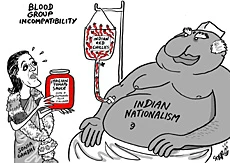
Manmohan’s rise came after Sonia Gandhi, the Congress leader, walked away from the post to protect the party from damaging attacks over her Italian birth.
Sonia, the widow of slain former Prime Minister Rajiv Gandhi, led Congress to a stunning general election victory and was front-runner for the post of premier.
As news that the pro-reform Manmohan might be the next prime minister filtered out on Tuesday, India’s main stock index rebounded sharply and recorded one of its biggest gains, a day after its biggest one-day dive due to doubts about the new government’s economic policies.
Manmohan, a 71-year-old former bureaucrat who was finance minister from 1991 to 1996, is seen as the father of Indian reforms, the man who steered the economy away from socialism to embrace free market capitalism.
He sought to calm markets after Tuesday’s slump, saying the new government would push ahead with economic reforms and ensure Asia’s third-largest economy grew at more than seven percent.
Analysts reacted cautiously to the prospect of Manmohan as prime minister.
“The father of India’s reform program rising to the prime ministership would be very positive from the standpoint of the market,” said Prasenjit Basu, managing director at Robust Economic Analysis Ltd, Singapore.
“But I would caution against excessive euphoria, since Dr. Manmohan Singh as an economic reformer is well regarded but his abilities as a political manager are untested.”
Although Manmohan has kept a low profile over the past few years, the gray-bearded economist is still remembered for decisively changing India’s inward-looking economic agenda and taking the growth rate from two-to-three percent to an average of six percent.
However, Manmohan was always an unlikely politician, who was trounced in a parliamentary election in 1999. In fact, he has never won an election and sits in the upper house. Instead, the man who has held a string of plum assignments including that of central bank governor, has always been seen as a Gandhi family loyalist.
“Mrs. Sonia Gandhi is the undisputed leader of our party... She has done a brilliant job of restoring people’s faith in the Congress party. She would make a very good prime minister,” he said in an interview five years ago.
“She’s very rational, straightforward, humane. She’s a good president of.. Congress.” A reluctant entrant into politics and widely viewed as one of the few honest public figures in India, Manmohan was first drawn upon by Congress leaders to refurbish the image of a party whose fortunes were sagging due to rampant dissension, cronyism and blind loyalty to the Nehru-Gandhi family.
Born into a poor Sikh family in the northern state of Punjab, Manmohan won scholarships to Cambridge and Oxford, earning a doctorate with a thesis on the critical role of exports and free trade in India’s economy.
After more than a decade of teaching at Indian universities, Singh served a stint at the United Nations, followed by several top government jobs, including a term as central bank chief.
In 1991, then Prime Minister P.V. Narasimha Rao offered him the Finance Ministry and the chance to rescue a sickly economy threatened by an acute balance of payments crisis.
Swapping a bureaucrat’s trouser-and-shirt outfit for a politician’s home-spun white kurta-pyjama, Manmohan as finance minister moved decisively in the initial years, opening up the economy to foreign investment and slashing trade barriers.
But his drive slowed within two years as political battles forced the government to cut deals with various interest groups. Today, many analysts say Manmohan may face a much rougher ride.
“Problems don’t get resolved with Manmohan Singh as prime minister. He has to come up with a consensus plan with allies to run the country as early as possible and then stick to it,” said Arun Kejriwal, director at research firm KRIS.