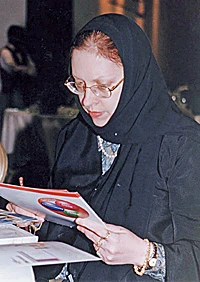
ALKHOBAR, 20 June 2004 — It’s time for some perspective on the current security situation in Saudi Arabia and I have the right face to provide it. I was watching CNN on Friday night when the announcement of Paul Johnson’s murder was broadcast. His death saddened me but I wasn’t surprised. Terrorists rarely listen to reason and even Johnson’s family had admitted that the odds of his being released weren’t favorable.
I have lived in Saudi Arabia for 20 years. Even though I am now a Saudi, I was born and spent my youth in the United States. I have never felt physically threatened in Saudi Arabia, although I frequently worried about my personal safety in Pittsburgh, Pennsylvania, the city where I grew up. Murders, rapes and robberies were not unusual occurrences there. Even though Pittsburgh is considered to have one of the lowest crime rates for a US city of its size, in 2002 there were still 47 murders, 148 rapes and 1,616 robberies. I don’t think I would ever walk down the street alone at 3 a.m. in Pittsburgh, but I’ve done so numerous times in Alkhobar where I make my home now.
I’m not happy about the terrorist attacks in Saudi Arabia. Few people in Saudi Arabia are. I’d like to say no one is pleased with the terrorist attacks, but I am sure that there are a few crazies here and plenty more abroad who are actually dancing with glee every time a masked man pulls out a bomb or a gun in the Kingdom. It seems like some of the international broadcasters are really excited about the terrorist attacks here too. On Friday one American was killed in Riyadh and CNN devoted hour after hour of airtime to the story. An American infantryman was killed in Baghdad on Friday. On CNN his death merited less than a minute of coverage. The BBC was more even-handed. Johnson’s murder led their hourly news, but they also reported on Spain demanding an investigation from Mexico into the kidnapping of five of its citizens over the past few months. Three of the five kidnapped Spaniards had been killed. It was interesting that CNN didn’t make a big deal out of that story.
It also should be noted that on satellite channels the quality of “experts” discussing Saudi Arabia is definitely slipping. On Friday, one expert stated that the reason Al-Qaeda could attract new members in Saudi Arabia is that the Kingdom’s youth are physically frustrated. I haven’t done a survey on that topic, but if it were true, then the majority of the young people on this planet would be terrorists. Another expert stated that most of the Sept. 11 hijackers were former members of Saudi security organizations. That is completely false. I have nothing against fiction on TV, but it’s criminal to portray biased ignorance with reality.
In the Eastern Province, lots of expatriate families have left. This could be the usual summer exodus however. Rents in Bahrain are now 30 percent more than rents in Saudi Arabia. The reverse used to be true. There are reports of some Westerners living in Bahrain and working in Saudi Arabia. Compounds have large numbers of vacancies in family housing units but some compounds have waiting lists for studio and one-bedroom apartments. That would seem to indicate that men are keeping their jobs. High-end apartments in the local community — SR50K+ annually — are being snapped up by expatriates. One Alkhobar real estate agent had an offer from a Canadian to rent half a new villa for SR45,000 annually on an eight-year lease.
The US State Department has told its citizens to leave Saudi Arabia. In part it has put out such an advisory to protect itself from legal action. Nevertheless, the American Embassy and consulates remain open. The American ambassador continues to work to maintain and grow business ties between Saudi Arabia and the USA. Even US Secretary of State Colin Powell has remarked that he does not want American workers to flee Saudi Arabia because that would reward the terrorists. Powell said Friday in a radio interview: “If they leave, then the terrorists have won, and I don’t think either the Saudis, the Americans, or these brave folks who work in Saudi Arabia want the terrorists to win.”
While some Americans are definitely leaving, other nationals are arriving. In the last week I have run into three high level information technology hires from abroad. They hail from the UK, Pakistan and South Africa. No, they aren’t Americans. So what? This market had already begun to replace extremely expensive American hires with other nationals. There’s nothing wrong with such hiring strategies as long as the education and experience level of the new staff is adequate. It’s about time Saudi organizations came to understand that US nationality alone is not an indicator of superior intelligence or ability.
Fighting terrorism in Saudi Arabia is essential but there is a concern that we are neglecting other local issues. Throughout the Kingdom’s entire history not more than 110 expatriates have been killed here in terrorist attacks. In the last 28 years, 67,000 people have died in accidents on Saudi roads. No embassy in Riyadh could provide me with figures, but I suspect that a considerable number of those fatalities were expatriates. Yes, Saudi Arabia must fight terrorism, but 15,000 security forces were used in the search for Johnson. How many lives might be saved if that number of additional police officers were committed to fight against terror on our roads? How many expatriates have left Saudi Arabia due to the high number of horrible deaths from road accidents?
The bottom line is be alert. Be sensible. Believe your eyes. Use your head. Be responsible for enhancing your own safety. Think rationally, then act.