
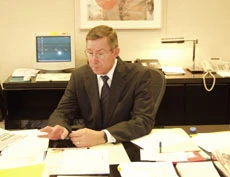
RIYADH, 13 July 2004 — US Ambassador to Saudi Arabia James C. Oberwetter spoke to Arab News in an interview about peace and security in the Middle East and situation in Iraq. He also spoke about security for the nationals of other countries in the Kingdom.
Excerpts:
Arab News: During a recent meeting with Foreign Minister Prince Saud Al-Faisal, representatives of 19 countries asked for intensified security for their nationals in the Kingdom. Do you feel they were reassured ?
Oberwetter: I think they were. There is still a great deal to be done with respect to making the expatriate communities feel safe and secure, and I think the government is on the right path by communicating what it is doing.
Q: Will foreigners be allowed in to give training in security?
A: Yes. It will be for private security forces, not the armed forces. The Saudis apparently have some private security, and plan for more. The question was how would these forces be trained.
Q: From your side, would you like to have outsiders come to train Saudi security?
A: There are a number of businesses and several governments that are asking questions like that. The government has said that it believes that Saudi security forces are capable of providing the protection needed. One of the questions asked had to do with some compounds whose residents felt they did not have adequate protection. They were asked to provide the list of these compounds and to tell the government, and they would be afforded additional protection.
Q: Suddenly America decided to give authority back to the Iraqis. Is this a trick just because the terrorists expected that you have these plans and you just spoiled the party for them, or were there other plans?
A: I think an assessment was made that the interim Iraqi government was ready to assume sovereignty. I am glad that it happened earlier rather than later. Many people have suggested that the US would not hand over authority on the 30th of June. Instead, we did so earlier.
It is a positive sign that President Bush means what he says. I think it added importance to the NATO meeting in Istanbul where countries that have said that they were waiting for sovereignty to occur before they took additional action to help. Now those countries can consider moving their plans forward.
Q: Originally, you were reluctant about internationalizing the Iraq situation. Now you seem to be keen on that. Do you find that reluctant countries are now interested in coming and helping?
A: We worked very hard for many, many years with the international community through the UN. There were numerous resolutions passed addressing the Iraqi situation, and then as we moved forward in the past year and a half or so the president again went before the UN and sought help.
A number of countries did step forward to help — not as many as in 1990 or 1991 during the Gulf War. For a variety of reasons, a number of other countries did not participate. But I think that almost all of them now will have the opportunity to help the Iraqi people move from its interim government to its established government, through the election process.
This will be up to those in charge, since sovereignty has been established. If it continues as originally planned, there will be elections in January of next year. Whether that happens at that time or later will depend on the situation in Iraq.
Q: Many people feel that your presence in Iraq with 141,000 soldiers, and more to come, means you are running the show and will be there for a long time.
A: Clearly the situation has to evolve. It would be horrendous for Iraq, the Middle East, and the world to get up and leave on day one. As the Iraqi military and security forces come into place, they will be able to assume authority. It would be a huge mistake if we withdrew. Having said that, Iraq has a sovereign government. If they want us to, they will ask. I am not expecting that we will be asked any time soon.
Q: If the Iraqis elected a government you did not like, say too close to Iran or anti-Israel, or whatever, what would you do?
A: I cannot speculate on what the outcome of the Iraqi elections might be, or what our reaction might be.
Q: There was talk in the past that if the Americans succeeded in Iraq, the next step would be to change the map of the region. That the US has plans for Iraq’s neighbors. Now that the picture has become clearer in Iraq, is it still true that the US will push for changes, and if so are they going to be mild changes for reform or real solid changes in the governance of certain countries?
A:What we are looking is for the people of countries of the region to have a bigger voice in the way their countries are run. It adds to stability of a country when everybody feels that they have a stake and they are part of it. We will not be imposing reforms, but encouraging reforms.
Q: Is that what the Greater Middle East Initiative is all about?
A: Yes, it is. Like any other plan, it will evolve and change depending on the country that is involved. What may work in one country may not work in another; but we stand ready to be of assistance to them in a number of fields; political reforms, if that is what is appropriate, education, women’s issues, women’s education, and economics.
Q: You also have a separate economic initiative for the region, or is that now part of the first?
A: I think that this is another piece of it. In my view countries need to find ways to develop sustainable businesses. This means finding ways to change your economic regulations and economic games that will allow for businesses to grow.
I refer not just to big businesses like the oil business, or IBM, but medium size and small. In most countries in the world up to 90 percent of all jobs are in SMEs. One of the things that I am excited about is visiting with the new head of the Saudi Arabia Investing Group who has some very good thoughts on how SMEs can advance.
Combine that with the changes in the labor laws that the new Labor Minister (Ghazi) Al-Gosaibi is making then you have a great combination to create jobs here that are sustainable and not based on income from any particular natural resource like oil. I want to salute those in the government and say, well we have a phrase in Texas: “Keep on keeping on.” Those seem to be really good policies.
Q: What about training, is it part of the deal?
A: This is another problem, but I think through the community college system that you have coming into place, and through the technical institutes, and the private institutes that are coming into place, you will be able to train a good work force.
Q: You said that President Bush means what he says. He promised us that the road map (for peace in Palestine) was the way to go. But then suddenly Sharon went to Washington and things changed, and it seems you have a change of mind and agreed to a unilateral move from the Israeli government. So, what is the position now?
A: The road map process remains intact. Meetings are occurring on a fairly regular basis now, on how to move the process forward. Some have said that it would not occur this year, because of the American political process, but in fact it is. The president and the secretary of state are engaged on the issue. One of the difficulties has been finding a group that you can talk with on the Palestinian side.
Q: About the US image in Arab and the Muslim world, and in Saudi Arabia; do you think that by pushing for and encouraging reforms, and helping solve the economic situation in these countries you can overcome the bad image and win your war for the hearts and minds of Muslims, especially considering the situation in Iraq, Afghanistan, the treatment of Muslims in America, the closing of Islamic charities, and the blind support of Israel?
A: These are a lot of questions.
Q: It is all about the image. Many Muslims see that Americans have a campaign against them. For example, you close Islamic charities; you do not allow zakah in the United States. How do you hope to change this perception?
A: A large part of the difficulty comes from our efforts to combat terrorism; some of the steps that we have taken against terrorism are considered to be that. Why that is I do not know, but I think what we need to do is to address issues not just of countering terrorism, but other problems of the moment. All of us have to take a long view. Any country that is having economic difficulties, or that has a large number of unemployed is not going to feel good about itself.
Anything we can do to encourage economic growth and opportunity, anything we can do to help, is going to ease some of those feelings. On the larger issues, especially right now, In Iraq, we are doing what we said, which is handing over power ahead of schedule, working with the new Iraqi government to bring elections about so that their people can have a government and realize themselves through that process and exiting the scene when the government there says.
Q: What about Afghanistan?
A: I think when the time is right, that government too will assert itself and we will be out of there.
Q: There were many promises that were not met.
A: Yes, but many have been met. The president in the NATO meeting talked to people who had said that they would help in Afghanistan. We are helping, and there were some promises that were not met, and the president now is working hard with the NATO countries that made those promises to help them keep their word.
Q: What about closing charities?
A: We look at that and we see where a number of charitable institutions had severe management problems which allowed funding intended to help people who were in poverty being used for purposes that were harmful to others in the world. That does not sound like a charity.

