
As the sun clips the horizon and a molten red pathway flows across the sea to the Corniche in Jeddah, families who have gathered and waited patiently for the end of the day of fasting break open their meals. The local feral cats, slightly plumper after the first week of Ramadan, detach themselves from the shadows under the monuments scattered along the shore and slink hopefully toward the rich smells of food, keeping just out of reach of excited children.
Iftar on the Corniche has become increasingly popular. The municipality has left the decorative lights from previous festivals and cleaned the several-kilometer stretch in response to the growing popularity of the venue.
A rather obvious and brightly lit police point has appeared at the Shahada circle, staffed with strutting policemen, keen to ensure there are no disturbances to interfere with the traditional — but fun — alfresco breaking of fast. One policeman in a squat patrol car meanders along the line of parked cars occasionally flashing his lights and shouting imperiously at latecomers trying to park their vehicles. Even he though is eventually is drawn to the platters of food laid waiting for him.
As dusk rises out of the sea and settles like a veil on the seashore, so does a special atmosphere of tranquillity and peace. Cars that normally stream along the Corniche strip are gone; scurrying fathers stagger under the weight of carpets and polished metal containers of food. Mothers and elder sisters glide across the paved seating areas herding small flocks of gamboling children who know the theory of the feast but are desperate for the practice. Families, each unknown to the other and spaced respectful distances apart, call each other’s children and proffer delicacies. There is a new spirit of quiet conviviality abroad.
Toddlers with footballs — not entirely under control — creep nervously onto a neighboring family’s carpeted territory to retrieve the errant plaything, expecting retribution but receiving only broad smiles. In a short while, the aggressiveness and short temperedness of the day brought about by abstinence from food and drink has gone.
Perhaps this is a glimpse of what has been lost under the veneer of “civilization” represented by the glass and concrete towers of hotels looming over the scene and the serpentine line of Detroit’s finest lining the kerb. Human contact, simple pleasures and companionship through the exercise of a ritual driven by a religious belief was enough for centuries. It will still be there when the city has crumbled to dust and the cars are rust — and it will be just as powerful.
Ten minutes drive from the pleasant surroundings of the Corniche is a large wet hole in the ground. Set about with angular diggers, looking in the gloaming like bizarre earth eating insects — the site is covered in snaking blue plastic water pipes and mounds of damp sand; clearly a place of great industry. However, it is iftar time and tucked away amongst the machinery and detritus of industry is a temporary haven of peace.
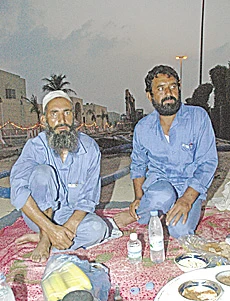
A red covering is precisely laid out on a patch of sandy ground, carefully cleared of stones. On it are dishes of yogurt, sambusak, “ful” and bread and vegetables — enough for a substantial meal.
With only the street lamp to light their feast, Riyad Khan and Akhtar Khanjani, laborers from Afghanistan laying Jeddah’s new water delivery pipes, are quietly observing the end of fast with a dignified solemnity, creating their own small patch of home for the meal, many thousands of kilometers from their families.
With great gentility, Riyad offers hospitality, insisting that I share the feast. Using his drinking water to pour over my hands to wash them, he explains that he is relatively new to Saudi Arabia and is delighted to be here and working in Ramadan. Akhtar insists that each dish is sampled in turn.
He says working in the Kingdom is fine, he is happy to be here but, especially at moments like this, his thoughts turn to his family who would be thinking of him while eating their meal in Kabul. For many minutes we sit silent, simply living in the moment, each with his own thoughts of a distant home and family from abroad.
The alfresco iftar meal, taken under the emerging stars and seated quietly on the ground, strips away the clutter of modernity and the hype of luxury and sophistication, leaving just the essence of the meal and the silent companionship that forms an infinitely stronger bond than words or ritual ever could. I do not want to break that bubble that surrounds us, sitting on the dirt on the median strip.
Bubbles are ephemeral things and it eventually breaks and I emerge into the reality of a dusty suburban Jeddah street. But just for a few minutes, there was a magical “rightness” about sitting with hospitable total strangers who were entirely at peace with a newcomer from an obviously different culture and background on the ground sharing food.
Ramadan and particularly iftar allow us to take a step back from the chaos and lemming like rush of sophisticated — a word that means corrupted or adulterated — society and for a few moments recapture the simple and wholesome pleasure of even a fleeting relationship with another human being.