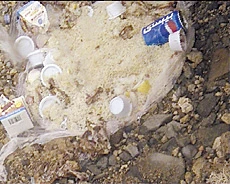
JEDDAH, 22 October 2004 — Efforts to keep the Jeddah Corniche clean are being hampered by motorists who throw litter from running cars and picnickers and holidaymakers who disfigure the picturesque coastline with empty bottles, cans and cartons.
The Corniche had telltale evidence, especially last weekend, of litter found all around. That was the first weekend of Ramadan and hundreds of people had camped out throughout the night.
On week days, too, the city’s 110-km Red Sea coastline is dotted with areas where people have been converging after Taraweeh prayers and staying either in the open or in tents for suhur.
Jeddah Municipality has provided hundreds of bins all along the Corniche for the picnickers to deposit their litter. “But not many seem to realize this and throw around whatever empty bottles and cans of drinks and wraps of snacks on the ground or even in the sea,” said Shujat Raza, a middle-aged Pakistani shipping executive.
“I wish to spend the whole night at the Corniche with my family, but the rubbish around the area puts you off,” said Raza who was camping with his family on north Corniche on Wednesday.
“Each morning, it’s a job collecting the rubbish left behind by people,” a municipal worker said. Those dirtying the Corniche are as much the local residents as visitors coming for business or Umrah. “One can imagine the impact of all such unhygienic activities on the environment,” he said.
Large recreational centers also dot the Corniche. These have been developed along the coastline without any adequate evaluation of potential environmental impacts. The construction of such large projects has required significant dredge and fill operations, which adversely impact the coastal environment. In addition to the direct destruction of marine life and key habitats, the suspended fine materials resulting from these activities can result in widespread damage to marine life, an activist involved in environment protection said.
“Such sedimentation results in the suffocation of marine life and has an adverse effect on the surrounding ecosystems involving mangroves, sea grass beds and coral reefs and, as a consequence, a decline in the productivity of the sea as measured by shrimping grounds and other fisheries,” Muhammad Zahrani, a young Saudi scuba diver, said.
Zahrani is one of many activists who have been periodically participating in cleaning up operations to protect the environment along the coastline.
The practice of pushing construction onto the coast and into the sea can change the current pattern, morphology and substrate, thus affecting the marine life, and usually provide new sources of continuous degradation, he added.
The Red Sea affords a unique opportunity to snorkel or scuba diving. Despite some damage due to construction and environment-related deterioration, its relative inaccessibility means that this section of the sea still offers some of the most beautiful and under-dived reefs in the world.
“All our efforts are directed toward protecting this,” Zahrani said, adding that efforts are also continuing to protect the 48-km Obhur Creek, north of the city that has excellent facilities for swimming, water-skiing, fishing and sailing.